
Certificate Course on
Medical Law
Healthcare
Law Certification India
India's most comprehensive medical law certification course online — covering the NMC Act 2019, Consumer Protection Act, Mental Healthcare Act 2017, MTP Act, Surrogacy Act, ART Regulation Act, Rights of Persons with Disabilities Act, Telemedicine Guidelines, medical-legal document drafting, NCDRC practice, and landmark Supreme Court case studies. Designed for doctors, lawyers, hospital administrators, and healthcare professionals. 4 weeks, 10 sessions — just ₹1,500.
Medical Law in India — A Complete Introduction
Medical law is the branch of law that governs the legal rights and responsibilities of patients, doctors, hospitals, and healthcare institutions. In India, it covers medical negligence, patient consent, professional misconduct, hospital liability, pharmaceutical regulation, mental health rights, reproductive law, disability rights, public health law, and telemedicine — regulated by Acts like the NMC Act 2019, Consumer Protection Act, Mental Healthcare Act 2017, MTP Act, Surrogacy Act, ART Regulation Act, Rights of Persons with Disabilities Act, and Telemedicine Practice Guidelines 2020.
India's healthcare sector faces an unprecedented surge in medical negligence cases, patient rights disputes, and regulatory compliance challenges. With over 1.4 billion patients and a rapidly growing private healthcare industry, the intersection of law and medicine has never been more critical — or more legally complex.
For doctors, ignorance of medical law is no longer a defence. Consumer forums, criminal courts, and the National Medical Commission now hold practitioners legally accountable for everything from improper consent to telemedicine prescriptions. For lawyers, medical negligence is one of the fastest-growing and highest-value practice areas in India. For hospital administrators, non-compliance with the Clinical Establishments Act, Rights of Persons with Disabilities Act, or Mental Healthcare Act 2017 carries serious institutional liability.
This certificate course on medical law from Legal Research and Analysis gives you complete, structured, and India-specific knowledge of medical law — taught by expert faculty from TISS Mumbai, NFSU Delhi, NHSRC (Ministry of Health & Family Welfare), and Aligarh Muslim University, in just 4 weekends at ₹1,500.
Understanding the Difference
| Aspect | Medical Law | Medical Ethics |
|---|---|---|
| Nature | Legally enforceable rules | Professional moral principles |
| Source | Statutes, court judgments | Medical codes of conduct |
| Binding? | Mandatory — must follow | Professional standard |
| Violation | Legal liability, prosecution | Disciplinary action, censure |
| Enforcer | Courts, consumer forums, NMC | Medical associations, NMC ethics board |
Why This is India's Best Medical Law Course in 2026
Faculty from TISS, NFSU, NHSRC (Ministry of Health & Family Welfare), and AMU — 12+ Indian laws — Supreme Court case studies — ₹1,500. No competitor offers this combination.
Expert Multi-Institution Faculty
Learn from faculty spanning TISS Mumbai (hospital management), NFSU Delhi (forensic justice & law), NHSRC (Ministry of Health & Family Welfare), and Aligarh Muslim University. The breadth of academic and government policy expertise is unmatched among affordable Indian medical law courses.
Real Supreme Court Case Studies
Every competitor teaches medical law in theory. This course anchors every topic in landmark Supreme Court judgments — Jacob Mathew, Samira Kohli, V.P. Shantha, and Common Cause. You understand not just what the law says but how courts actually apply it.
India-Specific Laws — All 12+ Acts Covered
NMC Act 2019, Consumer Protection Act, Clinical Establishments Act, Mental Healthcare Act 2017, Rights of Persons with Disabilities Act, MTP Act, Surrogacy Act 2021, ART Regulation Act 2021, Transplantation of Human Organs Act, Telemedicine Guidelines, Drugs & Cosmetics Act, Epidemic Diseases Act — all covered in structured detail.
Telemedicine, Digital Health & NDHM
Post-COVID, telemedicine is mainstream — but legally complex. This course covers the 2020 Telemedicine Guidelines, health data privacy under the National Digital Health Mission, DPDP Act 2023, and doctor liability for online consultations — the fastest-growing area of medical law in India.
4 Weekends · ₹1,500 · Career-Ready Knowledge
Complete your medical law certification in just 4 weekends. At ₹1,500 (60% off), this is significantly cheaper than NLS PACE, LawSkills, and comparable programmes — with superior India-specific content and multi-institution faculty.
12+ Indian Medical Laws + Real Case Studies — All in 4 Weeks
NMC Act 2019 & Professional Regulation
The National Medical Commission Act 2019 replaced the MCI — regulating medical education, maintaining the National Medical Register, defining professional conduct standards, and establishing new accountability mechanisms for all registered medical practitioners in India.
Patient Rights & Informed Consent
Types of consent (implied, express, informed), legal standards for valid consent, Samira Kohli case analysis, consent for minors, emergency procedures, and the right to refuse treatment. Living wills and advance directives covered alongside passive euthanasia.
Medical Negligence — Civil & Criminal
The distinction between civil negligence (compensation) and criminal negligence (prosecution) established in Jacob Mathew v State of Punjab. Bolam test, Consumer Protection Act application, and the V.P. Shantha case — all in one structured module.
Mental Health, Disability & Public Health Law
Mental Healthcare Act 2017, Rights of Persons with Disabilities Act 2016, Epidemic Diseases Act, Disaster Management Act, and lessons from COVID-19 on quarantine, vaccination, and lockdowns. Common Cause v Union of India landmark case included.
Complete 4-Week Medical Law Curriculum
10 live sessions — from foundational medical law to NCDRC practice and medical document drafting — structured for doctors, lawyers, and healthcare professionals equally.
Orientation and Introduction to Medical Law & Ethics
- Introduction, scope and evolution of medical law in India
- Intersection between law, medicine and ethics
- Importance of informed consent and patient autonomy
- Key ethical principles and professional responsibilities
Legal Framework Regulating Medical Practice in India
- National Medical Commission Act, 2019
- Clinical Establishments (Registration & Regulation) Act, 2010
- Professional conduct and ethical regulations for medical practitioners
- Legal responsibilities of doctors and healthcare institutions
Consent in Medical Practice & Right to Refuse Treatment
- Types of consent: implied, express and informed consent
- Legal requirements for valid consent
- Patient autonomy and the right to refuse treatment
- Living wills and advance directives in medical decision-making
Medical Negligence and Professional Liability
- Difference between civil and criminal medical negligence
- Standard of care and the Bolam test
- Important principles governing professional liability
- Consumer Protection Act and medical malpractice claims
Reproductive Health, Surrogacy & Fertility Laws
- Medical Termination of Pregnancy Act and reproductive rights
- The Surrogacy (Regulation) Act, 2021
- ART Regulation Act, 2021
- Ethical and legal issues in fertility treatments
Organ Transplantation, Bioethics & End-of-Life Issues
- Transplantation of Human Organs and Tissues Act, 1994
- Legal and ethical issues relating to organ donation
- Do Not Resuscitate (DNR) and right-to-die considerations
- Passive euthanasia and advance medical decision-making
Mental Healthcare, Disability Rights & Public Health Law
- Mental Healthcare Act, 2017 and a rights-based approach
- Rights of Persons with Disabilities Act, 2016
- Public health obligations during epidemics and emergencies
- Legal lessons from quarantine, vaccination and public health measures
Mental Healthcare, Disability Rights & Public Health Law
- Mental Healthcare Act, 2017 – Rights-based approach
- Rights of Persons with Disabilities Act, 2016
- Public health obligations under Epidemic Diseases Act & Disaster Management Act
- Lessons from COVID-19: Quarantine, Vaccination & Lockdowns
Emerging Trends in Medical Law and Regulatory Compliance
- Telemedicine Guidelines & Health Data Privacy (NDHM)
- Clinical trials, drug regulation (Drugs & Cosmetics Act, 1940)
- Medical waste, licensing, insurance
- International human rights perspectives and bioethics
Concluding Session
- Recap of key concepts covered throughout the course
- Review of major medical and healthcare laws
- Discussion on emerging challenges in medical law
- Final Q&A and clarification of participant queries
12+ Indian Medical Laws Covered in This Course
Every major Act governing healthcare in India — with amendments, penalties, and practical application to current clinical and legal practice.
National Medical Commission Act 2019
Clinical Establishments Act 2010
Consumer Protection Act 2019
Mental Healthcare Act 2017
Rights of Persons with Disabilities Act 2016
MTP Act 1971 (Amended 2021)
Surrogacy (Regulation) Act 2021
ART Regulation Act 2021
Transplantation of Human Organs Act 1994
Telemedicine Practice Guidelines 2020
Drugs & Cosmetics Act 1940
Epidemic Diseases Act & Disaster Management Act
Real Supreme Court Judgments — Analysed in Depth
Not just theory — every major topic is grounded in how India's Supreme Court actually decided these cases.
Jacob Mathew v State of Punjab
The definitive standard for criminal prosecution of doctors in India. The Supreme Court held that a doctor cannot be convicted for criminal negligence unless conduct was grossly negligent — going beyond a mere error of judgment or lack of skill. Established the two-prong test: civil negligence vs criminal negligence in medical practice. Protects doctors from routine prosecution while holding grossly negligent practitioners accountable.
Criminal Negligence StandardSamira Kohli v Dr. Prabha Manchanda
Landmark ruling on informed consent in Indian medical law. A surgeon performed a hysterectomy without explicit consent — the Supreme Court held this amounted to assault and awarded compensation, even though the procedure may have been medically indicated. Established the "real consent" doctrine — patients must be fully informed before any procedure. Transformed consent practice across Indian hospitals.
Informed Consent LandmarkIndian Medical Association v V.P. Shantha
The case that brought medicine under consumer law. The Supreme Court held that medical services — whether provided by government or private doctors — constitute 'services' under the Consumer Protection Act. Patients became 'consumers' entitled to file complaints before consumer forums for medical negligence. Opened the door to millions of consumer complaints against doctors and hospitals in India. A watershed moment in Indian healthcare accountability.
Medical Services = Consumer ServicesCommon Cause v Union of India
A nine-judge constitutional bench recognised the right to die with dignity as part of the fundamental right to life under Article 21. The Court upheld the validity of advance directives (living wills) — documents by which a person can specify their wishes for end-of-life care in advance. Permitted passive euthanasia subject to a defined legal process. Landmark for healthcare law, mental health rights, and palliative medicine in India.
Right to Die with DignityThis Medical Law Course is For You If…
MBBS Doctors & Specialists
Protect yourself from legal liability. Understand consent, negligence standards, and when criminal prosecution can arise — directly applicable to your clinical practice.
Practising Advocates
Build expertise in India's fastest-growing legal practice area. Medical negligence cases are complex — this course gives you the substantive knowledge to excel.
Law Students (LLB/LLM)
Add a high-value specialisation to your CV. Human rights in healthcare and medical negligence are growing exam and moot topics.
Hospital Administrators
Understand your institution's legal obligations under the Clinical Establishments Act, consumer law, RPwD Act, and Mental Healthcare Act — and avoid costly compliance failures.
Nurses & Paramedical Staff
Know your legal rights and responsibilities. Nursing liability, vicarious liability, and professional conduct standards under Indian medical law explained clearly.
Healthcare Compliance Officers
Master the regulatory landscape — NMC Act, Clinical Establishments Act, telemedicine guidelines, and DPDP Act — to build airtight compliance frameworks.
Pharma & MedTech Professionals
Understand liability for pharmaceutical products, medical device regulation, drug law, and emerging AI in healthcare law issues affecting the industry.
Medical Researchers & Academics
Research ethics, clinical trial law under Drugs & Cosmetics Act, informed consent for research subjects, data protection in health research, and institutional review board obligations.
Five Expert Faculty — TISS · NFSU · NHSRC & AMU
An exceptional combination of hospital management, forensic justice, central government health policy, and legal research expertise — all in one course.
 Course Mentor
Assistant Professor
Centre for Hospital Management
School
of Health Systems Studies, TISS Mumbai
Dr. Dhananjay Mankar brings rare expertise at the intersection of healthcare management and medical law. As a faculty member at the Tata Institute of Social Sciences (TISS) Mumbai — one of India's most prestigious institutions — he teaches hospital management with a focus on legal compliance, patient rights, and healthcare systems. His sessions on hospital liability, clinical establishments, and healthcare administration are grounded in real institutional experience.
 Course Mentor
Assistant Professor
School of Law, Forensic Justice &
Policy Studies
NFSU Delhi
Somabha Bandopadhay is a faculty member at the National Forensic Sciences University (NFSU) Delhi — India's premier institution for forensic sciences and forensic law. Her expertise spans forensic justice, medico-legal evidence, and health policy law. She brings forensic medicine's intersection with legal proceedings to life — teaching the legal dimensions of post-mortem reports, medico-legal cases, and forensic evidence in medical negligence litigation.
 Course Mentor
Legal Consultant
National Health Systems Resource Centre
(NHSRC)
Ministry of Health & Family Welfare, Government of
India
Yash Bagra is a Legal Consultant at the National Health Systems Resource Centre (NHSRC) — the technical advisory institution under the Ministry of Health & Family Welfare, Government of India. His professional work focuses on health systems law, public health regulation, and central government policy advisory. He brings a unique insider perspective on how India's healthcare laws are designed, implemented, and enforced — bridging the gap between statutory text and on-ground regulatory practice across India's vast public health system.
 Course Mentor
Research Scholar
Aligarh Muslim University, Aligarh
SM Marjina Sultana is a Research Scholar at Aligarh Muslim University — one of India's oldest and most respected central universities. Her research focuses on medical law, patient rights, and healthcare regulation. She brings the rigour of academic legal research to this course, providing in-depth analysis of legislation and case law grounded in current legal scholarship on healthcare and medical ethics in India.
 Course Supervisor
Course Supervisor
Advocate, High Court of Jharkhand, Ranchi
Pranav Kumar Jha is a practising Advocate at the High Court of Jharkhand and serves as Course Supervisor for this programme. He oversees curriculum design, ensures all content meets professional legal standards, and coordinates the practical case study and document-drafting sessions. His courtroom experience with civil and constitutional matters ensures the course content is directly relevant to legal practice and professionally delivered.
Real Reviews from Doctors, Lawyers & Healthcare Professionals
"As an MBBS doctor, I had no idea about the legal risks we face daily. This course was eye-opening — the medical negligence module and Jacob Mathew case analysis directly helped me understand how to protect myself and document properly. Every doctor in India must take this course."
"I am a practising advocate handling medical negligence cases. This course gave me structured knowledge of the NMC Act 2019, Consumer Protection Act applicability to hospitals, and landmark Supreme Court judgments. The medical record interpretation module was a bonus — very relevant for current practice."
"I joined as a hospital administrator and this is the best investment our institution made. The patient rights, consent law, and hospital compliance modules are directly applicable to our daily operations. Faculty from TISS, NFSU, and NHSRC brings tremendous credibility."
Medical Law Careers — High Demand, High Value in 2026
Medical law expertise opens doors that most law graduates and doctors never knew existed — high-value advisory roles at the intersection of healthcare and law.
-
Medico-Legal Consultant₹6–18 LPA | Hospitals, insurance companies, law firms
-
Hospital Compliance Officer₹5–15 LPA | Corporate hospitals, healthcare chains
-
Medical Negligence Lawyer₹8–30 LPA | Litigation, NCDRC, consumer forums, High Courts
-
Healthcare Legal Counsel (In-House)₹10–25 LPA | Pharma, MedTech, hospital chains
-
Telemedicine Compliance Specialist₹7–20 LPA | Digital health startups, telemedicine platforms
The Numbers Behind the Opportunity
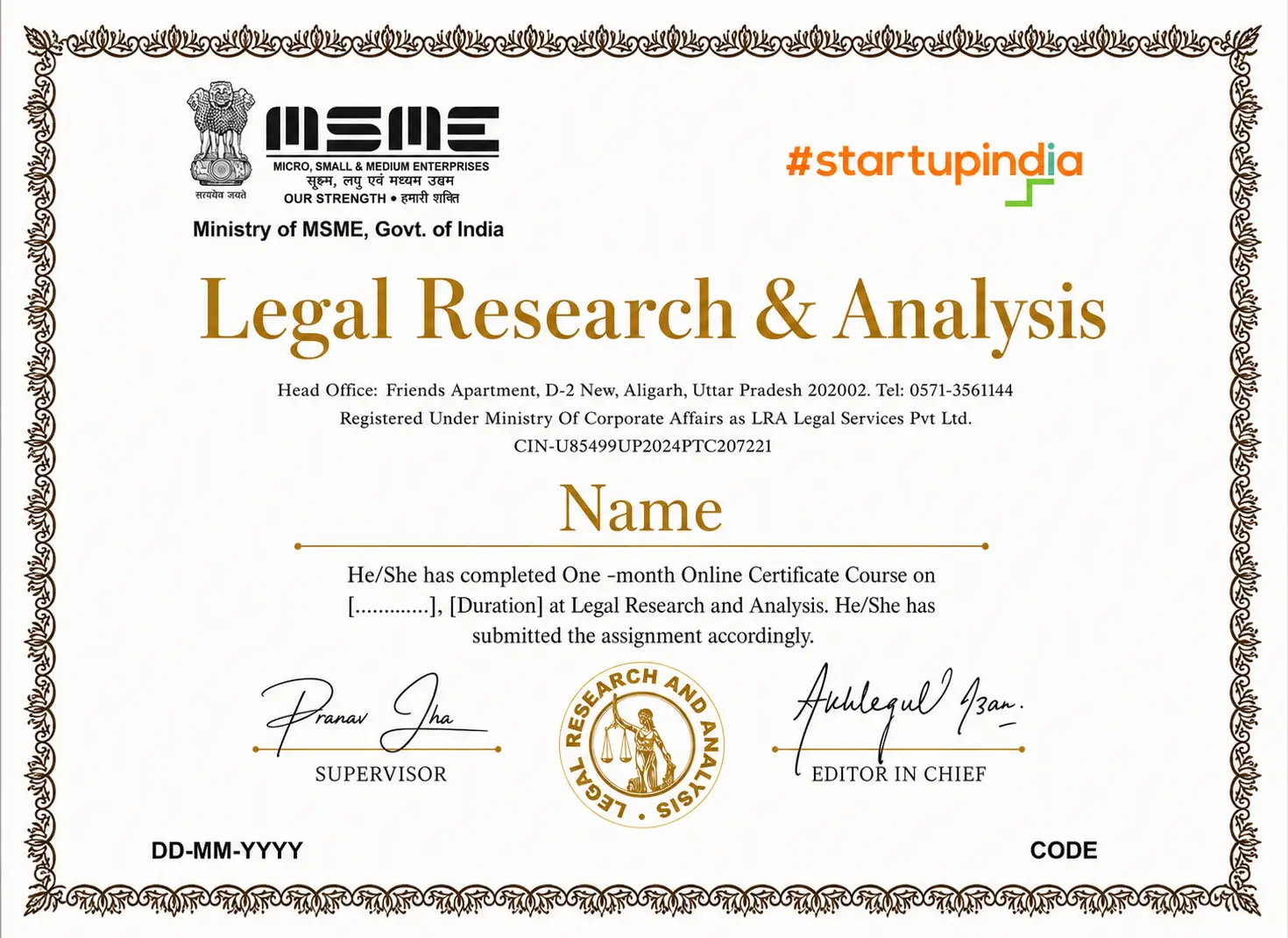
Sample Certificate
Receive a professionally designed Certificate of Completion from Legal Research & Analysis (LRA) after successfully completing the course requirements.
Complete Course Benefits Package
Every enrolled learner receives a career-boosting package — far beyond just course content.
E-Certificate
Verifiable e-Certificate of Completion from Legal Research and Analysis — shareable on LinkedIn and professional profiles.
Internship Opportunity
Meritorious participants receive structured internship with LRA — real medical law research, case analysis, and compliance documentation work.
Recommendation Letter
Top-ranked participants receive a personalised Recommendation Letter — valuable for jobs, higher studies, judicial services, and practice.
Notes & Study Materials
Comprehensive notes covering all 12+ Indian medical laws, landmark case studies, and ready-reference materials for lifetime use.
Practical Exposure
Hands-on document drafting, medical record interpretation exercises, and NCDRC complaint mock drafting in Weeks 3 & 4.
Everything You Need to Know About Medical Law
Enroll in India's Best Medical Law Course — Starting 26th September 2026
Join 20,000+ professionals trained by Legal Research and Analysis. Master medical negligence, patient rights, NMC Act 2019, telemedicine law, medical-legal drafting, NCDRC practice, and 4 landmark Supreme Court cases — at just ₹1,500. Limited seats.
⚡ Last date to apply: 25th September 2026 · Saturday & Sunday · 6:30–7:30 PM · Google Meet