Industrial growth has played a vital role in economic development and technological advancement. However, increasing industrial activity has also resulted in significant environmental challenges. One such major environmental issue identified in the late twentieth century was the depletion of the ozone layer caused by certain industrial chemicals. The refrigeration and air-conditioning industries historically relied on chemicals such as chlorofluorocarbons (CFCs) and hydrochlorofluorocarbons (HCFCs). Although these substances were highly efficient as refrigerants, scientific research later revealed that they damage the ozone layer and contribute to environmental degradation.
To address this issue, the international community adopted the Montreal Protocol, an agreement designed to phase out ozone-depleting substances. In India, environmental regulation in this area is implemented through the Ozone Depleting Substances (Regulation and Control) Rules, 2000 under the Environment (Protection) Act, 1986. These rules regulate the manufacture, use, import, export, and sale of substances that contribute to ozone depletion.
This research paper examines the relevance of these rules in the refrigeration manufacturing industry in India. It explores the objectives, provisions, regulatory framework, and impact of these rules on industrial practices. The study also highlights the transition toward environmentally friendly refrigerants and the importance of sustainable industrial development. The paper concludes that effective implementation of environmental laws, combined with responsible industrial behavior, can significantly reduce environmental harm and promote long-term sustainability.
1. INTRODUCTION
Environmental protection has become a global priority as industrialization and urban development continue to expand rapidly. Industries contribute significantly to economic growth, employment generation, and technological innovation. However, industrial activities can also cause environmental pollution if proper regulatory measures are not implemented. As a result, governments across the world have introduced environmental laws to regulate industrial activities and protect natural ecosystems.
One of the most critical environmental concerns identified during the twentieth century was the depletion of the ozone layer. The ozone layer, located in the Earth’s stratosphere, plays an essential role in protecting life on Earth by absorbing harmful ultraviolet radiation from the sun. When this protective layer becomes thinner, harmful radiation reaches the Earth’s surface, increasing the risk of skin cancer, eye diseases, damage to crops, and disruption of ecosystems.
The refrigeration and air-conditioning industry has historically been a major user of ozone-depleting substances. Chemicals such as chlorofluorocarbons were widely used because they were stable, non-flammable, and highly effective for cooling systems. However, scientific studies later revealed that these chemicals release chlorine atoms in the atmosphere, which break down ozone molecules and contribute to ozone layer depletion.
Recognizing the seriousness of the issue, the international community introduced the Montreal Protocol in 1987 to control the production and consumption of ozone-depleting substances. India, being a signatory to this agreement, introduced national regulations to comply with its provisions. The Ozone Depleting Substances (Regulation and Control) Rules, 2000 were enacted under the Environment (Protection) Act, 1986 to regulate the use of such substances within the country.
The refrigeration manufacturing industry plays an important role in sectors such as food processing, dairy production, pharmaceuticals, cold storage, and industrial cooling systems. Therefore, ensuring environmental compliance in this industry is essential for maintaining ecological balance while supporting economic growth.
2. BACKGROUND OF OZONE DEPLETING SUBSTANCES REGULATION
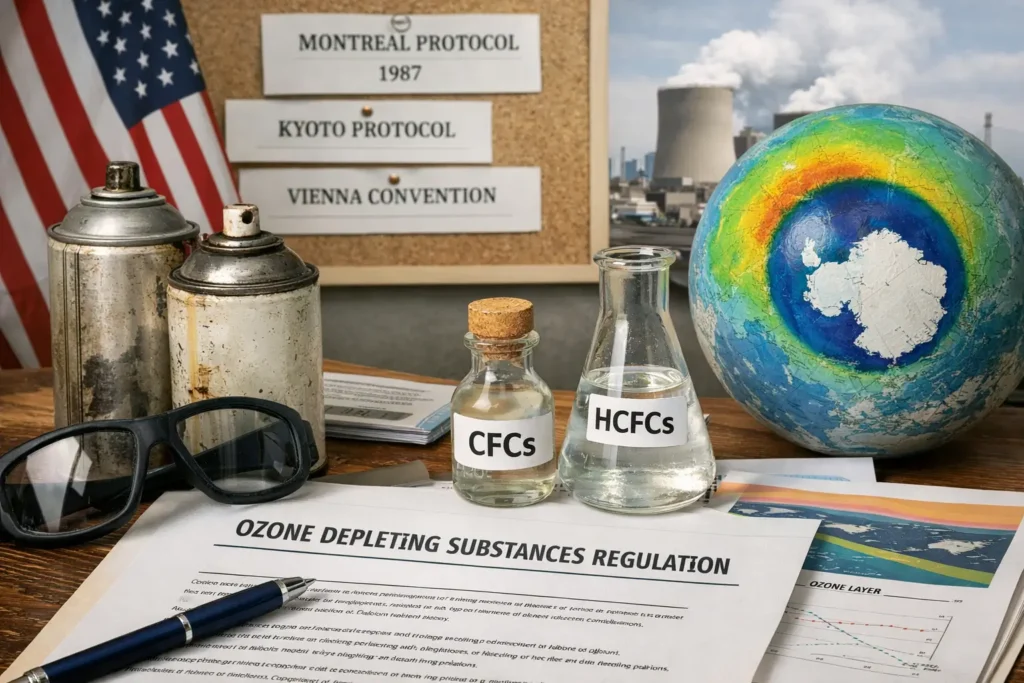
Scientific research during the 1970s and 1980s revealed that certain chemicals released into the atmosphere were responsible for damaging the ozone layer. Among these chemicals, chlorofluorocarbons were identified as major contributors. When these substances reach the stratosphere, ultraviolet radiation breaks them down and releases chlorine atoms. These chlorine atoms react with ozone molecules and destroy them, leading to thinning of the ozone layer.
The discovery of a large ozone hole over Antarctica raised serious global concern. This discovery prompted scientists and policymakers to work together to develop international solutions. As a result, the Montreal Protocol on Substances that Deplete the Ozone Layer was adopted in 1987. The agreement required countries to reduce and eventually eliminate the production and consumption of ozone-depleting substances.
India joined the Montreal Protocol and committed to implementing national regulations that would support the phase-out of harmful chemicals. To achieve this objective, the Government of India introduced the Ozone Depleting Substances (Regulation and Control) Rules, 2000. These rules established legal mechanisms for controlling the production, sale, import, export, and use of ozone-depleting substances in industries.
The rules also provided a clear timeline for the gradual elimination of harmful refrigerants. As a result, industries were encouraged to adopt safer alternatives and modern technologies that minimize environmental impact.
India’s adherence to the Montreal Protocol has been exemplary, with the country surpassing its HCFC phase-out targets ahead of the mandated schedule through comprehensive HCFC Phase-out Management Plans (HPMP Stages I, II, and III). By 2024, India had successfully eliminated HCFC-141b entirely from industrial use and emerged as a global leader in sustainable cooling initiatives through the India Cooling Action Plan (ICAP), which promotes energy-efficient alternatives amid rising demand for refrigeration and air-conditioning services. The ODS Rules have undergone several amendments, including notifications S.O. 929(E) of 2005 and S.O. 996(E) of 2004, which updated phase-out schedules for Groups I, II, and III substances, thereby aligning India’s regulatory framework with the Kigali Amendment to the Montreal Protocol adopted in 2016 and ratified by India
in 2019 for hydrofluorocarbon (HFC) reductions under the principle of common but differentiated responsibilities.
3. OBJECTIVES OF THE ODS RULES
The primary objective of the Ozone Depleting Substances Rules is to protect the ozone layer from further damage. By regulating the production and use of harmful chemicals, the government aims to prevent environmental degradation and safeguard public health.
Another important objective is to ensure that India fulfills its obligations under international environmental agreements such as the Montreal Protocol. By implementing these regulations, the country contributes to global efforts aimed at protecting the atmosphere.
The rules also encourage industries to adopt environmentally friendly technologies. By promoting the use of alternative refrigerants with lower environmental impact, the regulations support sustainable industrial development.
In addition, the rules provide mechanisms for monitoring and controlling industrial activities involving ozone-depleting substances. Industries must obtain licenses, maintain records, and submit reports to regulatory authorities. These requirements help ensure transparency and accountability in industrial operations.
Overall, the ODS Rules aim to create a balance between economic development and environmental protection.
4. OZONE DEPLETING SUBSTANCES USED IN REFRIGERATION
Several substances historically used in refrigeration systems have been identified as harmful to the ozone layer.
Chlorofluorocarbons (CFCs) were once widely used in refrigerators, air-conditioners, and aerosol products. Examples include CFC-11 and CFC-12. These substances remain in the atmosphere for long periods and have a high potential to destroy ozone molecules.
Hydrochlorofluorocarbons (HCFCs) were later introduced as temporary replacements for CFCs. Although they have a lower ozone depletion potential compared to CFCs, they still
contribute to environmental damage. HCFC-22 is a commonly used refrigerant in industrial refrigeration systems.
Halons are another group of chemicals mainly used in fire-extinguishing systems. These substances contain bromine, which has an even greater capacity to destroy ozone molecules.
Due to their harmful environmental effects, these substances are being gradually phased out worldwide. Industries are now adopting alternative refrigerants such as hydrofluorocarbons, ammonia, carbon dioxide, and hydrocarbon-based refrigerants.
5. Key Provisions of the ODS Rules
The Ozone Depleting Substances Rules include several regulatory provisions designed to control the use of harmful chemicals.
Regulation of Production and Consumption: The rules restrict the manufacture and consumption of specific ozone-depleting substances. Industries must comply with government-approved limits and phase-out schedules.
Licensing Requirements: Enterprises involved in the production, import, or export of ozone-depleting substances must obtain licenses from the government. This licensing system allows authorities to monitor industrial activities effectively.
Registration of Enterprises: Companies dealing with ozone-depleting substances are required to register with designated authorities. This helps maintain a database of industries involved in such activities.
Record Maintenance and Reporting: Industries must maintain detailed records of the production, sale, and use of ozone-depleting substances. These records must be submitted to regulatory authorities when required.
Inspection and Compliance Monitoring: Government authorities have the power to inspect industrial facilities to verify compliance with environmental regulations.
Schedules and Phase-Out Timelines: Schedule I of the ODS Rules lists controlled ozone-depleting substances including CFCs, HCFCs, halons, and other chemicals arranged by groups according to their ozone depletion potential. Schedule V mandates registration procedures for enterprises engaged in reclamation, recycling, or destruction activities beyond the respective phase-out dates. The rules explicitly prohibit the manufacturing of equipment based on ODS beyond specified dates and empower the central government to amend schedules through official notifications published in the Gazette of India.
6. IMPACT ON REFRIGERATION MANUFACTURING INDUSTRY
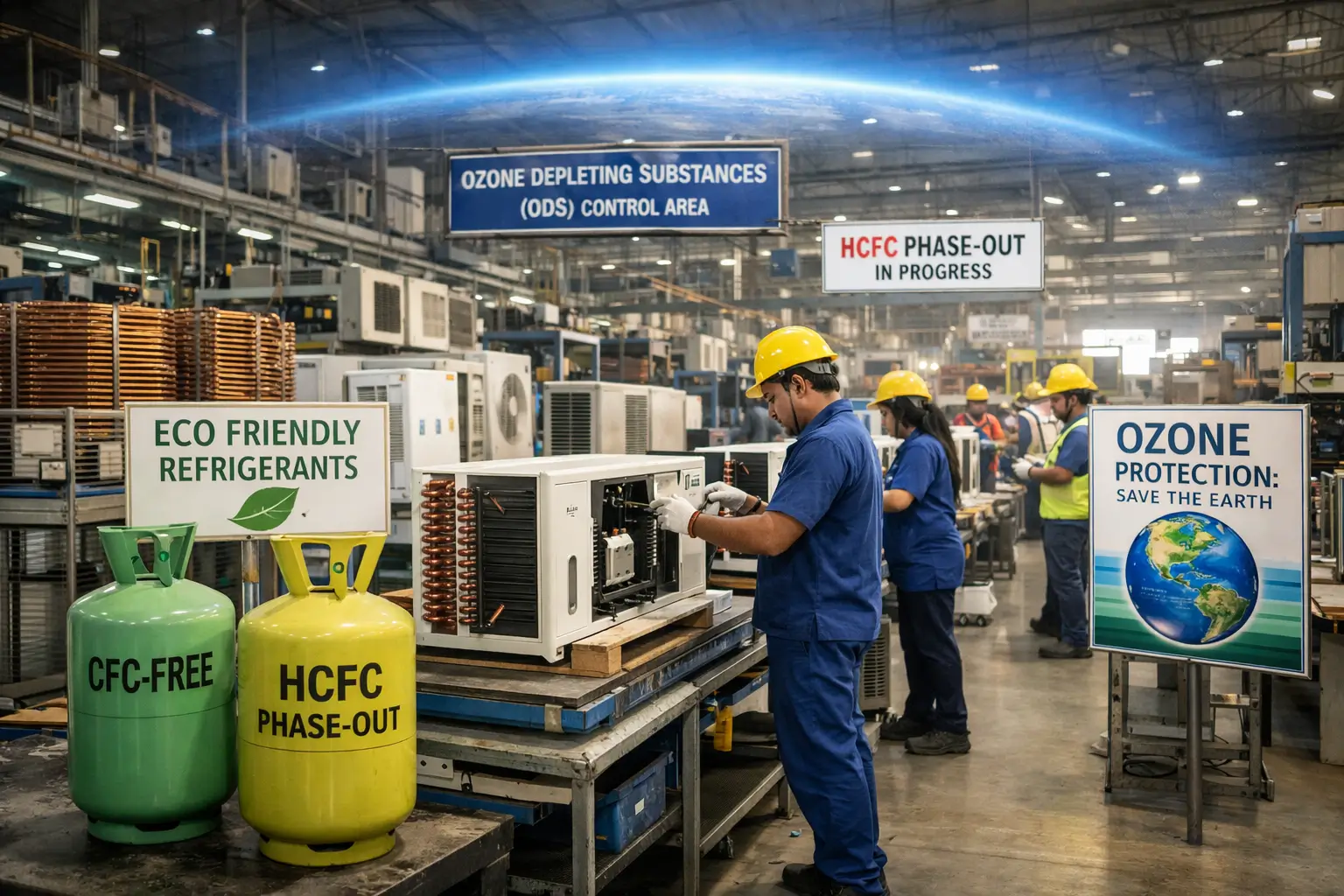
The implementation of the ODS Rules has significantly influenced the refrigeration manufacturing industry in India. One of the most notable impacts has been the transition toward environmentally friendly refrigerants. Manufacturers have redesigned equipment and processes to replace ozone-depleting substances with safer alternatives.
Another impact is the improvement in environmental management practices. Industries now follow strict guidelines for refrigerant storage, handling, and disposal. Proper leak detection and maintenance procedures are also implemented to reduce environmental risks.
The regulations have also encouraged technological innovation. Companies have invested in research and development to design energy-efficient and environmentally sustainable refrigeration systems.
Additionally, employees working in refrigeration industries are now trained in safe refrigerant handling techniques. These training programs improve workplace safety and environmental compliance.
A notable success case in India is the “Ecofrig” project implemented during the 1990s and early 2000s through collaboration between the National Chemical Laboratory (NCL) in Pune and German technical experts. This project successfully adapted hydrocarbon refrigerant technology for Indian domestic refrigerator manufacturing by utilizing cyclopentane as a blowing agent for foam insulation and hydrocarbon blends as refrigerants, thereby reducing dependence on ozone-depleting substances through pilot production plants that have since been scaled up across the Indian refrigeration industry.
7. CHALLENGES IN IMPLEMENTATION
Despite the benefits of environmental regulations, certain challenges still exist. One of the main challenges is the cost associated with replacing older technologies. Small and medium-scale industries may find it difficult to invest in new equipment that uses environmentally friendly refrigerants.
Another challenge is the lack of technical knowledge among some workers regarding proper refrigerant handling procedures.
Without adequate training, there is a risk of refrigerant leakage and environmental pollution.
Furthermore, monitoring and enforcement of regulations require strong institutional support and coordination among different government agencies. Continuous awareness programs and inspections are necessary to ensure effective implementation of environmental laws.
In Maharashtra, a key hub for refrigeration manufacturing industries including cities like Pune, the Maharashtra Pollution Control Board (MPCB) enforces ODS compliance through consent mechanisms that integrate requirements under the Water (Prevention and Control of Pollution) Act and the Air (Prevention and Control of Pollution) Act.
However, small and medium enterprises face significant challenges including high retrofit costs and the persistent problem of illegal HCFC imports through unauthorized channels. Additional regulatory measures such as global warming potential (GWP) limits and extended producer responsibility (EPR) provisions under e-waste management rules offer potential solutions for strengthening compliance frameworks.
8. Conclusion
Environmental laws play an essential role in protecting natural ecosystems and promoting sustainable industrial development. The Ozone Depleting Substances (Regulation and Control) Rules, 2000 represent an important step taken by the Government of India to regulate harmful chemicals used in refrigeration industries.
These rules have encouraged industries to phase out ozone-depleting substances and adopt safer technologies. As a result, the refrigeration manufacturing sector has made significant progress toward environmental sustainability.
However, continuous efforts are required to strengthen environmental awareness, improve enforcement mechanisms, and promote research into alternative refrigerants. Through cooperation between industries, regulatory authorities, and society, it is possible to achieve a balance between economic growth and environmental protection.
References
- Environment (Protection) Act, 1986, Ministry of Environment, Forest and Climate Change, Government of India (https://www.indiacode.nic.in/bitstream/123456789/4316/1/ep_act_1986.pdf, 2018)
- Ozone Depleting Substances (Regulation and Control) Rules, 2000, Gazette of India Notification S.O. 514(E), Ministry of Environment & Forests, 19th July 2000, (The Ozone Depleting Substances (Regulation and Control) Rules, 2000, 2012)
- Montreal Protocol on Substances that Deplete the Ozone Layer, United Nations Environment Programme, 16th September 1987, (Montreal Protocol on Substances that Deplete the Ozone Layer, 2026)
- Environmental Planning, Policies and Acts, Department of Forestry and Environmental Science School of Earth and Environmental Science, (Environmental Planning, Policies and Acts (ENS-507), 2017)
- Ozone Depleting Substances Rules Amendments, Gazette Notifications S.O. 929(E) 2005 & S.O. 996(E) 2004, Ozone Cell MoEFCC, (Ozone Cell – Ministry of Environment, Forest and Climate Change (MoEFCC), 2026)
- Annual Report 2024-25, Ministry of Environment, Forest & Climate Change, (Annual Report 2024–25, 2026)
- CEEW Report: HFC Phase-down Strategies for India, Council on Energy, Environment and Water, 2023, (Council on Energy, 2019)
- Ozone cell Ministry of Environment & Forest, Government of India, (India’s Success Story – 2002, Ozone Cell – MoEFCC, 2002)