Post: What Are The 4 Labour Codes In India?
India’s labour law landscape has undergone its most sweeping transformation in decades. On 21 November 2025, the Government of India made all four Labour Codes officially effective — replacing 29 outdated, fragmented labour laws with a unified, modern framework built for today’s workforce.
Whether you are an HR professional managing payroll compliance, an employer navigating the new regulatory landscape, a law student building your foundational knowledge, or a working professional trying to understand your rights — this guide will walk you through everything you need to know about the 4 Labour Codes in India.
Let’s start from the very beginning.
What Are India's 4 Labour Codes?
The 4 Labour Codes in India are four comprehensive pieces of legislation passed by the Parliament of India to consolidate and simplify the country’s labour laws. They replaced a patchwork of 29 central labour acts — many of which dated back to the pre-Independence era — with four clearly defined, sector-covering codes.
Each code addresses a distinct domain of employment regulation. Together, they form a comprehensive legal framework governing wages, worker rights, social protection, and workplace safety for virtually every category of worker in India.
Why Were The Labour Codes Introduced?
India’s old labour law system had a fundamental problem: it was built for a world that no longer exists.
Most of the laws that governed Indian workers were framed during the 1930s to 1950s — a time when manufacturing and agriculture dominated employment, formal factory workers were the primary concern of regulation, and concepts like gig work, platform employment, or digital workplaces hadn’t even been imagined.
Over the decades, these laws:
- Multiplied into 29 separate Acts — each with its own definitions, compliance requirements, and penalty structures
- Created confusion for employers who had to manage dozens of overlapping registers, licences, and returns
- Left millions of workers unprotected — informal workers, contract labourers, gig workers, and unorganised sector employees fell through the cracks
- Hindered ease of doing business — India’s complex labour regulations were frequently cited as a barrier to investment and industrial growth
The Government of India — after over a decade of recommendations from the Second National Commission on Labour (2002) — decided to consolidate these 29 laws into 4 comprehensive codes. The goal was simple: protect workers better, reduce compliance burden for businesses, and bring India’s labour ecosystem in line with global standards.
The result? A historic reform that took over six years from the first code’s passage (2019) to full implementation (November 2025).
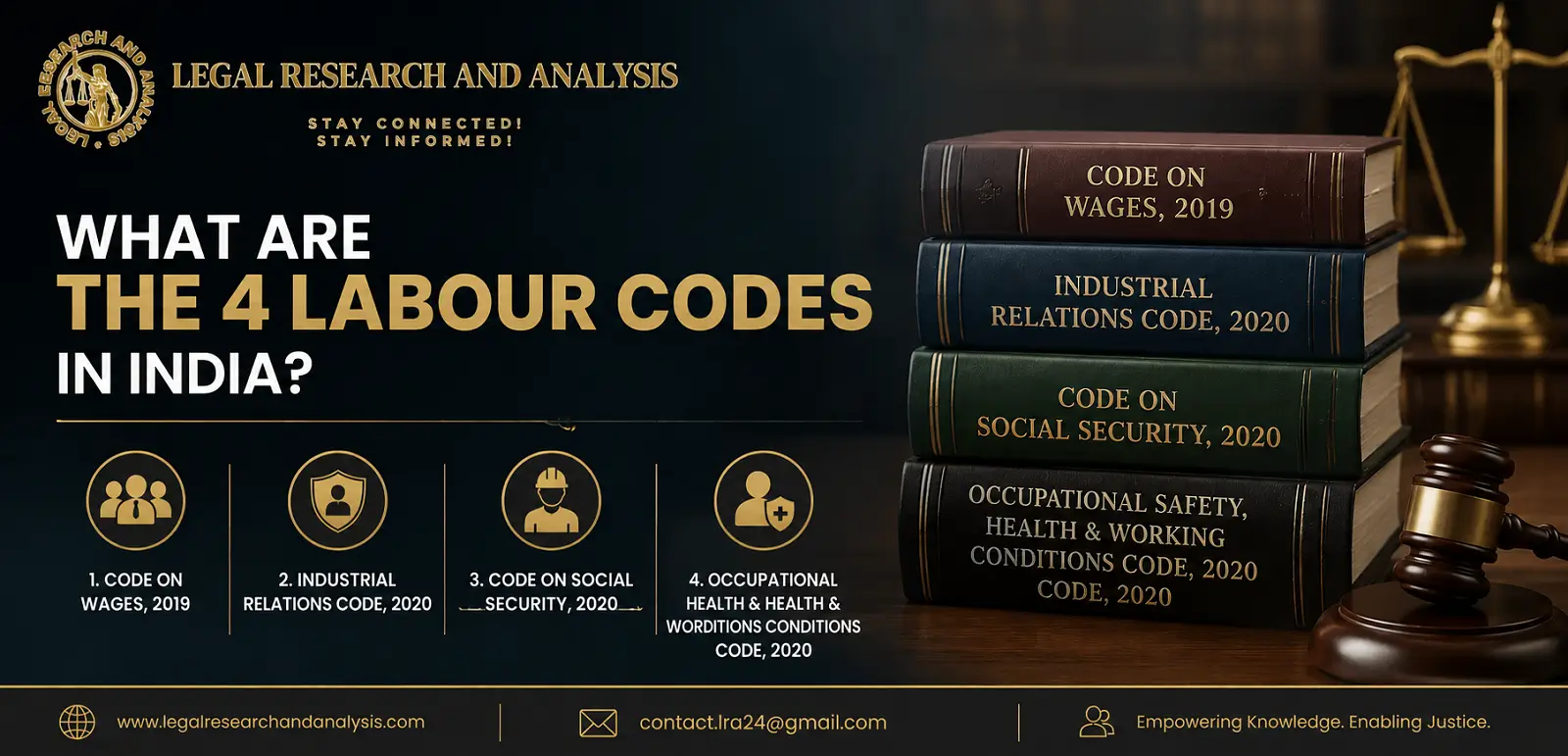
Complete List of the 4 Labour Codes in India
Here is a quick reference of all four codes, the laws they replaced, and their primary focus areas:
Code on Wages 2019 — India's First Labour Code Explaine
- Replaced: Minimum Wages Act (1948), Payment of Wages Act (1936), Equal Remuneration Act (1976), Payment of Bonus Act (1965)
- Primary Focus: Wages, minimum wage, equal pay, bonus
Industrial Relations Code, 2020
- Replaced: Trade Unions Act (1926), Industrial Employment (Standing Orders) Act (1946), Industrial Disputes Act (1947)
- Primary Focus: Trade unions, industrial disputes, retrenchment, strikes, fixed-term employment
Code on Social Security, 2020
- Replaced: Employees’ Provident Funds Act (1952), Employees’ State Insurance Act (1948), Maternity Benefit Act (1961), Payment of Gratuity Act (1972), and 5 other Acts
- Primary Focus: EPF, ESI, gratuity, maternity benefits, gig worker protection
Occupational Safety, Health and Working Conditions Code, 2020
- Replaced: Factories Act (1948), Mines Act (1952), Dock Workers Act (1986), Contract Labour Act (1970), and 9 other Acts
- Primary Focus: Workplace safety, health, working hours, women’s employment
Detailed Explanation of Each Labour Code
1. Code on Wages, 201
The Code on Wages, 2019 was the first of the four codes to receive Presidential assent (8 August 2019). It is the most immediately visible code for both employees and employers because it directly impacts what goes into every worker’s pay packet.
What It Covers
Universal Minimum Wage Coverage: Before this code, minimum wage protections applied only to workers in specific “scheduled employments.” The Code on Wages extends the concept of minimum wage to all employees, regardless of sector or establishment type.
National Floor Wage: The code introduces a national floor wage — a baseline below which no state minimum wage can fall. This ensures that even in states with lower living costs, workers receive a wage that meets minimum living standards.
The 50% Wage Rule: One of the most significant and widely discussed provisions is Section 2(Y) — the 50% wage cap rule. This provision defines “wages” to include basic pay, dearness allowance, and retaining allowance, and mandates that these components must constitute at least 50% of an employee’s total cost-to-company (CTC). Allowances (like HRA, conveyance, or special pay) cannot collectively exceed 50% of total remuneration. This directly affects payroll structuring, PF contributions, and take-home salary calculations.
Equal Remuneration: The code explicitly prohibits discrimination in wages and employment on the grounds of gender or any other ground for the same work or work of similar nature. Importantly, experience is now also a permissible factor in determining wage differentiation.
Timely Payment of Wages: Wages must be paid on time. Overtime work must be compensated at least at double the regular rate, and overtime must be consent-based.
Bonus: Provisions for statutory bonus under the old Payment of Bonus Act are retained and consolidated.
Key Impact at a Glance
2. Industrial Relations Code 2020 — Key Changes & Impact
The Industrial Relations Code, 2020 consolidates the three most consequential laws governing the relationship between workers and employers in industrial settings.
What It Covers
Fixed-Term Employment: This is one of the most business-friendly innovations in the new codes. Employers can now hire workers on fixed-term contracts in any sector — not just seasonally. Fixed-term employees receive the same wages, hours, allowances, and statutory benefits as permanent employees. Crucially, fixed-term employees become eligible for gratuity after just one year of continuous service, compared to the earlier threshold of five years.
Trade Union Recognition: The code establishes formal mechanisms for recognising trade unions at both the central and state levels. It brings clarity and legitimacy to collective bargaining processes.
Standing Orders: The threshold for mandatory standing orders (the formal document outlining rules of employment in an establishment) has been raised. Establishments with fewer than 300 workers are no longer required to have government-certified standing orders, though they can adopt model standing orders.
Industrial Disputes and Retrenchment: The code raises the threshold for requiring government permission before retrenching workers or closing establishments from 100 workers to 300 workers. This means establishments with up to 299 workers can retrench without prior government approval, giving smaller businesses more operational flexibility.
Grievance Redressal Committees (GRCs): GRCs have been expanded from a maximum of 6 members to 10 members, with mandatory proportional representation of women — addressing a significant gap in the old law.
Faster Dispute Resolution: The code introduces two-member Industrial Tribunals for faster adjudication of disputes, and allows parties to approach tribunals directly after conciliation.
Key Impact at a Glance
3. Social Security Code 2020 — Gig Workers & PF/ESI Changes
The Code on Social Security, 2020 is arguably the most socially transformative of the four codes. It extends the protective umbrella of social security — previously available only to formal sector employees — to include informal workers, contract workers, gig workers, and platform workers.
What It Covers
Universal Social Security Coverage: For the first time in India’s legislative history, gig workers (such as those working for app-based platforms) and platform workers are formally recognised and given access to social security benefits. This includes life insurance, health insurance, provident fund, and maternity benefits.
EPF (Employee Provident Fund): The code retains and strengthens the EPF framework. All workers in covered establishments contribute to their retirement corpus, with portability of benefits now embedded into the design.
ESI (Employee State Insurance): ESIC coverage is extended PAN-India. Establishments with even one employee engaged in hazardous processes are mandated to provide ESI benefits.
Gratuity: Fixed-term employees become eligible for gratuity after just one year of continuous service. For regular employees, the five-year threshold is retained.
Maternity Benefits: The code retains the 26-week paid maternity leave provision for women employees, consolidating the Maternity Benefit Act.
Portability of Benefits: Social security benefits are now portable across states and sectors — a crucial reform for India’s massive migrant worker population.
Digital Systems: The code mandates digital systems for registration, compliance, and benefit delivery — making it easier for both workers and employers to manage obligations electronically.
Appointment Letters: Every worker must now receive a mandatory appointment letter clearly stating their designation, wages, and social security entitlements — ensuring transparency and job security.
Key Impact at a Glance
4. Occupational Safety Code 2020 — Workplace Safety Rules
The Occupational Safety, Health and Working Conditions (OSH) Code, 2020 replaces 13 sector-specific safety laws with a single, unified framework covering the widest possible range of industries.
What It Covers
Unified Safety Framework: Previously, safety laws were fragmented across separate acts for factories, mines, docks, construction sites, plantations, and so on. The OSH Code creates a single standard applicable across sectors, with sector-specific provisions retained within the same legislation.
Working Hours: Working hours are capped at a maximum of 8 to 12 hours per day and 48 hours per week. Overtime requires worker consent and must be compensated at double the rate.
Free Annual Health Checkups: Employers must provide free annual health checkups to all workers above 40 years of age.
Women’s Employment: Women can now legally work in all types of establishments and all work categories — including underground mining, heavy machinery operation, and hazardous environments — subject to their consent and mandatory safety measures provided by the employer. This is a landmark gender-equity reform.
Inspector-cum-Facilitator: A new enforcement philosophy replaces the old punitive approach. Inspectors now function as “Inspectors-cum-Facilitators” — their role is to guide and assist establishments in achieving compliance, not simply to penalise non-compliance. Penalties are reserved for serious or repeat violations.
Hazardous Processes: Mandatory safety training for handling, storing, and using chemicals. Protective equipment is mandatory. Plantations with more than 10 workers or 5 or more hectares are covered.
National OSH Board: A National OSH Board is established to set harmonised safety and health standards across all sectors.
Single Registration and Return: Instead of multiple overlapping licences and filings, employers now submit a single registration, single licence, and single annual return — dramatically reducing the compliance burden.
Key Impact at a Glance
Old Labour Laws vs New Labour Codes: A Comparison
Benefits of the Labour Codes
The four Labour Codes deliver benefits across the entire employment ecosystem:
For Workers:
- Universal minimum wage — no worker left without protection
- Mandatory appointment letters — clarity on terms of employment
- Social security for gig workers — India’s first formal recognition
- Free annual health checkups for workers above 40
- Equal opportunities for women across all industries
- Portability of PF and ESI benefits across states
For Employers:
- Reduced compliance burden — fewer registers, filings, and licences
- Single annual return instead of multiple state-by-state filings
- Clearer definitions across all four codes
- Fixed-term contracts available in all sectors
- Inspector-cum-Facilitator model — guidance before penalty
- Decriminalisation of minor non-compliances
For the Economy:
- Improved ease of doing business ranking
- Reduced informality in the labour market
- Greater investor confidence in regulatory clarity
- Foundation for a future-ready workforce
Criticism and Challenges
No reform of this magnitude comes without debate. The Labour Codes have attracted criticism from several quarters:
From Trade Unions: Several central trade unions opposed the codes, arguing that raising the retrenchment threshold from 100 to 300 workers makes it easier for employers to dismiss workers without accountability. They also raised concerns that the weakening of standing order requirements could erode workers’ protections in smaller establishments.
From Labour Rights Organisations: Critics have questioned whether the “Inspector-cum-Facilitator” model, while reducing harassment, might also reduce effective enforcement — particularly in sectors with historically poor safety records.
From State Governments: Labour being a concurrent subject under the Indian Constitution, states must frame their own rules under each code. As of early 2026, most states were still in the process of finalising their rules, creating a period of transition uncertainty.
Implementation Lag: Although the codes became effective on 21 November 2025, Central Rules were only published in draft form on 30 December 2025 — giving employers limited time to adapt before rules were finalised.
Impact on Employees
The Labour Codes bring both rights and responsibilities for employees:
- Clearer wage structure — understanding what constitutes “wages” is now standardised
- 50% wage rule impact — employees may see changes in their take-home salary as employers restructure CTC to comply
- Gig economy workers gain formal legal recognition and access to social security benefits for the first time
- Women gain broader employment rights across industries previously closed to them
- Fixed-term workers gain equality with permanent employees in wages and benefits, plus gratuity after one year
- Migrant workers benefit from portable social security benefits across state lines
Impact on Employers
For employers — particularly HR, payroll, and compliance teams — the Labour Codes represent a significant operational shift:
- CTC restructuring may be necessary to ensure at least 50% of total remuneration qualifies as “wages”
- Revised PF and ESI contributions may result as the wage definition broadens
- New registration and return processes — single filing replaces multiple submissions
- Mandatory appointment letters for all workers
- Contract labour arrangements must be reviewed — principal employers now have extended liability for social security compliance of contract workers
- Standing orders need revision for organisations above 300 workers
- Fixed-term employment contracts can be introduced in any sector with appropriate safeguards
Impact on HR Professionals
HR professionals sit at the intersection of all four codes and must develop competency across each:
Payroll Compliance: HR must understand the new wage definition deeply. Restructuring CTC packages to comply with the 50% wage rule requires coordination between HR, Finance, and Legal teams.
Contract Management: The expanded definition of “employer” — which now includes indirect engagement through contractors — places greater responsibility on HR to monitor contract labour compliance.
Documentation: Appointment letters, wage registers, and attendance registers must be digitised and standardised as per the new unified requirements.
Training and Awareness: HR teams must train line managers, supervisors, and employees on the new rights and obligations under each code.
Strategic Workforce Planning: Fixed-term employment is now available in all sectors — HR can now design more flexible workforce models, though with equal-pay and benefits obligations clearly in mind.
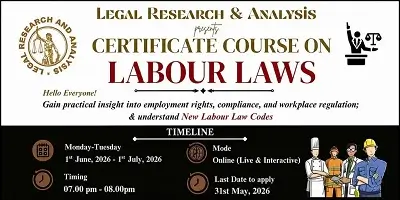
This is precisely why structured learning has never been more valuable for HR professionals. A dedicated Certificate Course on Labour Laws can equip HR practitioners with the expertise needed to navigate the new compliance landscape confidently and authoritatively.
Impact on Startups and Businesses
For startups and growing businesses, the Labour Codes present both opportunities and compliance demands:
Opportunities:
- Fixed-term employment in any sector gives startups workforce flexibility without the earlier legal complications
- Single registration and return simplify early-stage compliance
- The Inspector-cum-Facilitator model is more startup-friendly — inspections are now guidance-first
Challenges:
- Gig economy startups (aggregator platforms, food delivery, cab services) now have formal obligations toward gig and platform workers under the Social Security Code
- The 50% wage rule may require startups to restructure equity-linked compensation packages
- Legal departments and HR teams must now be well-versed in all four codes simultaneously
Labour Codes and Payroll Compliance
Payroll is the most immediate operational area affected by the Labour Codes.
Key Payroll Changes:
- Wage Definition — The expanded definition of wages under the Code on Wages directly determines the base for PF, ESI, gratuity, and overtime calculations.
- 50% Cap on Allowances — If a CTC package has more than 50% in allowances (HRA, LTA, special allowance, etc.), it must be restructured.
- PF Contributions — As wages increase (due to the 50% rule), PF employer and employee contributions may increase proportionally.
- Gratuity — Fixed-term employees become gratuity-eligible after one year, which must be provisioned for in financial planning.
- Digital Registers — Payroll teams must maintain unified electronic registers as mandated by the Social Security Code and its rules.
- Single Annual Return — A unified annual return replaces multiple filings under earlier acts.
Payroll compliance under the new codes is no longer just an administrative function — it is a strategic legal responsibility. Professionals handling payroll would benefit enormously from a structured Labour Laws Certification Course that covers these nuances in depth.
Labour Codes and Gig Workers
One of the most significant social policy shifts in the Labour Codes is the formal recognition of gig workers and platform workers.
Before November 2025, workers employed through app-based platforms — delivery agents, cab drivers, freelancers on digital marketplaces — had no formal labour law protections. They were neither “employees” nor “workers” in the traditional legal sense.
The Code on Social Security, 2020 changes this entirely:
- Gig and platform workers are formally defined and recognised in Indian law
- They are entitled to social security benefits including life insurance, accidental insurance, health and maternity benefits, and old age protection
- Aggregator platforms have formal obligations to register and contribute to a social security fund for gig workers
The government can create specific welfare schemes for this category
This is a landmark development for India’s rapidly growing gig economy — estimated to employ over 7.7 million workers as of 2023 and expected to grow significantly.
Labour Codes Effective Date and Implementation Timeline
Important Note: While all four codes became effective on 21 November 2025, the Central Rules were in draft form as of early 2026, and most states were still in the process of notifying their state-specific rules. During this transition period, the relevant provisions of existing acts continue to remain in force.
Latest Updates on Labour Codes 2026
November 2025: Government of India officially implements all four Labour Codes with effect from 21 November 2025.
December 2025: Draft Central Rules published under all four codes — inviting objections and suggestions from stakeholders within 30 to 45 days.
April 2026: Final Central Rules expected to be notified, marking the beginning of full rule-based implementation at the central level.
State Rules: Most states had published draft rules by early 2026; a few states had notified final state rules. Full state-level implementation is still rolling out.
Key Immediate Changes in Effect:
- Mandatory appointment letters for all workers
- Gig and platform worker social security recognition
- Fixed-term employment available in all sectors
- Women permitted to work in all establishments (with consent and safety measures)
- Annual health checkups for workers above 40
- Inspector-cum-Facilitator enforcement model active
How Labour Codes Affect Indian Companies
Indian companies — from large corporates to MSMEs — must adapt to the new framework across multiple functions:
Legal: Update employment contracts, standing orders, and fixed-term employment templates.
HR: Revise HR policies covering working hours, leave, fixed-term contracts, and social security contributions.
Payroll: Restructure CTC designs to comply with the 50% wage rule; update payroll software.
Compliance: Update registration details, review contract labour arrangements, and prepare for the single annual return.
Finance: Provision for increased PF, ESI, and gratuity costs arising from the broader wage definition.
Training: Educate employees about their new rights, entitlements, and appointment letter contents.
Companies that invest in understanding and implementing the Labour Codes early will gain a competitive advantage in talent retention, regulatory standing, and operational clarity.
Career Opportunities in Labour Law After the 4 Code Reform
The implementation of the Labour Codes has created a surge in demand for qualified labour law professionals across sectors:
In-Demand Roles:
- Labour Law Compliance Officer
- HR and Compliance Manager
- Labour Law Consultant (for law firms and consulting companies)
- Payroll and Statutory Compliance Specialist
- Industrial Relations Manager
- Legal Counsel — Employment and Labour Law
- Labour Law Trainer and Educator
Who Benefits from Labour Law Expertise:
- Law graduates entering corporate law or advisory practice
- HR professionals seeking to build compliance depth
- Chartered Accountants and Company Secretaries advising clients
- In-house legal teams at corporations
- Government and public sector employment lawyers
- Consultants advising MSMEs, startups, and multinationals
Given the scale and complexity of the Labour Code reforms, there has never been a better time to build structured expertise in this domain. The Certificate Course on Labour Laws at Legal Research and Analysis is specifically designed for legal professionals, HR practitioners, and compliance specialists who want to build authoritative, career-ready knowledge in this space.
Why Labour Law Knowledge Is Important in 2025 and Beyond
Understanding labour law is no longer optional for anyone involved in employment — it is a professional necessity.
For employees: Knowing your rights under the four codes — from the right to a minimum wage to social security coverage as a gig worker — protects you from exploitation and unlawful employment practices.
For employers and businesses: Non-compliance with the Labour Codes can attract penalties, legal liability, and reputational damage. Compliance is not just a legal obligation — it is a business imperative.
For HR professionals: The new codes touch every aspect of the employee lifecycle — from hiring (appointment letters, fixed-term contracts) to payroll (wage definition, PF, ESI) to separation (gratuity, retrenchment rules). HR professionals must be conversant with each code in detail.
For law students and legal professionals: Labour law is one of the most dynamic and practically relevant areas of Indian law. The consolidation and implementation of the four codes has created enormous demand for qualified legal advisors in this space.
For consultants and advisors: Businesses across India are seeking expert guidance on transitioning to the new regime. Professionals who can provide clear, practical compliance advice are in enormous demand.
If you are serious about building or deepening your expertise in this domain, enrolling in a structured labour law course is the most efficient and credible path forward.
Conclusion
India’s four Labour Codes — the Code on Wages (2019), the Industrial Relations Code (2020), the Code on Social Security (2020), and the Occupational Safety, Health and Working Conditions Code (2020) — represent the most comprehensive reform of the country’s employment law framework since independence.
Effective from 21 November 2025, these codes have:
- Replaced 29 fragmented, outdated laws with four unified codes
- Extended social security to gig workers and platform workers
- Introduced fixed-term employment across all sectors
- Standardised the wage definition and established a national floor wage
- Modernised workplace safety and enforcement
- Simplified compliance for employers of all sizes
The reform is ongoing. Central and state rules are still being finalised. Companies, workers, HR departments, and legal professionals must stay current, adapt quickly, and build genuine expertise in this evolving framework.
For anyone looking to build that expertise — from foundational understanding to advanced compliance advisory — the Certificate Course on Labour Laws at Legal Research and Analysis provides structured, practitioner-led learning built for the post-reform landscape.