Skip to content

AI AND LAW

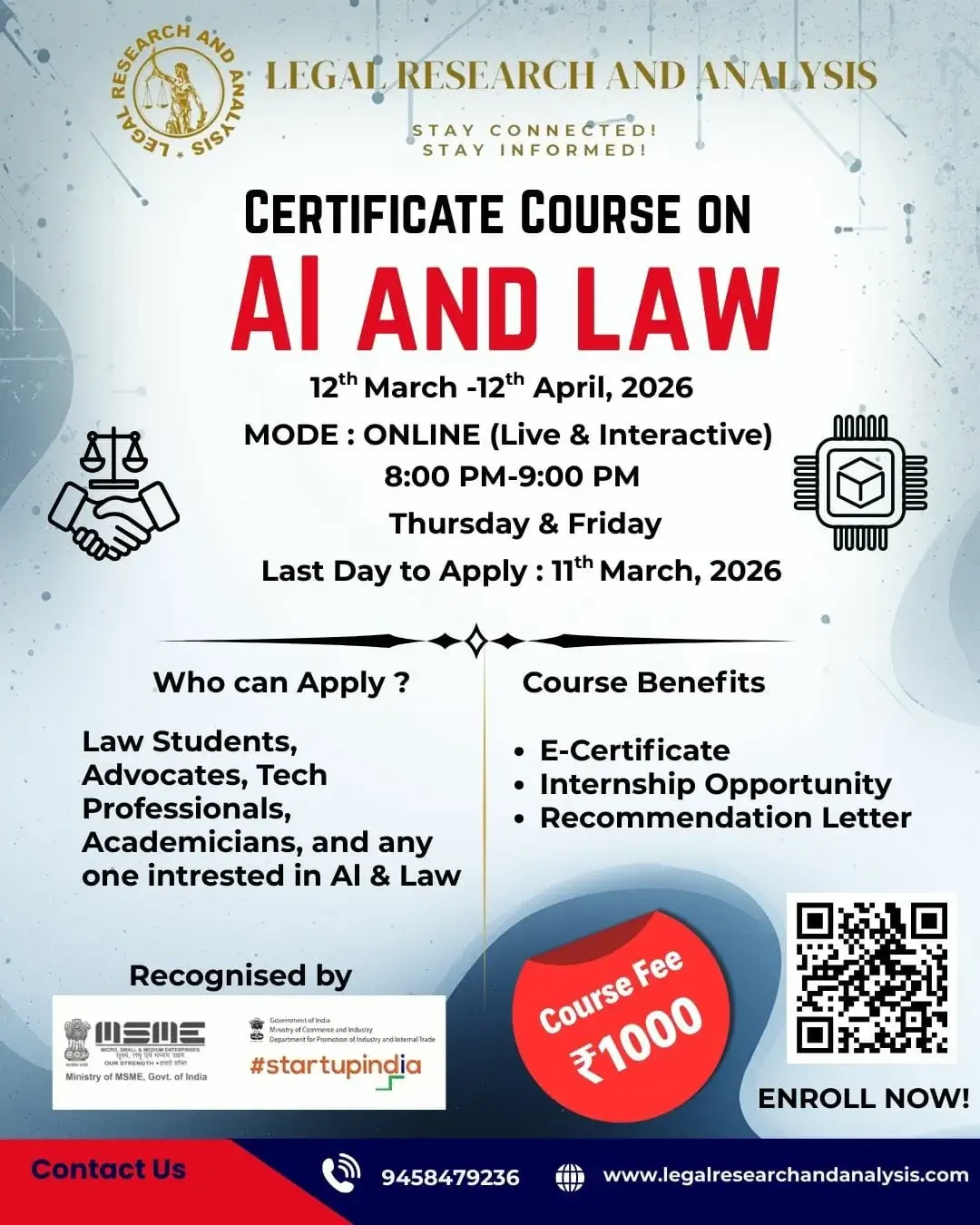
CERTIFICATE COURSE0
Ai and Law

Complete Career-Focused Certificate Course on AI and Law

4.8 (461 Rating)

₹1000

Schedule

Important Dates

Artificial Intelligence (AI) is transforming the legal landscape, reshaping how law is practised, interpreted, and enforced. This one-month certificate course is designed to provide a comprehensive understanding of the intersection between Al and law, covering regulatory frameworks, ethical concerns, and real-world applications.
Through eight interactive sessions over four weeks, participants will explore key legal issues surrounding AI, including data protection, intellectual property rights, criminal justice, and policy-making. The course is structured to benefit law students, legal professionals, policymakers, and researchers seeking to understand the legal and ethical dimensions of AI.

Comprehensive Coverage: Explore the intersection of Al and law, including regulation, ethics, and legal applications.

Expert-Led Sessions: Learn from leading professionals, legal scholars, and Al experts.

Real-World Case Studies: Analyse practical examples of Al in legal research, judicial decision-making, and law enforcement

Comparative Legal Perspectives: Understand AI regulations in India, the EU, the US, and China.

Ethical & Policy Discussions: Delve into issues like algorithmic bias, privacy concerns, and Al accountability.

Interactive Learning: Engage in discussions, Q&A sessions, and thought-provoking debates.

  1. Understanding Al and Law- Introduce participants to Al technologies and their implications for legal practice and governance.
  2. Regulatory Frameworks- Analyse existing laws and policies governing Al, including data protection, intellectual property, and criminal justice.
  3. Comparative Analysis Examine- AI regulations in India, the EU, the US, and China to understand global best practices.
  4. Ethical Considerations- Discuss issues like algorithmic bias, Al transparency, and human rights concerns.
  5. Practical Applications- Explore real-world use cases of Al in legal research, contract management, and dispute resolution.
  6. Future Perspectives- Assess the evolving landscape of Al governance and potential legal reforms.

Aims
  • To provide a foundational understanding of Artificial Intelligence (AI) and its impact on the legal system.
  • To explore the legal, ethical, and regulatory challenges associated with Al in India and globally.
  • To equip participants with practical insights into Al’s role in legal research, judicial decision-making, and governance.
  • To foster critical thinking on AI-related policy developments and legal reforms.

In-Depth Curriculum Overview: AI and Law Specialization Program

Session 1: Understanding Artificial Intelligence

  • Basics of Al: Definition, types, and applications
  • Key concepts: Machine Learning, Neural Networks, and Natural Language Processing
  • Al in the Indian and global context: Opportunities and challenges

Session 2: Al and the Legal System

  • Role of Al in the judiciary (e.g., predictive justice, case law research tools)
  • Applications of Al in contract management, dispute resolution, and compliance
  • Ethical and moral dilemmas of Al in the legal domain
Week 2: Regulatory Frameworks and Policy Perspectives

Session 3: Legal Framework Governing Al in India

  • Digital Personal Data Protection Act, 2023
  • IT Act, 2000, and cybersecurity regulations
  • Sectoral laws (e.g., Competition Act, Consumer Protection Act) impacting Al

Session 4: Comparative Analysis of Al Regulations

  • The EU AI Act: Key features and lessons for India
  • US and China’s approach to regulating AI
  • International principles: OECD Guidelines and UNESCO Recommendations

Session 5: Al and Intellectual Property Law

  • Copyright challenges: Authorship of Al-generated works
  • Patentability of Al inventions
  • Trade secrets and database protection in the Al era

Session 6: Al in Criminal Justice

  • Use of Al in policing: Predictive policing and surveillance systems
  • Al and human rights: Issues of privacy, bias, and accountability
  • Case studies: Examining Al’s role in criminal investigations and judicial decisions
Week 4: Ethical and Future Considerations

Session 7: Ethical and Social Implications of Al

  • Algorithmic bias and discrimination
  • Transparency and accountability in Al systems
  • Al and the right to privacy: Striking a balance

Session 8: The Future of Al and Law

  • Emerging trends in Al and its impact on the legal profession
  • Regulating Al responsibly: Policy suggestions for India
  • Group discussion: Debating the role of Al in enhancing access to justice

Who Should Apply?

Law students, legal professionals, academicians, policymakers, and technology enthusiasts

AI and Law Course Assessment and Certification Details

  1. Final Assignment: Write a 1,000-word analysis on any one aspect of Al and law. 
  2. Certificate: Awarded upon completion of all sessions and submission of the assignment

Mentors

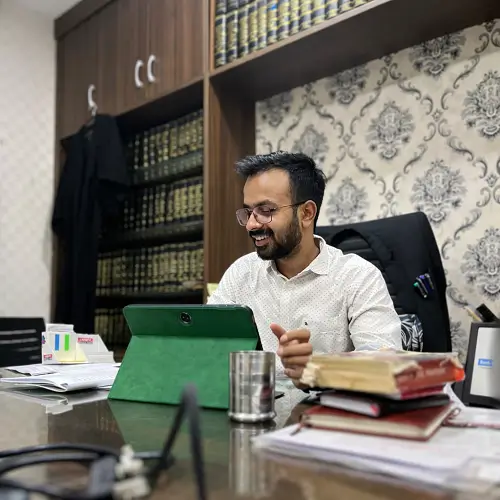
Adv. Ujjwal Ashutosh

UGC NET Qualified, Practicing Advocate & Teaching Associate

JHA PRANAV KUMAR

Mr. Pranav Jha

Mr. Pranav Jha was serving as a Junior Research Consultant at the National Human Rights Commission. He has completed his LL.M (Access to Justice) from Tata Institute of Social Sciences, Mumbai.
He has graduated in Law- {B.A.LL.B (Hons.)} with distinction from Aligarh Muslim University, Murshidabad Centre (W.B). He has been very dedicated to his academic excellence. He was a student representative at CDFC, TISS.

Perks

Contact Us