
Cryosphere Degradation and National Security: A Legal Analysis in the Indian Context
- Author (s) Shivadharshini Murugesan
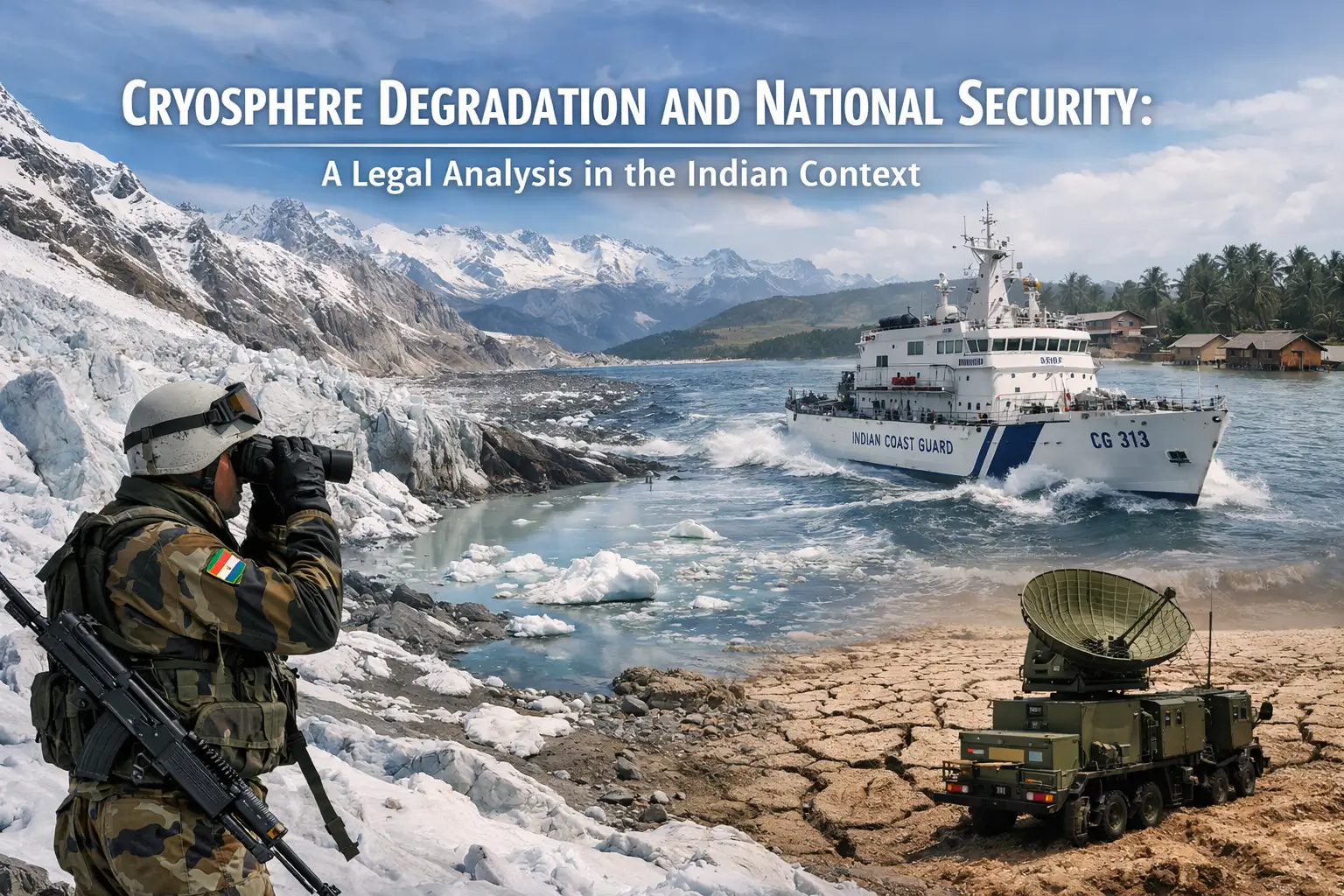
Table of Contents
ABSTRACT
Climate change is no longer an environmental concern. In the himalayan region the degradation of the cryosphere has emerged as a critical challenge, with its impacts reaching beyond environmental protection and transforming into governance, disaster management, and security challenges. Glaciers in the Himalayan region play a vital role in both hydrological and ecological functions such as sustaining major river systems and regulating stability in climate conditions. Accelerated glacial retreat, driven by anthropogenic activities, has fueled disaster risks and increased vulnerable conditions in India’s ecologically weak and strategically important regions. Despite these developments, India lacks a proper legal framework that focuses on cryosphere degradation as an immediate regulatory concern. Since all the existing constitutional provisions, environmental laws, and disaster management legislation engage with climate related risks, some recent judicial interventions have broadened the interpretation of fundamental rights to encompass climate induced challenges, marking a huge shift in environmental jurisprudence. However, judicial recognition alone is not sufficient to address the prolonged risks caused by glacial loss. This study focuses a doctrinal legal analysis of India’s constitutional, statutory, and judicial responses to cryosphere degradation, situating the issue within a climate-security framework and argues that the absence of targeted legal solutions for glaciers undermines proactive governance and national resilience.
INTRODUCTION
The Himalayan glaciers are the cardinal component of India’s environmental landscape. The cryosphere, encompassing glaciers, snow cover, and permafrost system is important to regulate river flows, moderating climate patterns in the region, and supporting ecological stability across vast downstream areas. In recent decades, cryosphere degradation has been documented in the Himalayan region, primarily driven by rising global temperatures and anthropogenic activities. This change has altered hydrological regimes and increased environmental instability, creating risks that extend beyond the realm of environmental protection. India’s dependence on the Himalayan glacial systems is multifaceted. The major river basins that arise from the Himalayas are supporting agriculture, supply of drinking water, energy generation, and the livelihoods of millions of people in many ways. At the same time, the region is fragile due to its geology, high disaster vulnerability, and strategic importance due to its proximity to border areas. Glacial retreat has increased hazards such as glacial lake outburst floods, landslides, and flash floods, showing structural weaknesses in development planning and disaster preparedness. Events like the 2013 Kedarnath disaster and the 2021 Chamoli incident illustrate how cryosphere induced disasters can trigger cascading failures affecting infrastructure, governance capacity, and emergency response systems. This kind of phenomena necessitates the change in perspective from viewing cryosphere degradation solely as an environmental issue to viewing it as a non-traditional security threat. Climate caused challenges to water availability, vulnerability to disasters, and displacements are putting continuous pressure on state institutions and social stability.
Despite the strategic implications of cryosphere degradation, India’s legal framework does not transparently mention glaciers or cryospheric systems as distinct regulatory subjects. Environmental and disaster related laws are only related to climate impacts, while administrative responses are often reactive. Although constitutional courts have progressively expanded the scope of fundamental rights to encompass environmental and climate related harms, judicial intervention works within the structural limitations and cannot substitute for comprehensive legislative action. Against this backdrop, this study examines whether India’s constitutional provisions, statutory mechanisms, and evolving judicial doctrines are sufficient to address the legal and security challenges posed by cryosphere degradation. By situating glacier loss within a climate security framework, this study seeks to highlight the normative gaps and argue for the need to reconsider cryosphere protection as an integral component of national security.
METHODOLOGY
This study employs a doctrinal legal research methodology, supported by contextual analysis drawn from climate science and conservation studies, to assess India’s legal response to cryospheric degradation. This doctrinal approach is appropriate as it focuses on interpreting constitutional provisions, legal frameworks, and judicial pronouncements relevant to environmental protection, disaster management, and climate related risks. Primary legal sources form the basis of the analysis, including the Indian Constitution, key environmental and disaster management laws, and judgments of constitutional courts and specialized tribunals. These documents are examined to assess how existing legal norms recognise environmental challenges and whether they are equipped enough to address the special characteristics of cryospheric degradation. Particular attention is given to constitutional provisions and laws with some judicial arguments that have expanded the scope of fundamental rights in the context of environmental and climate impacts. And also this study utilizes secondary sources such as scientific assessments and policy reports related to glacial retreat, disaster patterns,regional vulnerability and this study does not undertake a comparative analysis across jurisdictions.
CONSTITUTIONAL FRAMEWORK FOR CRYOSPHERE PROTECTION
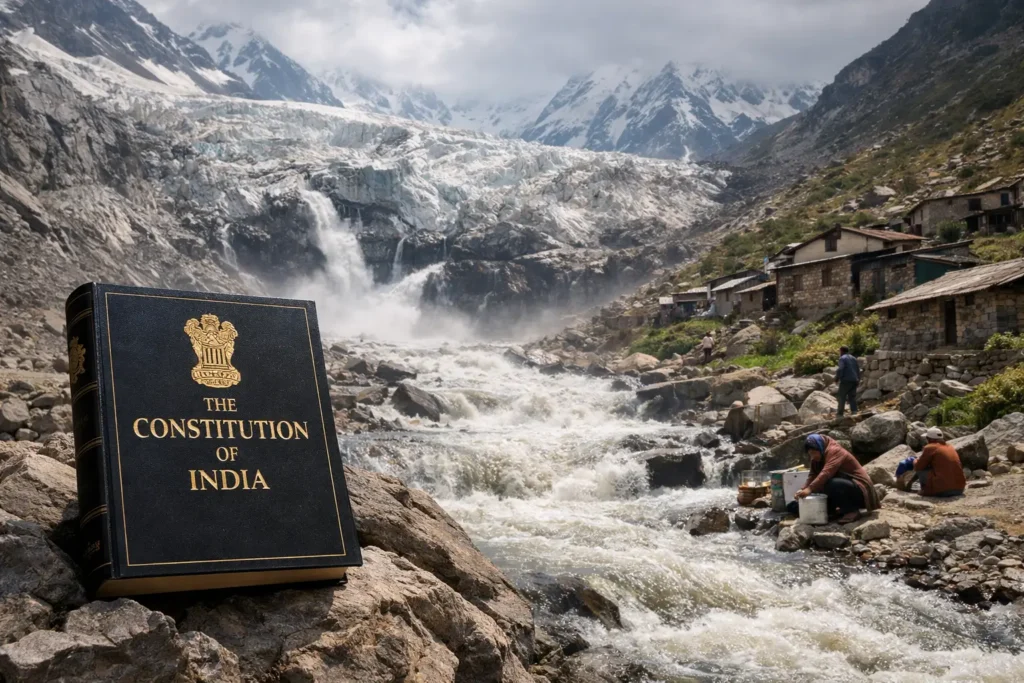
Even supposing, there are no precise references to climate change or glaciers, India’s constitutional framework provides an implicit yet significant normative basis for addressing cryosphere degradation. At the heart of this context, Article 21 which has been judicially explained to encompass the conditions essential for a dignified and safe existence of all. Environmental degradation that compromises access to clean water, ecological stability, or protection from disaster related challenges has been recognized as the right to life. In the context of cryosphere degradation, glacial retreat that directly threatens water security and disaster resilience, particularly for the population that depends on glacier-fed river systems for their livelihood.
The Directive Principles of State Policy further supports this constitutional approach. Article 48A, introduced through a constitutional amendment, reflects an evaluative commitment to environmental protection and ecological stewardship. While not justiciable, the Directive Principles inform constitutional interpretation and guide the development of environmental governance. Read in conjunction with Article 21, Article 48A strengthens the argument that the state has a responsibility to anticipate and mitigate environmental harms arising from climate induced processes that give way to glacial loss in any way.
The Fundamental Duties, as mentioned under Article 51A(g) of the Indian constitution, also contribute to the constitutional discourse on environmental responsibility. Primarily, this provision has not been used to justify regulatory actions and judicial intervention in environmental matters. But in the context of cryosphere degradation, it supports the notion that glacier protection is a shared societal obligation rather than a discretionary policy choice under civics duty for every citizen to protect and improve the natural environment including forest Rivers, lakes, wildlife and to have compassion for living creatures through the 42nd Amendment in 1976.
Next, The principle of equality under Article 14 adds a further dimension to the constitutional analysis. Climate impacts are distributed unequally, affecting people in the mountainous and downstream regions. This differential exposure to disaster risk and water insecurity raises concerns of unequal protection, where state responses fail to account for vulnerability and regional disparities.
Despite its interpretive flexibility in nature, the constitutional framework is particularly limited in addressing cryosphere degradation. Its dependence on judicial expansion leads to reactive rather than preventive. Without legal measures and institutional integration, constitutional safeguards are at risk when confronted with rapid cryospheric change.
Statutory Framework Governing Cryosphere and Climate Risks
India’s legal framework addressing environmental protection and disaster management only addresses the cryosphere degradation fragmentarily. While the state is empowered with several legislative instruments to respond to environmental issues and disaster vulnerabilities, none clearly explains glaciers or cryospheric systems. This absence is particularly worthy of mention given the slow onset and cumulative nature of glacial retreat.
The Environment (Protection) Act, 1986, works as a central pillar of India’s environmental regulatory regime. This Act gives the central government broad powers to regulate activities affecting the environment and to impose restrictions in environmentally sensitive areas. While these provisions are flexible enough to cover climate related harms and issues, the act primarily focuses towards pollution control and industrial regulation. The design of this act reflects a regulatory logic that aimed at managing the distinct sources of environmental degradation rather than addressing long time environmental processes such as glacial mass loss or complete cryospheric disruption. Consequently, the Act sometimes functions as a
reactive instrument, responding to environment related issues after thresholds have been crossed.
The Disaster Management Act, 2005, represents a significant institutional development by establishing multi-tiered authorities responsible for disaster preparedness, response, and recovery. The legal definition of disaster is broad enough to include events resulting from environmental degradation, thereby allowing glacier-related hazards such as glacial lake outburst floods to fall within its purview. However, the operational significance of the law is primarily centered on response coordination and post-disaster relief. While mitigation and preparedness are acknowledged in principle, the legal framework lacks mechanisms specifically designed to address climate induced, slow onset hazards related with cryosphere degradation in the Himalayas.
The National Green Tribunal Act, 2010, strengthens environmental adjudication by providing a specialized forum for resolving disputes related to environmental issues. The Tribunal’s mandate to apply principles such as sustainable development and the precautionary principle has enabled progressive interventions in environmentally sensitive contexts. Nevertheless, the Tribunal’s jurisdiction is derivative in nature, dependent on existing statutory frameworks. In the absence of glacier specific standards or monitoring obligations, adjudicatory interventions remain ad hoc, episodic, and case-specific.
Taken together, these laws expose a regulatory framework that treats cryosphere degradation as an incidental concern rather than a major governance and security challenge. This lack of legislative specificity constrains proactive risk management and limits the ability of institutions to address the strategic implications of glacier loss. This deficiency in the law indicates the need for a comprehensive legal approach that recognizes cryosphere degradation as a distinct and emerging threat.
Judicial Intervention and the Evolution of Climate Jurisprudence
In the absence of specific legislative action, the judiciary has played a crucial role in shaping India’s response to climate related risks. With the help of broad interpretation of constitutional rights and environmental principles, the courts have addressed the normative gaps within the legal framework. Thus, judicial intervention has served as an important mechanism for addressing the legal dimensions of glacial melt.
Central to the interpretation of Article 21 of the Constitution, The courts have consistently held that environmental conditions affecting health, safety, and access to essential resources are linked to the right to life of every individual. In recent judicial pronouncements, this argument has been extended to recognize that climate impacts can violate constitutionally protected interests. This doctrinal development marks a shift from viewing climate change as merely a policy matter to considering it a constitutional issue subject to judicial analysis. The recognition of climate related vulnerabilities under Articles 14 and 21 also introduces an equity dimension to environmental justice.
The National Green Tribunal has extensively contributed to climate jurisprudence by executing environmental principles in the administration of justice. By emphasizing precaution and sustainability, the tribunal has underlined the need for proactive regulation in ecologically sensitive zones. However, the lack of specific legal criteria for glacial protection has limited its interventions. Consequently, the judiciary’s engagement with glacier related risks remains largely remedial, addressing the wrongs only after the environmental damage has occurred.
The National Green Tribunal has extensively contributed to climate jurisprudence by executing environmental principles in the administration of justice. By emphasizing precaution and sustainability, the tribunal has underlined the need for proactive regulation in ecologically sensitive zones. However, the lack of specific legal criteria for glacial protection has limited its interventions. Consequently, the judiciary’s engagement with glacier related risks remains largely remedial, addressing the wrongs only after the environmental damage has occurred.
While judicial innovations have strengthened the normative basis for climate governance, they cannot substitute for comprehensive legislative action. Courts operate within institutional constraints and are ill-suited to designing long-term regulatory frameworks. Dependence on judicial intervention risks fragmenting climate action and placing undue pressure on judicial institutions. Therefore, judicial intervention should be understood as a specific solution, not a substitute.
Cryosphere Degradation and National Security Implications
As Himalayas form the natural terrain of India and lie in close proximity to international boundaries, glacier degradation in the Himalayas has emerged as a significant non-traditional security challenge, with its implications for water security, disaster management and internal stability in many ways. The issue of glacier retreat makes a shift in hydrological patterns, disrupts mountain ecosystems and increases the frequency of climate induced hazards. These processes interact with existing socio-economic vulnerabilities to create irreversible impacts.
In the himalayan mountains, glaciers that have nourished India’s rivers for thousands of years are now melting at an alarming rate that immediately causes water security. Water security is one of the most immediate security dimensions of glacier loss. Declining of glacier fed river flow threatens the river systems that are critical for agriculture, energy production and domestic consumption which will lead to water unavailability in northern India and fuels disputes with Pakistan, China, and Bangladesh over shared water resources.
Apart from this, Glacial lake outburst floods and increased sedimentation will damage the hydroelectric projects and military installations without compromise and this will lead to the disruption of strategic mobility in border areas. And also changing topography in high altitude areas like Ladakh and Arunachal Pradesh affects military logistics and increases tensions with China and other porous borders that gives way to cross border terrorism and insurgency. Disaster frequency and severity is another important security concern. Repeated disaster response operations place constant demands on civil administration and security forces, diverting resources from other strategic priorities. Along with this population displacement is another dimension of the climate security nexus. Loss of livelihoods and repeated exposure to disasters force migration from affected areas towards urban areas. Such movements can also have implications for border management and affect national security. Despite these risks, national security planning in India has yet to fully integrate cryosphere degradation into the strategic assessment framework. Recognizing cryosphere degradation as a conservation issue is essential to aligning environmental regulation with sustainability and resilience for the future.
Conclusion
The degradation of the Himalayan Cryosphere is a complex issue that has a normative foundation by constitutional interpretation, statutory mechanisms, and judicial intervention for environmental protection, yet they lack rapid response to the systematic risks posed by glacier retreat. The issue of cryosphere degradation intersects directly with water security, disaster vulnerability, and internal stability, mentioning its relation to national resilience. While constitutional jurisprudence has expanded the scope of fundamental rights, only reliance on judicial interpretation is insufficient. Moving forward, there is a strong case for developing a dedicated legal or policy framework that recognises glaciers and cryospheric systems as strategic ecological assets. Such an approach would enable anticipatory governance, improve coordination between environmental regulation and disaster management, and merge climate risks into security planning. Strengthening scientific monitoring, enhancing centre-state coordination, and incorporating climate adaptation into infrastructure planning are some important components of this issue. Reconceptualising cryosphere degradation through a legal and security lens is critical for moving beyond reactive crisis management towards sustainable and flourishing biosphere if India is to address the challenges posed by cryospheric transformation in the Himalayas.
References
- International Centre for Integrated Mountain Development (2023) Hindu Kush Himalaya Assessment https://www.icimod.org/assessment/
- Intergovernmental Panel on Climate Change (2021) Climate Change 2021: The Physical Science Basis https://www.ipcc.ch/report/ar6/wg1/
- Intergovernmental Panel on Climate Change (2023) AR6 Synthesis Report: Climate Change 2023 https://www.ipcc.ch/report/ar6/syr/
- M.K. Ranjitsinh & Ors. v. Union of India (2024) Supreme Court of India https://main.sci.gov.in/supremecourt/2019/20754/20754_2019_2024_03_21.pdf
- Ministry of Environment, Forest and Climate Change (1986) The Environment (Protection) Act, 1986 https://legislative.gov.in/sites/default/files/A1986-29.pdf
- Ministry of Home Affairs (2005) The Disaster Management Act, 2005 https://www.ndma.gov.in/sites/default/files/PDF/DM_Act2005.pdf
- Ministry of Law and Justice (1950) The Constitution of India https://legislative.gov.in/constitution-of-india/
- Ministry of Law and Justice (1976) The Constitution (Forty-Second Amendment) Act, 1976 https://legislative.gov.in/sites/default/files/A1976-42.pdf
- Ministry of Law and Justice (2010) The National Green Tribunal Act, 2010 https://legislative.gov.in/sites/default/files/A2010-19.pdf
- United Nations (n.d.) Five Ways the Climate Crisis Impacts Human Security https://www.un.org/en/climatechange/climate-crisis-human-security
- United Nations Development Programme (2025) Climate Security Mechanism: Progress Report 2024 https://www.undp.org/publications/climate-security-mechanism-progress-report-2024

Questions of medical negligence have acquired increasing importance in India as healthcare has moved into a more rights-conscious and legally supervised environment.… Continue reading
Waste generation has emerged as one of the most serious environmental challenges facing India today. Population growth, rapid urbanization, and increasing consumption patterns have… Continue reading

India`s labour laws went for transformative consolidation in 2025 by supplanting over 29 distinct pre-existing statute to four unified labour codes that are Code on Wages… Continue reading