ABSTRACT
India’s four consolidated labour codes-enacted as the Code on Wages, 2019; Industrial Relations Code, 2020; Code on Social Security, 2020; and Occupational Safety, Health and Working Conditions (OSH) Code, 2020, and operationalized nationwide from 2025 constitute a fundamental transformation of statutory labour jurisprudence, embedding substantive gender equity imperatives within a unified regulatory matrix. This doctrinal and empirical inquiry interrogates the legal and regulatory framework of these instruments, elucidating their prospective amelioration of entrenched gender asymmetries in India’s labour market, characterized by abysmally low Female Labour Force Participation Rates (FLFPR), stagnating at 33-37% per Periodic Labour Force Survey (PLFS) metrics as of 2025. Pivotal innovations include non-suspendable wage parity (Code on Wage, 2019, section 3), augmented maternity entitlements (Code on Social Security, 2020, section 5(5)), creche mandates (Code on Social Security, 2020, section 44), and hazardous employment liberalization (OSH Code, 2020, sections 43 and 56). Notwithstanding formal advancements, lacunae in enforcement, state rulemaking heterogeneity, and informal sector exclusion persist, benchmarked against ILO Conventions Nos. 100 and 183. The study proposes judicial glosses, gender audits, and data driven fortification for transformative equality under Articles 14 and 39(d).
Keywords: Labour Codes, Gender Equality, Female Labour Force, Women’s Employment, Gender Disparities.
1. INTRODUCTION
India`s labour laws went for transformative consolidation in 2025 by supplanting over 29 distinct pre-existing statute to four unified labour codes that are Code on Wages, 2019, Industrial Relations Code, 2020, Code on Social Security, 2020, Occupational Safety, Health and Working Conditions Code, 2020.
These laws were operationalized via ministerial notifications in late 2025 and it is visioned for “Viksit Bharat” by 2047. These codes embed gender specific reforms to increase female workforce, addressing systematic barriers through non-discriminatory mandates to align with Sustainable Development Goal [SDG] 5 (Gender Equality) [1] and Constitutional mandates under Article 14 (Right to equality), 15 (Right against discrimination for all citizens), 16 (Right to equality of opportunity), 39(d) (Equal pay for equal work).
According to NSS Time Use Survey (TUS) 2019, India has more than 90% of Indian women participated in unpaid domestic work at home in 2019 compared to 27% of men [2]. On the
other hand, only 22% of women participated in employment and related activities compared to 71% of men [2]. This distribution of unpaid domestic work is a major barrier to women “officially” participating in the labour force. PLFS (Periodic Labour Force Survey) report available for year 2019-20, has showed estimated Worker Population Ratio (WPR) on usual status basis for aged 15 years and above both for male and female was 73.0% and 28.7% respectively [3]. The Worker Population Ratio (WPR) for women aged 15 years and above has risen from 22.0% in 2017-18 to 40.3% in 2023-24, while the Labour Force Participation Rate (LFPR) for women has increased from 23.3% to 41.7% in the same period [4]. Notably, female unemployment has dropped significantly from 5.6% to just 3.2%, reflecting a shift toward greater inclusion and economic empowerment. Over 422 cases, or about 35 per month, were reported in the country in 2022 (National Crime Records Bureau data) [5]. As per the Women Peace and Security Index 2023 released by Georgetown Institute for Women, Peace and Security, India ranks 128 out of 177 countries in terms of women’s inclusion, justice, and security [6].
From the earlier data and discussion, it is evident that women’s participation in the workforce is lower compared to men. The new labour codes may serve as an initial step toward improving women’s financial mobility and increasing their economic participation.
2. Legacy laws and limitation
Pre-2025 regime imposed huge restrictions like section 66 of Factories Act, 1948 restricting women to do work in daylight hours (6am-7pm), and Maternity Benefit Act, 1961 (as Amended 2017) extending benefits to contractual or casual workers in some informal sectors, not universal (case: Geeta Sharma vs. Union of India, 2017), Section 16 of Equal Remuneration Act, 1976 creating a significant loophole as “factors other than sex” is frequently misused for not giving penalties. These relics perpetuated a gendered division of labour, confining women to skill informal rolls for prioritizing domesticity. The Mines Act, 1952 (section 46) regulates women by prohibiting them to work below the ground at any mine that is occupational segregation and Plantation Labour Act, 1951(section 12) do the same also. Contract Labour (Regulation) Act, 1970 (Rule 25) prohibits female to do work before 6am or after 7pm.
2.1. Case laws based on previous labour laws
Pre-2025, Indian labour laws were often misused by employers through discriminatory interpretations, leading to gender inequalities. Some landmark cases are:
- Air India v. Nergesh Meerza, 1981: Air India misused service regulations to mandate stewardess resignation on marriage or first pregnancy, citing “discipline.” Supreme Court ruled it arbitrary discrimination under Article 16, violating equal employment; “traumatically transparent” gender bias.
- Mackinnon Mackenzie & Co. v. Audrey D’Costa, 1987: Employer paid “Lady Stenographers” less than male counterparts for identical work, misusing designations to evade Equal Remuneration Act section 4. SC (Supreme Court) mandated parity, pioneering “indirect discrimination” via job structuring; applied Article 39(d).
iii. Vasantha R. v. Union of India (2001, Madras HC): Factories Act section 66(1)(b) banned women night shifts; HC struck it as unconstitutional under Articles 14 and 15, denying livelihood. Laid model safety conditions (transport, creches), influencing state exemptions (e.g., Haryana, Karnataka).
- Municipal Corporation of Delhi v. Female Workers (MCD), 2000: MCD denied maternity benefits to muster roll women, misinterpreting Maternity Benefit Act as for “regulars” only. SC extended benefits to casual/temporary workers post-160 days, prohibiting discriminatory exclusion.
- Anuj Garg v. Hotel Association of India, 2008: Liquor service bans for women under Excise Acts misused “protection” rationale. SC invalidated as paternalistic stereotypes; differential treatment must pass strict scrutiny under Article 15(3).
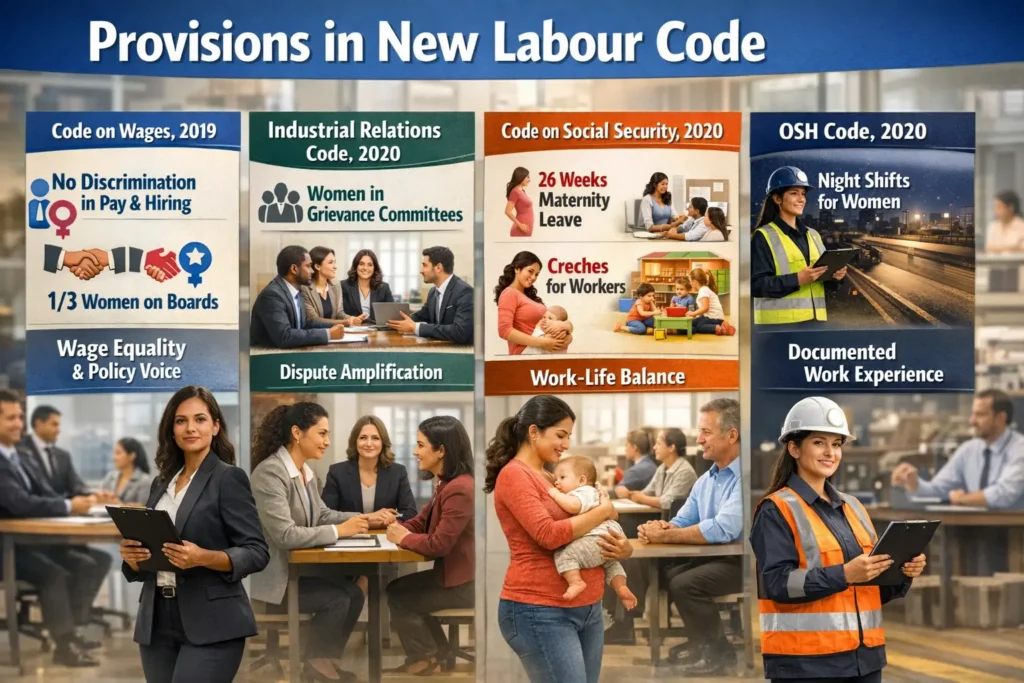
3. Provisions in new labour code
Table no. 01: Gender Provisions with respective codes
4. Positive Impacts
- Women labour participation: India’s 2025 Labour Codes have shown promising early impacts on women’s workforce participation (FLFPR), rising from 32.8% (PLFS 2024- 25) to projected 33.7-35% by mid-2026 per Economic Survey estimates, driven by targeted reforms [7].
- Night Shift Access Boosts Urban Uptake: OSH Code Sections 43 and 56 enables women in night roles (BPO/textiles) with safety protocols. Ex. Gujarat pilots report 15% female hiring surge in manufacturing, adding around 2 million jobs (NASSCOM 2026) [8].
iii. Creche Mandates Aid Retention: Social Security Code section 44 requires facilities in 50 plus worker units (₹2,000 crore Budget allocation); Tamil Nadu SEZs show 12% maternity return rate vs. pre-code 7%, stabilizing post-childbearing LFPR [9].
- Gig Economy Formalization: Section 110 extends maternity and welfare to platform workers. Ex. Urban women in ride-hailing or delivery (Zomato) gain e-Shram benefits, lifting informal FLFPR by 5% [10].
- Equal Pay Enforcement: Wage Code Section 3 parity with audits narrow 20-34% gap. Ex. States like UP report more women in skilled roles via transparent hiring (1/3 board women, Section 9) [11].
- Hazardous Sector Entry: OSH liberalization unlocks mining/construction; early data shows female inclusion in Rajasthan quarries, enhancing overall FLFPR amid formalization. These gains around 2-3% FLFPR increment Q1 2026 align with govt targets (50% by 2030), though sustained via enforcement [12].
5. Challenges and gaps
5.1.Limitation persists
- Weak penalties: The penaties are often too small to strongly discourage companies from ignoring safety rules like under the Occupational Safety, Health and Working Conditions (OSH) Code range from about 2-5 lakh rupees for serious safety violations. This becomes more concerning in risky sectors like mining, where many workers are migrant labourers and women from SC-ST communities. The law may fail to properly protect these vulnerable workers from hazardous working conditions.
- Informal exclusion: It refers to a situation where certain groups are left out of legal protections even though the law does not explicitly say so. In recent labour codes, the focus is mainly on formal employers and employees. As a result, self-employed women running micro-enterprises in the informal sector are often not properly recognized. This leads to limited access to legal protection, social security benefits, and financial support for these women.
- Flexibity over rights: Labour laws are giving more importance to employer flexibility rather than job security for workers. Fixed-term employment allows companies to hire workers for a limited period without making them permanent employees. This reduces the chances of workers getting long-term job stability along with benefits linked to permanent jobs. As a result, workers may face uncertainty in employment and weaker protection of their labour rights.
- Data gaps: there is not enough proper information about how laws affect women workers. There is no gender-sensitive audits to check whether workplace policies are fair and safe for women. Also, clearly mandates for regular monitoring or reporting of gender-based issues in many sectors are not mentioned. Due to this lack of data and legal direction, problems faced by women workers often remain unnoticed and unaddressed.
5.2. International benchmark
- International Labour Organization (ILO) C100: This is for equal remuneration, but informal economic dominance, weak enforcement infrastructure, economic pressures (care economy) are the obstacles to fulfill this convention.
- ILO C138: This is for minimum age for work but due to economic necessity, this convention is not fulfilled.
- ILO C176: This is for safety and health in mines but due to low ratification and prioritizing foreign direct investment (FDI) or mineral export over safety hampers the objectives of this convention.
6. Recommendation
- Mandatory gender audits: Mandatory gender audits are required in establishments with more than 50 workers to review wages, safety, and working conditions every year. This would help identify gender inequality at the workplace and ensure better protection and fair treatment for women workers.
- Escalate Informal Coverage: Creches and maternity support should be expanded to micro-units with at least 5 workers through subsidies under the e-Shram system. It should also create a national informal workers’ fund (₹50,000 crore) to replace the earlier Building and Other Construction Workers (Regulation Employment and Conditions of Service) Act (BOCW Act), 1996 and beedi welfare funds and provide financial protection to informal workers.
- Robust Enforcement: by increasing the labour inspectorate to a 1:500 inspector establishment ratio with mandatory gender-sensitivity training, and deploy AI-enabled digital compliance portals for real-time monitoring and reporting of labour law violations may help to build belief on new labour codes. Additionally, uniform model rules under article 254(2) of the Constitution of India should be adopted to minimize regulatory fragmentation and prevent state-level arbitrage in the implementation of labour codes.
- Strengthen Penalties: Enhance deterrence by increasing fines to 5% of payroll with a minimum of ₹10 lakh for repeat violation, and mandate temporary or permanent closures for workplaces with occupational safety and health (OSH) fatalities. Penalty structures should be aligned with ILO standards, exceeding current ₹2 lakh caps, to ensure meaningful compliance
- Judicial Directives: Public Interest Litigations (PILs) should be registered properly to enhance the meaning of articles 21 and 39(d) purposively, ensuring “safe work” environments and equitable job evaluations. The Sexual Harassment of Women at Workplace (Prevention, Prohibition and Redressal) Act (PoSH Act), 2013 and labour compliance frameworks within Gender Sensitisation and Internal Complaints Committee (GSICC) (Regulation 4 of the Gender Sensitisation and Sexual Harassment of Women at the Supreme Court of India (Prevention, Prohibition and Redressal), Regulations, 2013) should be promoted for coordinated enforcement of workplace gender protections.
7. Conclusion
The consolidation of India’s labour laws into four labour codes marks an important step toward promoting gender inclusivity in the workforce. The new codes introduce progressive provisions such as equal pay, maternity benefits, creche facilities, and the removal of restrictions on women working at night. These reforms have the potential to increase women’s labour force participation and economic independence. However, several challenges remain, including weak enforcement, limited coverage of informal workers, and inadequate gender-specific monitoring. Therefore, stronger implementation, better data collection, and stricter penalties are necessary to ensure that the labour codes truly advance gender equality and create safe, inclusive workplaces for women in India.
References
Statues and Legislations
Constitution of India, 1950
Code on Wages, 2019
Industrial Relations Code, 2020
Code on Social Security, 2020
Occupational Safety, Health and Working Conditions Code, 2020
Factories Act, 1948
Maternity Benefit Act, 1961
Equal Remuneration Act, 1976
The Mines Act, 1952
Plantation Labour Act, 1951
Contract Labour (Regulation) Act, 1970
Building and Other Construction Workers (Regulation Employment and Conditions of Service) Act, 1996
Sexual Harassment of Women at Workplace (Prevention, Prohibition and Redressal) Act, 2013 Bibliography
[1] United Nations, Sustainable Development Goals https://sdgs.un.org/goals
[2] Ministry of Statistics and Programme Implementation (Government of India), Time Use in India 2019 https://mospi.gov.in
[3] Ministry of Statistics and Programme Implementation (Government of India), Periodic Labour Force Survey (PLFS) Annual Report 2019–20 https://mospi.gov.in
[4] Ministry of Labour and Employment (Government of India), Significant Increase in Women Participation in Workforce (Press Information Bureau, 28 November 2024) https://labour.gov.in/sites/default/files/pib2078530.pdf
[5] National Crime Records Bureau, Crime in India 2022 (Ministry of Home Affairs, Government of India, 2023) https://ncrb.gov.in/en/crime-india-2022
[6] Georgetown Institute for Women, Peace and Security, Women, Peace and Security Index 2023/24 https://giwps.georgetown.edu/the-index/
[7] Government of India, Ministry of Finance, Economic Survey 2025–26 https://www.indiabudget.gov.in/economicsurvey/
[8] Gujarat govt amends Factories Act to allow women in night shifts, increase working hours Desh Gujarat (3 July 2025) https://deshgujarat.com/2025/07/03/gujarat-govt-amends factories-act-to-allow-women-in-night-shifts-increase-working-hours/
[9] Dennis Jesudasan, ‘Creche may be made compulsory in all establishments with 50 or more staff’ The Hindu (26 June 2020) https://www.thehindu.com/news/national/tamil-nadu/creche may-be-made-compulsory-in-all-establishments-with-50-or-more-staff/article31926906.ece
[10] ‘Ride-hailing to boost female workforce’ Times of India (15 December 2023) https://timesofindia.indiatimes.com/business/india-business/ride-hailing-to-boost-female workforce/articleshow/106001829.cms
[11] UP distributes appointment letters to 2,438 recruits through transparent process, IndiaTimes (27 August 2025) https://indiatimes.com/trending/up-distributes-appointment letters-to-2438-recruits-through-transparent-process-668067.html
[12] India aims to lift female labour force participation to 55% by 2030, Economic Times (7 November 2025) https://economictimes.indiatimes.com/news/economy/indicators/india aims-to-lift-female-labour-force-participation-to-55-by-2030/articleshow/125142511.cms
Case Laws
Geeta Sharma v. Union of India, Rajasthan High Court, 2017
Air India v. Nergesh Meerza, Supreme Court of India, 1981
Mackinnon Mackenzie & Co. v. Audrey D’Costa, Supreme Court of India,1987 Vasantha R. v. Union of India, Madras High Court, 2001
Municipal Corporation of Delhi v. Female Workers (MCD), Supreme Court of India, 2000 Anuj Garg v. Hotel Association of India, Supreme Court of India, 2008
International Conventions
International Labour Convention and Guidelines