
The POSH Act: Legal Framework for Prevention of Sexual Harassment at Workplace in India
- Author (s) Rajni Verma

Table of Contents
ABSTRACT
Sexual harassment at the workplace is a major social and legal issue that affects the dignity, safety, and equality of women employees. Such conduct not only creates a hostile work environment but also affects productivity and professional growth. To address this issue, the Government of India enacted the Sexual Harassment of Women at Workplace (Prevention, Prohibition and Redressal) Act, 2013 (1). The Act provides a comprehensive legal framework to prevent sexual harassment and ensure effective grievance redressal mechanisms in workplaces. This article examines the objectives, scope, and key provisions of the Act. It also discusses the composition and role of the Internal Complaints Committee, complaint procedures, annual reporting requirements, penalties for non-compliance, misconduct, and misuse. In addition, the article analyses significant judicial decisions, including Vishaka v. State of Rajasthan (2) and Apparel Export Promotion Council v. A.K. Chopra . (3) Three case studies are also presented to demonstrate how the law operates in practical workplace situations. The article concludes by emphasising the importance of awareness, compliance, and organisational commitment to ensure safe and respectful workplaces for women.
INTRODUCTION
The workplace plays a vital role in shaping professional development and social interaction. Employees must feel safe and respected in order to perform their duties effectively. However, sexual harassment persists as a serious problem in workplaces.
Sexual harassment includes any unwelcome behaviour of a sexual nature that creates a hostile or intimidating environment. Such behaviour not only violates the dignity of women employees but also discourages them from participating fully in professional activities.
The development of workplace harassment laws in India began with judicial intervention. The landmark decision in Vishaka v. State of Rajasthan established guidelines for preventing sexual harassment in workplaces. These guidelines required employers to establish mechanisms for addressing complaints and protecting employees.
Based on these guidelines, the Indian Parliament enacted the Sexual Harassment of Women at Workplace (Prevention, Prohibition and Redressal) Act, 2013. The Act aims to ensure that women employees can work in environments free from harassment and discrimination.
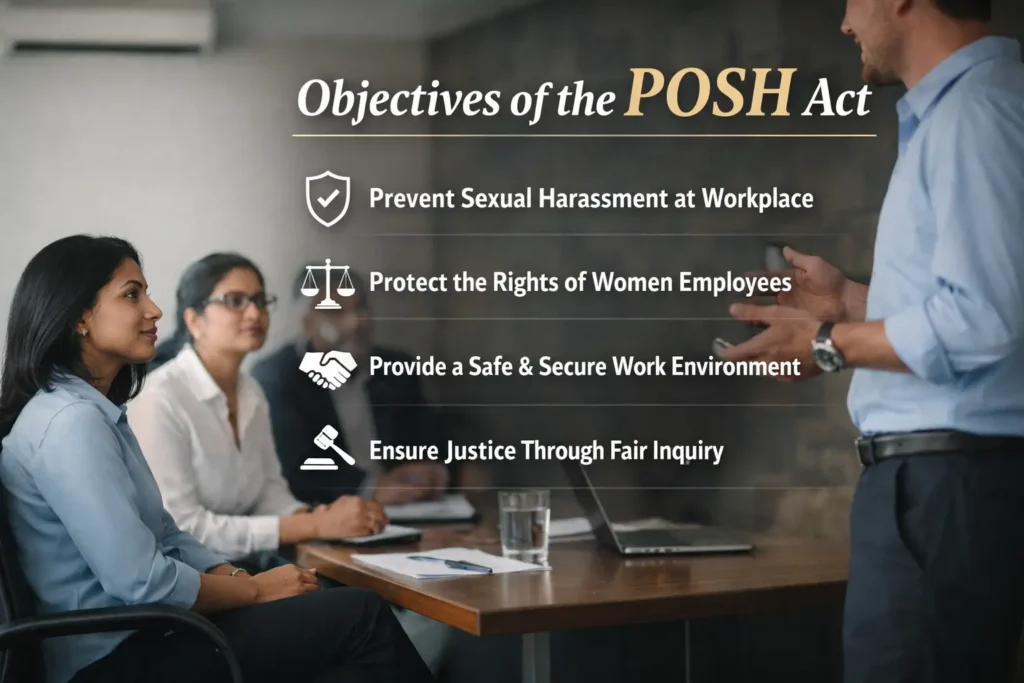
OBJECTIVES OF THE POSH ACT
The POSH Act has several important objectives.
The primary objective is to protect women employees from sexual harassment in workplaces and ensure their dignity and equality. The law recognises that harassment can affect the mental and professional well-being of employees.
Another objective is to establish a formal complaint redressal mechanism within organisations. Through Internal Complaints Committees, employees can report incidents of harassment and receive timely justice.
The Act also aims to promote awareness regarding workplace behaviour and gender sensitivity. Employers are required to conduct regular training sessions and awareness programs for employees.
Finally, the law ensures accountability among employers by imposing penalties for non-compliance.
DEFINITION OF SEXUAL HARASSMENT
The POSH Act defines sexual harassment broadly to include any unwelcome act or behaviour of a sexual nature.
According to the Act, sexual harassment includes physical contact and advances, requests for sexual Favors, sexually coloured remarks, showing pornography, or any other unwelcome physical, verbal, or non-verbal conduct of a sexual nature. (4)
The law also recognises that harassment may occur during work-related travel, training programs, conferences, or social events related to employment.
Internal Complaints Committee (ICC)
One of the most important provisions of the POSH Act is the requirement for organisations to establish an Internal Complaints Committee.
Every workplace with ten or more employees must constitute an ICC. The committee is responsible for receiving complaints of sexual harassment and conducting inquiries.
Composition of the ICC
The Internal Complaints Committee must include the following members:
- Presiding Officer – A senior woman employee in the
- Two employee members – Employees committed to women’s causes or familiar with social work or legal issues.
- External member – A person from an NGO or association committed to women’s rights or with experience in legal matters.
At least 50% of the committee members must be women. Functions of the ICC
The ICC performs several important functions:
- Receiving complaints of sexual harassment
- Conducting inquiries into complaints
- Recommending disciplinary actions
- Maintaining confidentiality during investigations
- Preparing annual reports regarding complaints received
- The presence of an external member ensures impartiality and fairness in the investigation process.
Complaint Procedure under the POSH Act
The POSH Act provides a structured procedure for filing and investigating complaints.
A woman who experiences harassment may file a written complaint with the ICC within three months of the incident happening. The committee may extend this period if justified.
After receiving the complaint, the committee may attempt conciliation if requested by the complainant. However, monetary settlement cannot be the basis for conciliation.
If conciliation is not pursued, the ICC conducts a formal inquiry similar to disciplinary proceedings. Both the complainant and the respondent are given an opportunity to present evidence.
The inquiry must generally be completed within 90 days. After the inquiry, the committee submits a report to the employer recommending appropriate action.
Annual Report Submission
The POSH Act requires the Internal Complaints Committee to prepare an annual report. The report must include:
- Number of complaints received during the year
- Number of complaints disposed of
- Number of cases pending for more than 90 days
- Nature of action taken by the employer
- Awareness programs conducted during the year
This report is submitted to the employer and the District Officer appointed under the Act.
Annual reporting ensures transparency and accountability in the implementation of workplace harassment policies.
Penalties for Non-Compliance
The POSH Act imposes penalties on organisations that fail to comply with its provisions.
If an employer fails to constitute an Internal Complaints Committee or violates the provisions of the Act, a fine of up to ₹50,000 may be imposed.
If the organisation repeatedly violates the law, the penalties may increase, and authorities may cancel the organisation’s business license or withdraw government approvals.
These penalties emphasise the importance of compliance and encourage organisations to adopt proper workplace harassment policies.
Misconduct and Penalties for Misuse of the POSH Act
While the POSH Act was enacted to protect women employees from sexual harassment, it also recognises the possibility of misuse of the complaint mechanism. Therefore, the law includes provisions to address false or malicious complaints, ensuring fairness and protecting the rights of both parties involved in the investigation.
According to the Sexual Harassment of Women at Workplace (Prevention, Prohibition and Redressal) Act, 2013, if the Internal Complaints Committee finds that a complaint has been made with malicious intent or that false evidence has been submitted during the inquiry, it may recommend appropriate disciplinary action against the complainant.
However, the law also clearly states that mere inability to prove a complaint does not mean that the complaint is false or malicious. This provision ensures that genuine victims are not discouraged from reporting harassment due to fear of punishment.
Situations Considered Misuse of the POSH Act
Misuse of the POSH Act may occur in the following situations:
- Filing a complaint with the intent to harm the reputation of another
- Submitting false information or fabricated evidence during the inquiry
- Making a complaint for personal revenge or professional rivalry.
- Attempting to blackmail or threaten an employee using a false harassment allegation.
When such misconduct is proven, the Internal Complaints Committee may recommend disciplinary measures similar to those applicable for employee misconduct under organisational policies.
Penalties for False or Malicious Complaints
If the Internal Complaints Committee determines that a complaint was made with malicious intent, it may recommend disciplinary action against the complainant. The type of penalty generally depends on the organisation’s service rules or employment policies.
Possible disciplinary actions may include:
- Written warning or reprimand
- Deduction of salary or benefits
- Suspension from employment
- Termination of employment
- Mandatory counselling or training programs
These penalties are intended to discourage misuse of the law while ensuring that the complaint process remains fair and unbiased.
Importance of Safeguards Against Misuse
The inclusion of provisions related to false complaints reflects the principle of natural justice, which requires fairness to both the complainant and the respondent. While the law strongly supports victims of harassment, it also ensures that employees are protected from wrongful accusations.
The Internal Complaints Committee plays a crucial role in maintaining this balance. During the inquiry process, the committee must carefully evaluate evidence, witness statements, and documentation before reaching a conclusion.
By addressing both genuine complaints and potential misuse, the POSH Act aims to maintain credibility in the complaint mechanism and promote trust within organisations.
Case Studies
Case Study 1: Vishaka Case
The landmark case of Vishaka v. State of Rajasthan involved the gang rape of a social worker while performing her duties. Women’s rights groups filed a public interest litigation seeking protection against workplace harassment.
The Supreme Court recognised sexual harassment as a violation of fundamental rights under Articles 14, 15, and 21 of the Constitution. The Court issued the Vishaka Guidelines requiring employers to establish complaint mechanisms.
These guidelines became the foundation for the POSH Act.
Case Study 2: Apparel Export Promotion Council Case
In Apparel Export Promotion Council v. A.K. Chopra, a senior officer attempted to sexually harass a female employee.
The employer conducted an internal inquiry and dismissed the officer from service. The accused challenged the decision in court.
The Supreme Court upheld the employer’s decision and stated that sexual harassment violates the dignity of women employees and must be strictly punished.
Case Study 3: Corporate Workplace Complaint
In a corporate IT company, a female employee reported repeated inappropriate messages and personal advances from her team leader.
The employee filed a complaint with the Internal Complaints Committee. The committee conducted an investigation by examining messages, emails, and witness statements.
After the inquiry, the committee concluded that the supervisor had engaged in misconduct and recommended disciplinary action. The organisation suspended the supervisor and issued strict workplace guidelines.
This case demonstrates how organisations can effectively implement the POSH Act to protect employees.
Challenges in Implementation
Despite the comprehensive provisions of the POSH Act, several challenges remain.
Many employees are unaware of their rights and the complaint procedures under the law. Lack of awareness discourages victims from reporting harassment.
Another challenge is the social stigma associated with filing complaints. Victims may fear retaliation or damage to their professional reputation.
In addition, some organisations fail to conduct regular training programs for Internal Complaints Committee members.
To overcome these challenges, organisations must conduct regular awareness programs and ensure strict compliance with the law.
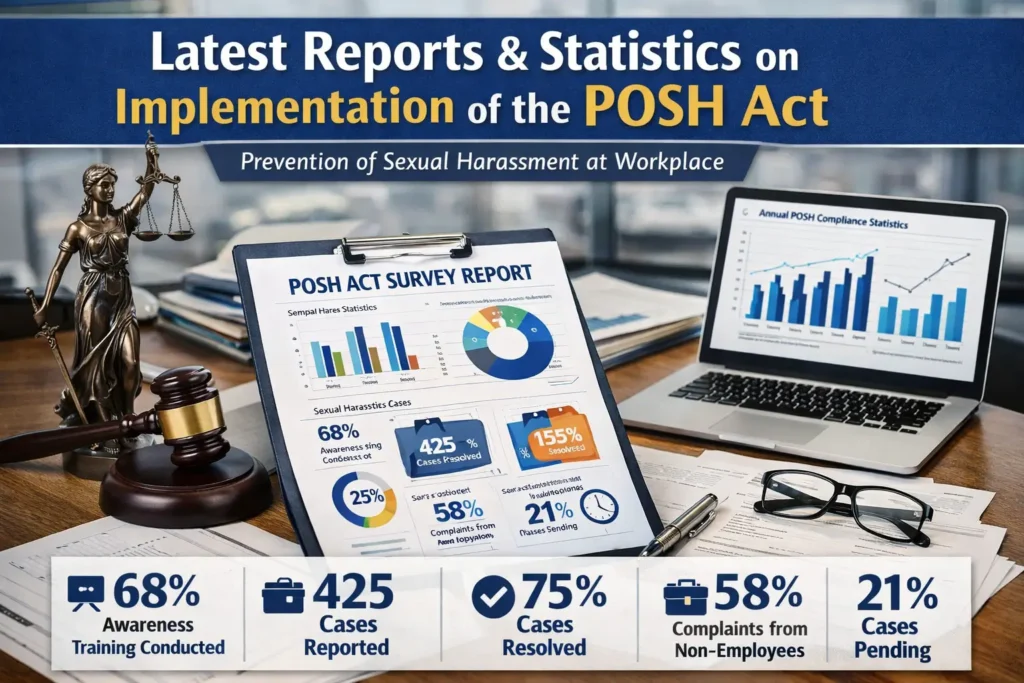
Latest Reports and Statistics on Implementation of the POSH Act.
Recent reports and government data indicate that awareness and reporting of workplace sexual harassment in India have increased since the implementation of the Sexual Harassment of Women at Workplace (Prevention, Prohibition and Redressal) Act, 2013. Several government agencies and corporate disclosures now provide statistical insights into the functioning of the Act.
According to data presented in the Indian Parliament, 254 complaints of workplace sexual harassment were filed through the government’s SHe-Box portal in 2025. The SHe-Box platform was relaunched in 2024 to strengthen the monitoring of complaints and ensure faster resolution mechanisms for employees in both public and private sectors. (Times of India ) Corporate reporting under POSH compliance has also increased significantly. An analysis of major Indian companies shows that sexual harassment complaints reported in listed companies increased to about 2,777 cases in FY2024, compared with 2,026 cases in FY2023 and 1,313
cases in FY2022. The increase reflects both growing awareness among employees and improved reporting mechanisms within organisations. ( Forbes India)
Similarly, reports from large Indian corporations indicate that complaints of workplace sexual harassment in major companies increased by nearly 79% over the last five years. Experts believe that this rise may not necessarily indicate more incidents but rather greater willingness among employees to report misconduct due to improved grievance redressal systems under the POSH framework. (ETHRWorld)
In addition, regulatory changes have strengthened transparency requirements. The Ministry of Corporate Affairs now requires companies to disclose the number of sexual harassment complaints received and resolved each year in their corporate board reports. This measure ensures accountability and encourages organisations to strictly follow POSH compliance procedures.
Reports by the National Commission for Women also highlight the importance of awareness programs and training initiatives. Thousands of participants across government and private organisations have received POSH awareness training aimed at preventing harassment and strengthening internal complaint mechanisms.
Overall, these reports demonstrate that the implementation of the POSH Act has led to increased reporting, stronger corporate accountability, and greater awareness regarding workplace harassment. However, experts also emphasise the need for continuous training, effective Internal Complaints Committees, and strict enforcement to ensure safer workplaces for women across India.
Conclusion
Sexual Harassment of Women at Workplace (Prevention, Prohibition and Redressal) Act, 2013 represents an important step toward ensuring safe and respectful workplaces for women in India.
The Act provides a comprehensive legal framework that includes preventive measures, complaint procedures, penalties, and monitoring mechanisms.
However, the success of the law depends on effective implementation by employers and awareness among employees. Organisations must promote a culture of respect, equality, and professionalism to ensure that women employees can work without fear of harassment.
Through proper compliance and continuous awareness efforts, workplaces can become safer and more inclusive environments.
Author Bio.
I, Rajni Verma, am a human resources professional with more than five years of experience in HR functions, including employee engagement, compliance, and workplace policies. I have a keen interest in labour law, workplace ethics, and organisational behaviour. My research interests focus on legal and policy frameworks that promote employee welfare and safe work environments. This article reflects my interest in understanding the implementation of the Sexual Harassment of Women at Workplace (Prevention, Prohibition and Redressal) Act, 2013 and its role in ensuring gender equality at the workplace.
References
Ed. HRUTVIK THAKOR. 15 June 2021. <https://lawfoyer.in/vishaka-ors-vs-state/>.
A.K. Chopra Vs Apparel Export Promotion Council and Others. 20 Jan 1997.
<https://www.courtkutchehry.com/judgements/386348/ak-chopra-vs-apparel-export-promotion-council-and-others/>.
https://cdnbbsr.s3waas.gov.in/. n.d.
<https://cdnbbsr.s3waas.gov.in/s3296472c9542ad4d4788d543508116cbc/uploads/202 5/12/2025120245.pdf>.
Sexual Harassment of Women at Workplace (Prohibition, Prevention and Redressal) Act. Ed. Avon Centre work product. 9 Dec 2013. 14 Mar 2026.
<https://www.law.cornell.edu/gender-
justice/resource/sexual_harassment_of_women_at_workplace_%28prohibition_preve ntion_and_redressal%29_act?>.


Questions of medical negligence have acquired increasing importance in India as healthcare has moved into a more rights-conscious and legally supervised environment.… Continue reading

Waste generation has emerged as one of the most serious environmental challenges facing India today. Population growth, rapid urbanization, and increasing consumption patterns have… Continue reading

Environmental protection has become a global priority as industrialization and urban development continue to expand rapidly. Industries contribute significantly to economic growth… Continue reading