Skip to content
CERTIFICATE COURSE0
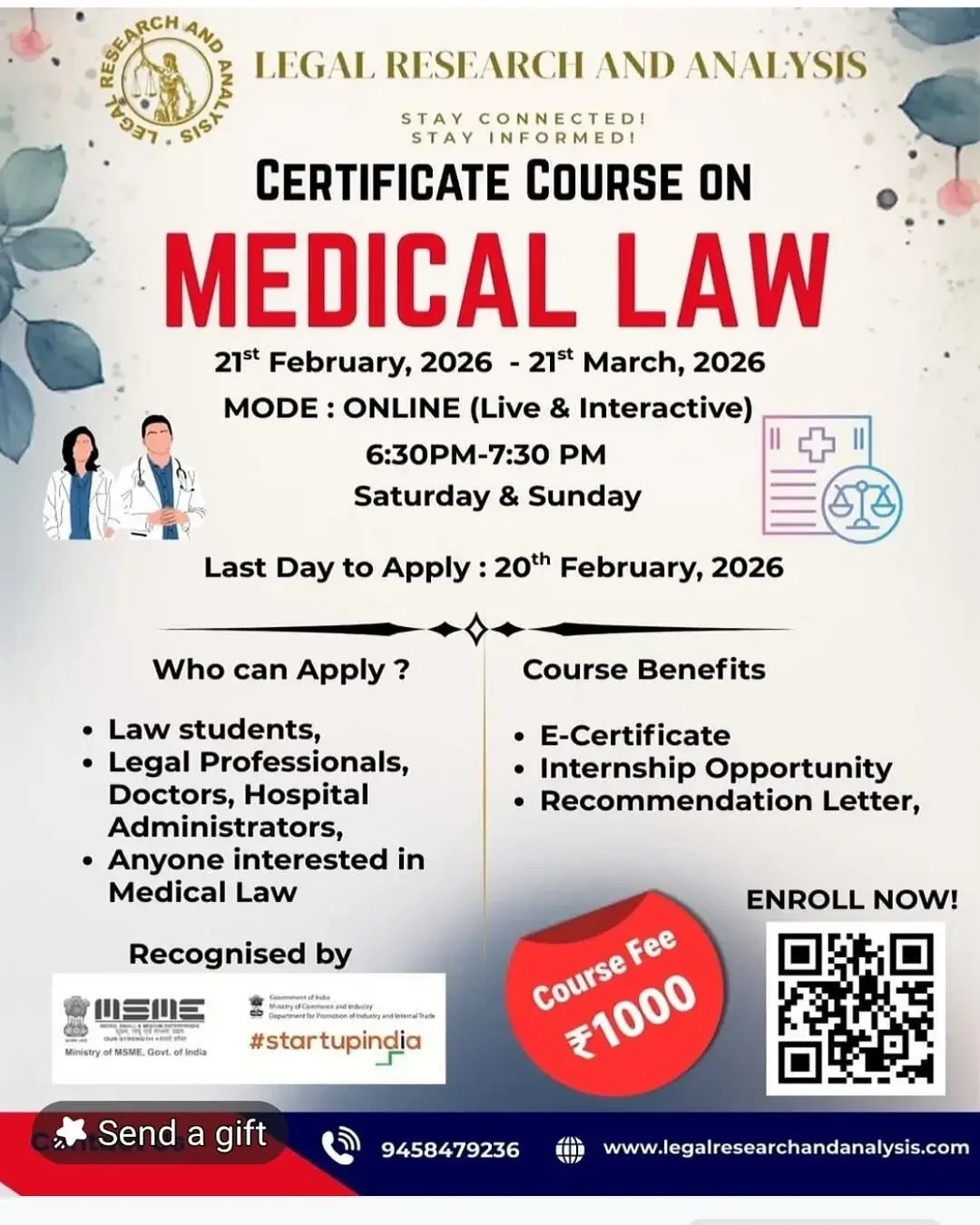
Certificate Course on Medical Law Offered by Legal Research & Analysis

Certificate Course on Medical Law

4.8 (461 Rating)

₹1000

Schedule

Important Dates

The Certificate Course on Medical Law is a specialized 4-week online program designed to provide a comprehensive understanding of the legal, ethical, and regulatory dimensions of medical practice and healthcare delivery in India. With the rising intersection between law and medicine—ranging from patient rights, medical negligence, bioethics, and health data privacy to landmark developments in reproductive rights and mental health legislation—this course seeks to empower participants with the knowledge and tools required to navigate the medico-legal landscape effectively.

Structured across 8 interactive sessions held over weekends, the course offers a multidisciplinary approach, blending statutory analysis, case law discussions, and practical insights from both legal and medical experts. It caters to law students, practicing advocates, medical professionals, hospital administrators, public policy researchers, and anyone interested in understanding the rapidly evolving field of health law in India.

Through a well-curated curriculum, real-life case studies, and policy perspectives, the course aims to bridge the gap between healthcare delivery and legal accountability, fostering a rights-based, ethical, and legally compliant medical environment.

Comprehensive 4-Week Program: 8 live interactive sessions conducted on weekends (Saturday & Sunday) for flexible yet intensive learning. 

Interdisciplinary Curriculum: Covers the legal, ethical, and regulatory dimensions of healthcare, including patient rights, medical negligence, and bioethics.

Case Law-Based Learning: In-depth analysis of landmark Supreme Court judgments such as Jacob Mathew, Samira Kohli, and Common Cause.

Expert Faculty & Guest Lectures: Sessions delivered by leading legal scholars, medical practitioners, and healthcare law professionals.

Contemporary Focus: Includes emerging issues like telemedicine, health data privacy, mental health law, and COVID-19 legal challenges.

Assessment & Certification: Certificate awarded upon successful completion of a quiz/reflection paper and meeting minimum attendance requirements.

Access to Study Materials: Participants receive curated resources such as reading materials, judgment summaries, and case briefs in PDF format.

Networking & Career Opportunities: Highly valuable for students, lawyers, doctors, hospital administrators, and public health researchers.

This course is open to everyone with an interest in medical law. There are no prerequisites regarding age, gender, or background. Law students, legal professionals, medical professionals, and healthcare enthusiasts are all encouraged to enroll.

Eligibility
  • Open to all individuals interested in the medico-legal field

  • No prior legal or medical knowledge required

Aim of the Course
  • To Introduce the Fundamentals of Medical Law:
    To provide participants with a foundational understanding of medical law, including its historical evolution, scope, and relevance in the Indian and global legal context.

  • To Enhance Understanding of Patients’ Rights and Doctors’ Duties:
    To critically examine legal principles governing consent, confidentiality, medical negligence, and the rights of patients, with reference to leading judgments and ethical norms.

  • To Bridge Law and Medicine through Interdisciplinary Learning:
    To promote interdisciplinary dialogue between legal practitioners, healthcare professionals, and academics for better medico-legal understanding and cooperation.


Course Format

  • Live Sessions: Interactive webinars conducted by expert faculty.
  • Recorded Lectures: Available anytime for flexible and self-paced learning.
  • Case Studies: Real-world medico-legal scenarios for practical understanding.
  • Assessments: Quizzes and assignments designed to reinforce key concepts.
  • Certificate: Awarded upon successful completion of the course.


Join us in exploring the intricacies of medical law. Whether you are advancing your career or expanding your legal knowledge, this course empowers you to thrive in the evolving medical and healthcare landscape.

Course Curriculum

Week 1: Introduction & Foundational Concepts
Session 1: Orientation Session
Session 2: Introduction to Medical Law and Ethics
  • Definition, scope, and evolution of medical law in India

  • Intersection of law, medicine, and ethics

  • Importance of informed consent and patient autonomy

  • Key global and Indian instruments (e.g., Hippocratic Oath, NMC Code)

Session 3: Legal Framework Regulating Medical Practice in India
  • National Medical Commission Act, 2019

  • Clinical Establishments Act, 2010

  • Professional Conduct Regulations

  • Legal liability of doctors and hospitals

Session 4: Consent in Medical Practice and Right to Refuse Treatment
  • Types of consent: implied, express, informed

  • Legal standards for valid consent

  • Case law: Samira Kohli v. Dr. Prabha Manchanda

  • Living wills and advance directives (passive euthanasia)

Session 5: Medical Negligence and Liability
  • Civil vs. criminal negligence

  • Standard of care and Bolam Test

  • Key judgments: Jacob Mathew v. State of Punjab, V.P. Shantha Case

  • Role of Consumer Protection Act in medical malpractice

Week 3: Specialized Areas of Medical Law
Session 6: Laws Relating to Reproductive Health and Surrogacy
  • Medical Termination of Pregnancy Act (as amended)

  • Surrogacy (Regulation) Act, 2021

  • ART Regulation Act, 2021

  • Ethical dilemmas in fertility treatments

Session 7: Organ Transplantation, Bioethics, and End-of-Life Issues
  • Transplantation of Human Organs and Tissues Act, 1994

  • Legal and ethical issues in organ donation

  • DNR and Right to Die

  • Passive euthanasia: Common Cause v. Union of India

Week 4: Contemporary Issues & Compliance
Session 8: Mental Healthcare, Disability Rights & Public Health Law
  • Mental Healthcare Act, 2017 – rights-based approach

  • Rights of Persons with Disabilities Act, 2016

  • Public health obligations under Epidemic Diseases Act & Disaster Management Act

  • Lessons from COVID-19: quarantine, vaccination, lockdowns

Session 9: Emerging Trends in Medical Law and Regulatory Compliance
  • Telemedicine Guidelines & Health Data Privacy (NDHM)

  • Clinical trials and drug regulation (Drugs & Cosmetics Act, 1940)

  • Medical waste, licensing, insurance

  • International human rights perspectives and bioethics

Session 10: Concluding Session

Who Should Apply?

This course is designed for law students, practicing advocates, medical professionals, hospital administrators, public policy researchers, and anyone interested in the intersection of healthcare and law. It is suitable for both beginners seeking foundational knowledge and professionals aiming to enhance their expertise in medico-legal issues and healthcare regulations.

Mentors

Dr Dhananjay Mankar

Assistant Professor Mumbai Campus, Centre for Hospital Management, School of Health Systems Studies, TISS Mumbai.

Somabha Bandopadhay

Assistant Professor, School of Law, Forensic Justice and Policy Studies, NFSU Delhi.

Ajay Tambulkar

Assistant Professor, Army Law College, Pune.

SM Margina Sultana

Research Scholar, Aligarh Muslim University, Aligarh.

JHA PRANAV KUMAR

Mr. Pranav Jha

Mr. Pranav Jha was serving as a Junior Research Consultant at the National Human Rights Commission. He has completed his LL.M (Access to Justice) from Tata Institute of Social Sciences, Mumbai.
He has graduated in Law- {B.A.LL.B (Hons.)} with distinction from Aligarh Muslim University, Murshidabad Centre (W.B). He has been very dedicated to his academic excellence. He was a student representative at CDFC, TISS.

Perks

Contact Us