
Medical Negligence in Pediatric Practice in India: A Legal Appraisal of Duty, Liability, and Risk Prevention
- Author (s) Dr. Venugopal Reddy Iragamreddy
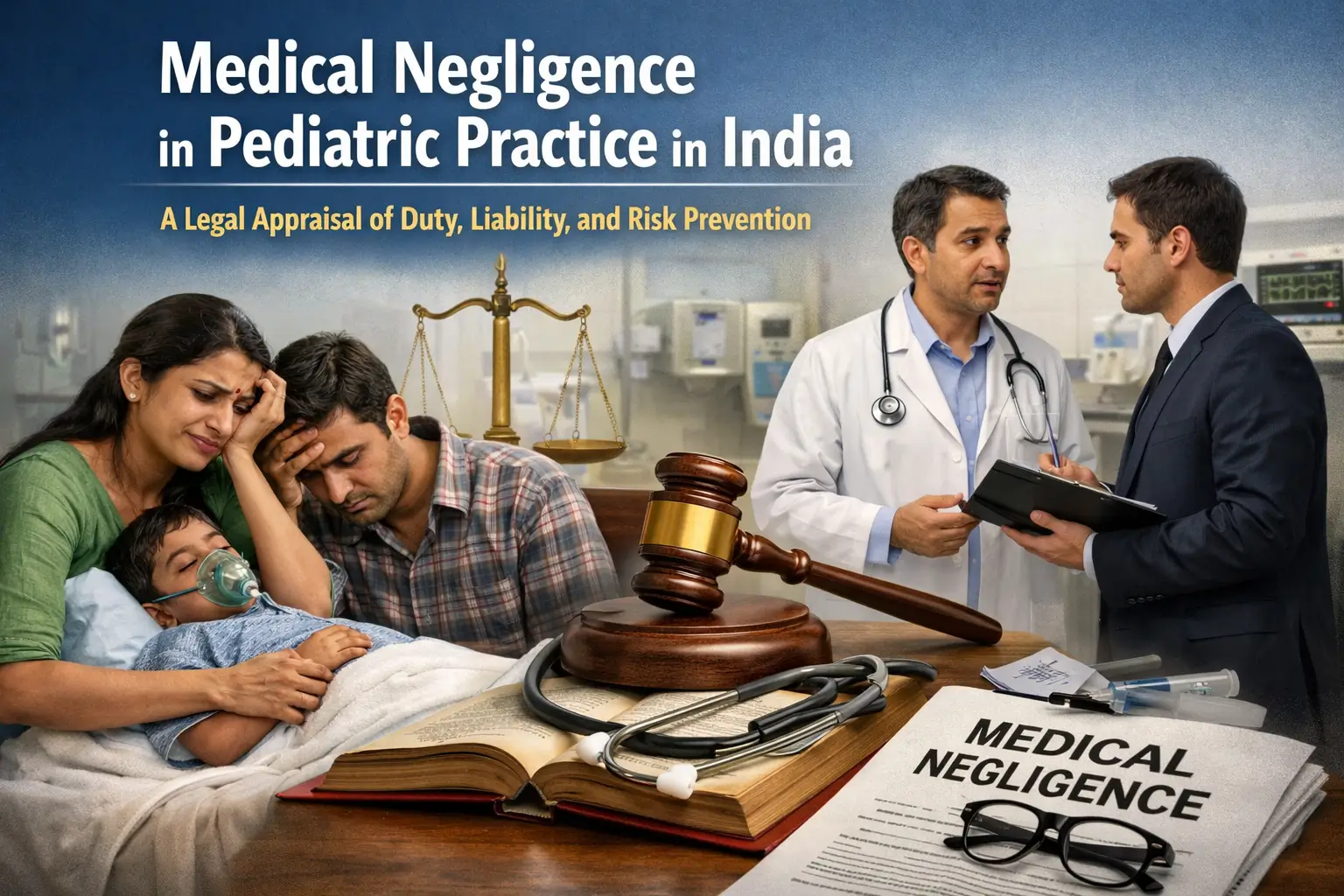
Table of Contents
ABSTRACT
Questions of medical negligence have acquired increasing importance in India as healthcare has moved into a more rights-conscious and legally supervised environment. Within this broader field, pediatric practice deserves special attention because treatment decisions concern persons who are legally incapable of exercising independent autonomy. The child, the parent, the treating doctor, and the hospital together form a particularly sensitive medico-legal setting in which errors of judgment, communication lapses, system failures, and documentation gaps can quickly become subjects of dispute. Pediatricians also work in a clinical space where symptoms may be subtle, deterioration may be sudden, and therapeutic decisions often depend on age-specific and weight-based calculations.
This paper studies medical negligence in pediatric practice from an Indian legal perspective. It first explains the basic ingredients of negligence, including duty, breach, causal connection, and injury. It then examines the legal framework through which such claims are assessed in India, especially consumer law, criminal law, judicial precedent, and professional regulation. The paper further identifies common medico-legal risk areas in pediatrics, including delayed diagnosis, medication mistakes, neonatal management, consent-related concerns, referral delays, and communication failures.
Two Indian decisions are used to illustrate how courts have approached medical negligence: Spring Meadows Hospital v. Harjol Ahluwalia, which demonstrates institutional and staff liability in a child-care context, and Jacob Mathew v. State of Punjab, which clarifies the high threshold required for criminal prosecution of doctors. The paper argues that the best protection against medico-legal liability lies not in defensive medicine but in careful practice, reasoned documentation, honest disclosure, protocol-based care, and institutional preparedness.
INTRODUCTION
Modern medical practice is no longer judged solely by professional ethics or clinical outcome. It is also examined in light of legal standards, patient rights, and institutional accountability. In India, this shift has become increasingly visible over the last few decades. Families are better informed, access to legal remedies has expanded, and the medical profession is more frequently called upon to justify how decisions were made, whether accepted standards were followed, and whether avoidable harm occurred. This development is particularly important in pediatrics.
Pediatric medicine differs from many other specialties because the patient is a child. The child may be unable to narrate symptoms clearly, comprehend the illness, or legally authorize treatment. For that reason, the pediatrician does not interact only with disease; the pediatrician also works within a relational setting shaped by parents, caregivers, and the hospital system. Legal conflict often arises not merely from a poor outcome but from the way the child was assessed, how the family was informed, whether the record reflects clinical reasoning, and whether timely intervention or referral took place.
The law does not treat every unfavorable medical result as negligence. Courts have repeatedly recognized that medicine involves uncertainty. A competent doctor may still lose a patient. A correct diagnosis may emerge late despite reasonable efforts. An accepted line of treatment may fail. Yet, once treatment is undertaken, the law expects a doctor to exercise reasonable care, ordinary professional competence, and sound judgment. Where that expectation is not met and harm follows, liability may arise.
Pediatric practice intensifies this concern because many serious childhood conditions begin deceptively. A septic child may appear only mildly febrile in the early stage. A neonate may show little more than poor feeding or lethargy. A drug dose error that might be tolerated in an adult can be disastrous in a small child. A delay of a few hours may significantly alter outcome. These clinical realities explain why pediatricians require not only technical competence but also legal awareness.
This paper explores negligence in pediatric practice through an Indian medico-legal lens. It sets out the legal meaning of negligence, discusses the Indian framework that governs such claims, identifies common risk points in child healthcare, and suggests practical safeguards that reduce exposure to disputes while also strengthening patient safety.
RESEARCH OBJECTIVES
This paper has four objectives. First, it seeks to explain the legal meaning of medical negligence in a manner relevant to pediatric practice. Second, it examines the statutory and judicial basis on which negligence claims against medical professionals are assessed in India. Third, it identifies recurring medico-legal vulnerabilities in pediatric care. Fourth, it proposes preventive measures that are clinically workable and legally significant.
RESEARCH METHOD
This study is doctrinal and analytical in nature. It is based on legal principles developed through statutes, judicial decisions, and medico-legal standards applicable to medical practice in India. The discussion is interpretive rather than empirical. The purpose is not to measure the frequency of negligence claims statistically, but to examine how law understands negligence in pediatric settings and how practitioners may reduce the risk of liability.
UNDERSTANDING MEDICAL NEGLIGENCE IN LAW
In legal terms, negligence is not synonymous with misfortune. Nor is it equivalent to an error visible only in retrospect. A negligence claim usually requires proof of four connected elements: a duty owed by the doctor, a breach of that duty, a causal link between the breach and the injury complained of, and actual harm suffered by the patient.1
The first requirement is straightforward. When a doctor agrees to examine or treat a child, a duty of care arises. The second question is more difficult: did the doctor fall below the standard expected from a reasonably competent practitioner in similar circumstances? This is where courts often rely on accepted medical practice and professional standards. The well-known Bolam formulation continues to influence this assessment. Under that approach, a doctor is not negligent simply because another practitioner might have chosen a different method, so long as the course adopted is supported by a responsible body of medical opinion.2
However, pediatric negligence cannot be understood purely through abstract legal formulas. Clinical context matters. The law must assess what the pediatrician knew, or ought reasonably to have known, at the relevant time. A diagnosis that seems obvious after deterioration may not have been apparent at the first encounter. Even so, the law expects vigilance, appropriate investigation, timely escalation, and rational decision-making.
In this respect, pediatric cases are often fact-sensitive. Courts may ask whether warning signs were missed, whether observation was inadequate, whether the family was alerted to danger symptoms, whether dosage calculation was sound, or whether referral to a higher centre should have happened sooner. Thus, the legal inquiry into negligence in pediatrics is usually inseparable from documentation, chronology, and communication.
THE INDIAN LEGAL POSITION
In India, complaints relating to medical negligence may travel through more than one legal path. The most commonly used route is consumer law. A major turning point came when the Supreme Court held that medical services fall within the scope of actionable service claims under the consumer protection framework.3 This made it significantly easier for patients and families to bring allegations of deficiency in service before consumer fora.
Apart from consumer liability, a doctor may also face civil consequences in the form of compensation claims. Professional conduct may be examined by medical regulatory bodies as well. In exceptional situations involving death or grave harm, criminal law may be invoked, especially under provisions dealing with death caused by negligent acts. But Indian courts have been careful not to equate every medical lapse with criminal guilt.
The leading authority on that point is Jacob Mathew v. State of Punjab. The Supreme Court emphasized that criminal prosecution of doctors requires a markedly higher threshold than ordinary civil negligence. Gross negligence or recklessness must be shown; ordinary professional error is not enough.4 This distinction is of considerable importance in pediatric practice, where doctors often make urgent decisions under uncertainty.
Another important judgment is Kusum Sharma v. Batra Hospital, in which the Court cautioned against second-guessing medical treatment merely because the outcome was poor or another line of treatment was available.5 The decision reinforced a basic judicial principle: liability must rest on clear departure from accepted standards, not on hindsight or emotional reaction to tragic outcomes.
In addition to these judgments, professional regulation remains relevant. The ethical framework governing medical practitioners in India requires competence, proper records, informed consent, and patient-centred conduct. Although such regulations are professional in nature, they often influence how courts view responsible medical behaviour.
WHY PEDIATRICS PRODUCES DISTINCT LEGAL DIFFICULTIES
Pediatric negligence cannot be treated as a simple extension of general medical negligence. Certain features of child care make the field particularly vulnerable to dispute.
The first difficulty arises from consent and decision-making. In most situations, the doctor must depend on parents or legal guardians to authorize treatment. This creates room for conflict when the outcome is poor and the family later feels that the risks, alternatives, or seriousness of the illness were not clearly conveyed.
The second difficulty lies in clinical ambiguity. Infants and young children often present with non-specific symptoms. A dangerous illness may initially mimic a simple viral fever or feeding problem. Because deterioration can be swift, the legal criticism later directed at the doctor may focus on whether the early warning signs were taken seriously enough.
A third difficulty is dose sensitivity. Pediatric prescribing is inherently calculation-based. Even a small numerical mistake can produce serious consequences. This makes pediatrics especially vulnerable to allegations involving prescription, infusion, dilution, and administration errors.
A fourth issue is system dependence. Pediatric outcomes often depend not only on the doctor’s decision but also on the quality of nursing supervision, monitoring, oxygen delivery, emergency readiness, availability of NICU or PICU support, and timely transport. In many negligence disputes, therefore, the real problem is institutional rather than purely individual.
Finally, pediatrics is legally sensitive because parents experience harm in both emotional and practical ways. When a child suffers serious injury, the consequences extend beyond the patient to the family unit. Courts are often conscious of this broader impact.
COMMON SITUATIONS THAT LEAD TO NEGLIGENCE ALLEGATIONS
Certain patterns recur in pediatric medico-legal claims.
One is missed or delayed recognition of serious illness. A child with sepsis, meningitis, severe dehydration, intussusception, congenital cardiac disease, or respiratory failure may initially seem relatively stable. Later deterioration often prompts scrutiny of the initial consultation.
Another is drug-related harm. Wrong strength, wrong route, wrong frequency, and wrong weight calculation are classic areas of exposure. In hospitalized children, liability may also arise from nursing administration mistakes or inadequate supervision of staff.
A third is neonatal negligence. Birth asphyxia, delayed resuscitation, improper thermal care, oxygen-related mismanagement, failure to recognize jaundice severity, and inadequate monitoring in premature infants frequently produce legal disputes because the consequences can be permanent.
A fourth is poor communication and discharge advice. Sometimes the treatment itself may have been reasonable, yet the record does not show that parents were warned about red-flag symptoms, follow-up urgency, possible complications, or the need for immediate review if the child worsened.
A fifth is delay in referral. If a child needs ventilatory care, surgery, advanced imaging, subspecialty input, or higher-level monitoring that is unavailable locally, the law may later ask why referral was not made earlier.
CASE ANALYSIS
A. Spring Meadows Hospital v. Harjol Ahluwalia
This decision remains one of the most important Indian judgments involving negligence in relation to child care. In that matter, a young patient suffered catastrophic injury after a wrong injection was administered during hospital treatment. The Supreme Court did not treat the event as an isolated nursing lapse detached from institutional responsibility. Instead, it held the hospital answerable, recognizing that patient safety depends on systems of supervision and competent staffing, not merely on the individual attending doctor.6
The case is significant for pediatric practice for three reasons. First, it shows that children are especially vulnerable to medication errors because small bodies tolerate little margin for mistake. Second, it confirms that hospitals may be vicariously liable for the acts of their employees. Third, it acknowledges that injury to a child places a continuing burden on parents, who may also be considered victims in a meaningful sense.
B. Jacob Mathew v. State of Punjab
This case did not arise from pediatrics, yet its legal significance for pediatricians is immense. The Supreme Court warned against casually converting medical mishaps into criminal cases. It held that criminal culpability requires something far more serious than ordinary negligence.7
For pediatricians, the judgment is valuable because it recognizes the real conditions of medical decision-making. Child health emergencies do not always permit leisurely deliberation. Doctors must often act under time pressure, with incomplete information, while balancing risk and benefit. Jacob Mathew therefore protects principled, good-faith medical action from being unfairly criminalized merely because the final outcome was tragic.
PREVENTIVE MEASURES FOR PRACTITIONERS
The strongest medico-legal defence is careful practice rather than after-the-event explanation.
Documentation should be detailed, chronological, and clinically meaningful. It should reflect what was seen, what was suspected, what treatment was chosen, what alternatives were considered when relevant, and what was explained to the parents. Records should also show review findings, worsening signs, referral advice, and consent discussions.
Communication deserves equal weight. Families are less likely to litigate when they feel they were heard, informed, and treated honestly. Pediatricians should explain uncertainty where it exists, avoid false reassurance, and document important conversations.
Consent practices should be proportionate to the procedure and setting. For invasive procedures, high-risk treatment, sedation, transfer, or NICU interventions, properly recorded consent is crucial. In emergencies, the urgency and clinical rationale should be noted clearly.
Medication safety requires robust habits: current weight documentation, dose verification, legible prescriptions, standard concentration charts, and double-check systems for high-risk drugs.
Referral discipline is another safeguard. A timely referral often prevents both clinical harm and legal criticism. Delay caused by reluctance, communication gaps, or institutional ego is difficult to defend.
Continuous learning matters as well. Updated knowledge, protocol-based care, and team training reduce avoidable mistakes and demonstrate professional seriousness.
INSTITUTIONAL RESPONSIBILITY
No pediatrician practices in isolation. Child safety depends heavily on hospital systems. A good institution minimizes negligence risk by ensuring trained staff, functioning equipment, emergency readiness, drug-check procedures, infection prevention, escalation pathways, and proper record systems.
Hospitals should regularly audit adverse events, near misses, medication incidents, and referral delays. Such review must not become a blame ritual; it should instead support corrective learning. In law, the absence of systems is often more damaging than the presence of an isolated human error.
CONCLUSION
Medical negligence in pediatric practice raises difficult questions because it sits at the point where vulnerable patients, anxious families, urgent clinical judgment, and legal accountability meet. Indian law does not punish every poor outcome. But it does require that pediatricians and hospitals act with reasonable competence, caution, and responsibility. Cases such as Spring Meadows demonstrate that institutional and staff failures can attract liability in a child-care context, while Jacob Mathew reminds courts that criminal law must not be used indiscriminately against doctors.
The central lesson is clear. Safer pediatric practice and lower medico-legal exposure grow from the same roots: better communication, better records, careful prescribing, timely referral, ethical conduct, and strong institutional systems. A pediatrician who understands the law is not practicing fearfully; such a doctor is practicing more responsibly.
FOOTNOTES
- See generally Ratanlal & Dhirajlal, The Law of Torts (LexisNexis). ↩︎
- Bolam v. Friern Hospital Management Committee (1957) 1 WLR 582. ↩︎
- Indian Medical Association v. V.P. Shantha (1995) 6 SCC 651. ↩︎
- Jacob Mathew v. State of Punjab (2005) 6 SCC 1. ↩︎
- Kusum Sharma v. Batra Hospital & Medical Research Centre (2010) 3 SCC 480. ↩︎
- Spring Meadows Hospital v. Harjol Ahluwalia (1998) 4 SCC 39. ↩︎
- Jacob Mathew v. State of Punjab (2005) 6 SCC 1. ↩︎

Artificial intelligence is rapidly entering the field of organ transplantation, from algorithmic donor-recipient matching to machine learning models that predict graft survival and robotic surgical systems that assist in transplant operations.… Continue reading

Mergers and Acquisitions (M&A) Mergers and acquisitions in the banking and fintech industry can be described as the amalgamation of financial entities, which may be a merger of two organizations creating… Continue reading

In courtrooms across India, fresh law graduates often find themselves lost not for lack of legal knowledge, but for lack of knowing what to do with it.” This quiet crisis in legal education has persisted despite… Continue reading