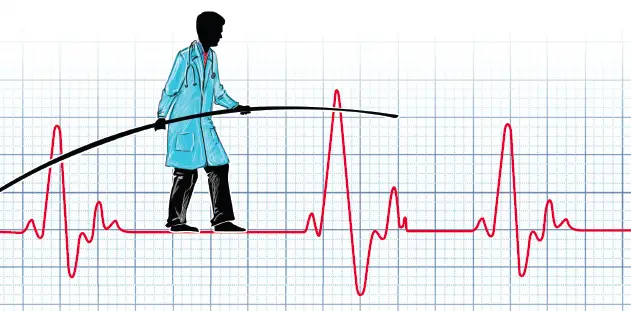
Negligence is the breach of a legal duty to care. It means carelessness in a matter in which the Laws mandate carefulness. A breach of this duty gives a patient the right to initiate action For negligence. Negligence is a large and amorphous subject. Almost seventy-ve years after the seminal decision of the House of Lords in Donoghue v. Stevenson, the boundaries of negligence are still as blurred as ever. Some of the obscurity surrounding this tort is inescapable. However, this article tries to give an overview of the tort of negligence. Negligence, in general, means omission to do something which a reasonable man, guided by those of ordinary considerations which ordinarily regulate the conduct of human affairs would do or the doing of something which a a reasonable and prudent man would not do. Wineld denies negligence as a breach of a legal duty to take care, which results in damage, undesired by the defendant to the plaintiff.
In other words, negligence is a failure to exercise the care that a reasonably prudent person would exercise in like circumstances. Further negligence in its legal acceptance includes acts of omission as well as commission. The area of tort law known as negligence involves harm caused by carelessness, not intentional harm. Medical negligence is a combination of two words. The second word solely describes the meaning, though the meaning of negligence has not been described in a proper way it is an act recklessly done by a person resulting in foreseeable damages to the other. Negligence is an offense under tort, IPC, Indian Contracts Act, Consumer Protection Act, and many more. Medical Negligence basically is the misconduct by a medical practitioner (physician, surgeon, or doctor) by not providing enough care resulting in a breach of their duties and harming the patients which are their consumers. In the medical profession terms like “bedside manners” and work ethics in a hospital are important parts of their job. A professional is deemed to be an expert in that eld at least; a patient getting treated under any doctor surely expects to get healed and at least expects the doctor to be careful while performing his duties. Medical negligence has caused many deaths as well as adverse results to the patient’s health. This article focuses on explaining negligence under various laws, professional negligence, medical negligence, and landmark as well as recent cases in India, the United States of America, and the United Kingdom. This provides information on liability that can be incurred by the victim of the medical malpractice. It aims to describe elements of the said topic, who carries the ‘onus probendi’ states case laws and what precedents they put forward, and what damages are awarded to the plaintiff if the injury is proved.
After the Consumer Protection Act, 1986, came into effect, a number of patients have led cases against doctors. This paper is a summary of legal decisions related to medical negligence: what constitutes negligence in civil and criminal law, and what is required to prove it. Public awareness of medical negligence in India is growing. After the act has come into force some patients have led legal cases against doctors, have established that the doctors were negligent in their medical service, and have claimed and received compensation. As a result, a number of legal decisions have been made on what constitutes negligence and what is required to prove it. Medical Negligence “No doctor knows everything. There’s a reason why it’s called “practicing” medicine.” Humans are bound to make errors. Though patients see the doctors as God and believe that their disease will be cured and they will be healed by the treatment but sometimes even the doctors make mistakes which can cost a lot to the patients in many ways. Sometimes the mistakes are so dangerous that a patient has to suffer immensely. “In my opinion, our health care system has failed when a doctor fails to treat an illness that is treatable.” – Kevin Alan Lee. “Being in such a profession where sick, ill and sufferers are your customers who look upon you as the almighty, an absolute amount of care is expected.” Medical negligence also known as medical malpractice is the improper, unskilled, or negligent treatment of a patient by a physician, dentist, nurse, pharmacist, or other health care professional. Medical malpractice occurs when a healthcare provider strays from the recognized “standard of care” in the treatment of a patient. The “standard of care” is denied as what a reasonably prudent medical provider would or would not have done under the same or similar circumstances.
“The important question isn’t how to keep bad physicians from harming patients; it’s how to keep good physicians from harming patients. – Atul Gawande” Mistakes or Negligence in the medical profession may lead to minor injuries or some serious kinds of injuries and sometimes these kinds of mistakes may even cause death. Since no man is perfect in this world, it is evident that a person who is skilled and has knowledge over a particular subject can also commit mistakes during his practice. To err is human but to replicate the same mistake due to one’s carelessness is negligence. The fundamental reason behind medical error or medical negligence is the carelessness of the said doctors or medical professionals it can be observed in various cases where reasonable care is not taken during the diagnosis, during operations, sometimes while injecting anesthesia, etc. For example, after a severe operation of a patient, he is likely to get infected by many diseases because of certain reasons which can include loss of blood, weakness, high dose of medicines. In due course, standard care is expected from the doctor to give premedication regarding certain infectious diseases. If a doctor fails to do so due to which a patient suffers from some infection that can cause a lot of harm or even death in adverse cases, the doctor is said to have committed medical negligence or malpractice. Essentials Doctor’s duty to attend to the patient with care Medicine is such a profession where a practitioner is supposed to have the requisite knowledge and skill needed for the purpose and has a duty to exercise a reasonable duty of care while dealing with the patient. The standard of care depends upon the nature of the profession. A surgeon or anesthetist will be determined by the standard of the average practitioner in that eld while in the case of specialists, a higher skill is needed.
If the doctor or a specialist doesn’t attend a patient admitted in emergency or under his surveillance and the patient dies or becomes a victim of consequences which could have been avoided with due care from the doctor, the doctor can be held liable under medical negligence. This was held in Sishir Rajan Saha v. The the state of Tripura that if a doctor did not pay enough attention to the patients in government hospitals as a result of which the patient suffers, the doctor can be held liable to pay compensation to the patient. Moreover, the liability of the doctor cannot be invoked now and then and he can’t be held liable just because something has gone wrong. For fastening the liability, a very high degree of such negligence was required to be proved. A a doctor or a medical practitioner when attending to his patients owes him the following duties of care: A duty of care in deciding whether to undertake the case A duty of care in deciding what treatment to give
A duty of care in the administration of the treatment When you go to a doctor, you expect to be seen promptly and attentively, and at a reasonable cost. You expect the doctor to be knowledgeable about the latest advances in his eld of specialty, and educate you about your diagnosis and prognosis, and explore the best possible solution to your health issue. In short, you expect to be healed. But for millions of people, what they expect is far from what they receive. Doctor acting in a negligent manner It is well accepted that in the cases of gross medical negligence the principle of res ipso loquitur is to be applied. The principle of res ipso loquitur is said to be essentially an evidential principle and the said principle is intended to assist the claimant.
while deciding the liability of the doctor it has to be well established that the negligence pointed out should be a breach of due care which an ordinary practitioner would have been able to keep. Latin for “the thing speaks for itself,” a doctrine of law that one is presumed to be negligent if he/she/it had exclusive control of whatever caused the injury even though there is no specific evidence of an act of negligence, and without negligence the accident would not have happened. A doctor is not an insurer for the patient, inability to cure the patient would not amount to negligence but carelessness resulting in an adverse condition of the patient would. In Gian Chand v. Vinod Kumar Sharma, it was held that shifting of the patient from one ward to another in spite of the requirement of instant treatment to be given to the patient resulting in damage to the patient’s health then the doctor or administrator of the hospital shall be held liable under negligence. In Jagdish Ram v. the State of H.P., it was held that before performing any surgery the chart reveals information about the amount of anesthesia and allergies of the patient should be mentioned so that an anesthetist can provide amply amount of medicines to the patient. The doctor in the above case failed to do so as As a result of the overdose of anesthesia, the patient died and the doctor was held liable for the same. Liability The liability of the person committing the wrong can be of three types depending on the harm or the injury suffered by the injured person they are :
Civil Liability Civil liability usually includes the claim for damages suffered in the form of compensation. If there is any breach of duty of care while operating or while the patient is under the supervision of the hospital or the medical professionals they are held to be vicariously liable for such wrong committed. And are liable.
to pay damages in the form of compensation. At times the senior doctors are even held vicariously liable for the wrongs committed by the junior doctors. If someone is an employee of a hospital, the hospital is responsible if that employee hurts a patient by acting incompetently. In other words, if the employee is negligent (is not reasonably cautious when treating or dealing with a patient), the hospital is on the hook for any resulting injuries to the patient. In Mr. M Ramesh Reddy v. State of Andhra Pradesh, the hospital authorities were held to be negligent, inter alia, for not keeping the bathroom clean, which resulted in the fall of an obstetrics patient in the bathroom leading to her death. A compensation of Re. 1 Lac was awarded against the hospital.
Criminal Liability There may be an occasion when the patient has died after the treatment and criminal case is led under Section 304A of the Indian Penal Code for allegedly causing death by rash or negligent act. According to S. 304A of the IPC, whoever causes the death of any person by a rash or negligent act not amounting to culpable homicide shall be punished by imprisonment for up to two years, or by ne, or both. In Dr. Suresh Gupta’s Case – Supreme Court of India, 2004 – the court held that the legal position was quite clear and well settled that whenever a patient died due to medical negligence, the doctor was liable in civil law for paying the compensation. Only when the negligence was so gross and his act was as reckless as to endanger the life of the patient, criminal law for offence under section 304A of Indian Penal Code, 1860 will apply. Indian Penal Code 1860 sections 52, 80, 81, 83, 88, 90, 91, 92 304-A, 337 and 338 contain the law of medical malpractice in India. The conduct of medical malpractice was brought under the Consumer Protection Act, 1986.
Due to the landmark case of the Indian Medical Association vs. V. P. Shantha & others, The judgment in this case denied medical care as a “service” that was covered under the Act, and also clarified that a person seeking medical attention may be considered a consumer if certain criteria were met. -The service provided was not free of charge or for a nominal registration fee; -If free, the charges were waived because of the patient’s inability to pay; -The service was at a private hospital that charges all patients; or -Any service rendered which was paid for by an insurance rm. This meant that certain categories of patients could now sue errant health care providers for compensation under the Consumer Protection Act, 1986, as a breach of contract. Only facilities and doctors that provided all services free of cost to all clients were not liable under the CPA. However, even patients that do not fall under the category of consumers under the Act can sue for negligence under the law of Torts. The burden to prove negligence, however, is on the patient. In the landmark case of Dr Laxman Balkrishna Joshi v. Dr Trimbak Bapu Godbole the Supreme Court ruled that if the treatment done by the doctor is proper according to the body of medical professionals who are skilled in that particular eld he cannot be held negligent just because something went wrong in the treatment. The famous UK Bolam Test case is the backbone of emerging laws on medical negligence. The Test came from the case of Bolam v Friern Hospital Management Committee, the judgment was given by McNair J. Here the facts were that Mr. Bolam was a voluntary patient at Friern Hospital a mental health institution run by the Friern Hospital Management Committee. He agreed to undergo electro-convulsive therapy.
Foreign jurisdictions
UNITED KINGDOM
His body was not restrained during the procedure, and he moved violently before the procedure was stopped, suffering serious injuries, including fractures of the acetabula. He sued the Committee for compensation, arguing that they were negligent for not issuing relaxants, not restraining him, and not warning him about the risks involved. The court held that a doctor is not guilty of negligence if they have acted in accordance with a practice accepted as proper by a responsible body of medical professionals skilled in that particular field.
The Civil Procedure Rules in England and Wales allow claims for medical negligence to be initiated within three years of the alleged negligence occurring or within three years of the victim becoming aware of the possible negligence. This is particularly relevant to minors, as the three-year period begins when the individual reaches the age of maturity, i.e., 18 years.
Medical law academics have argued that any patient encountered in a professional setting is owed a duty of care not only by the doctors they directly interact with but also by others employed by the Trust to provide patient care. For example, a patient who suffers a cardiac arrest in a hospital corridor is owed a duty of care by any doctor passing by. In such circumstances, providing assistance would likely be expected and would not be considered a ‘Good Samaritan’ act. However, this academic perspective has not yet been tested in a British court environment.
In Crawford v Board of Governors of Charing Cross Hospital, a patient sustained a brachial plexus injury due to being kept in one position for an extended period. An article describing such a complication had been published six months earlier, but the anaesthetist had not read it and was unaware of its implications. As a result, it was determined that they had not breached their duty of care. Furthermore, errors of judgment do not automatically amount to breaches of duty; they only do so when the doctor fails to act with the level of care expected from a reasonably competent professional.
UNITED STATES OF AMERICA
In the United States, the laws of medical negligence are governed by individual states rather than the federal government, and they are derived from common law. The legal system is structured in a way that encourages extensive discovery and negotiations between the parties to resolve disputes without proceeding to formal judicial trials. The plaintiff must prove that they were provided with substandard medical care, which directly caused their injury.
The initiation of lawsuits depends on the state: in some states, filing begins at the time of injury, while in others, it does not begin until the person becomes aware that they have been injured. Damages awarded in such cases include both economic losses, such as lost income and future medical expenses, and non-economic losses, such as pain and suffering. Doctors in the United States generally carry medical negligence insurance to protect themselves against malpractice claims and unintentional injuries. In some cases, this insurance is mandatory for obtaining hospital privileges or employment in the medical field. Medical malpractice lawsuits in the U.S. are filed in state trial courts, which have the jurisdiction and legal authority to hear and decide such cases.
Medical malpractice suits in the United States began to appear more regularly in the 1800s. However, prior to the 1960s, such legal claims were relatively rare and had minimal impact on medical practice. Since the 1960s, the frequency of malpractice claims has increased significantly, and today, lawsuits filed by patients alleging physician malpractice are relatively common across the country.
AUSTRALIA
Australia has one of the highest rates of medical negligence in the world, according to reports by the World Health Organization (WHO). As per these reports, around 18,000 people may die every year in hospitals due to preventable medical negligence in Australia, while approximately 50,000 people suffer permanent injuries annually as a result of such negligence. Additionally, nearly 80,000 Australian patients are hospitalized each year due to medication errors.
The present law governing medical negligence in Australia was established in the case of Rogers v. Whitaker, which introduced the ‘failure to warn’ principle. In this case, a patient sued a doctor for not warning about a slight risk of serious side effects following an operation.
Previously, Australia followed the precedent set in Bolam v Friern Hospital Management Committee, commonly known as the Bolam Test. However, the legal position in Australia now primarily follows the principles laid down in Rogers v. Whitaker. This differs from the Bolam Test in that the Bolam principle focuses on the actual provision of treatment, whereas the ‘failure to warn’ principle concerns the risks involved in providing that treatment.
In Rogers v. Whitaker, the judges emphasized that the issue was related to the quality of advice given rather than the treatment itself. Additionally, the Bolam Test had previously granted medical practitioners significant protection by allowing them to avoid liability if their actions were in line with accepted medical practices. This effectively made such cases matters of medical judgment, often shielding doctors from negligence claims.
Coclusion
It is not suggested that doctors are negligent or irresponsible; however, while performing duties that require a high degree of patience and care, practitioners may sometimes fail or breach their responsibility toward patients. Medicine, being one of the noblest professions, is expected to operate within a framework that benefits those suffering from various diseases. Yet, even experienced doctors and specialists may occasionally overlook small but important aspects of care, which can lead to harm that could otherwise have been avoided, and in some cases, even result in the death of patients.
Such instances of professional negligence require focused attention rather than being addressed only under general laws or statutes. There is a need for an independent and specialized legal framework to regulate malpractice effectively. In India, a notable example is the case of Krishna Iyer v. State of Tamil Nadu and Others, where the Apex Court awarded compensation of ₹1.8 crores on July 1, 2015, after the victim lost her eyesight in 1996. This remains one of the highest compensation amounts awarded in the country. Activists and victims of medical negligence have often raised concerns about the challenges in obtaining proper redressal against the wrongful acts of medical practitioners.
Furthermore, the need for accountability is not limited to the medical profession alone. Similar legal standards should apply to all professions that require a significant level of skill and a duty of care. In a country where people already face numerous health challenges, it becomes essential to reduce avoidable harm and improve professional standards, ensuring that places meant for healing do not become sources of further suffering or loss of life.