
MEDICAL NEGLIGENCE AND LIABILITY: A COMPREHENSIVE AND CRITICAL REVIEW WITH DETAILED ANALYSIS OF INDIAN CASE LAWS
- DR. ROHITH JAISWAL
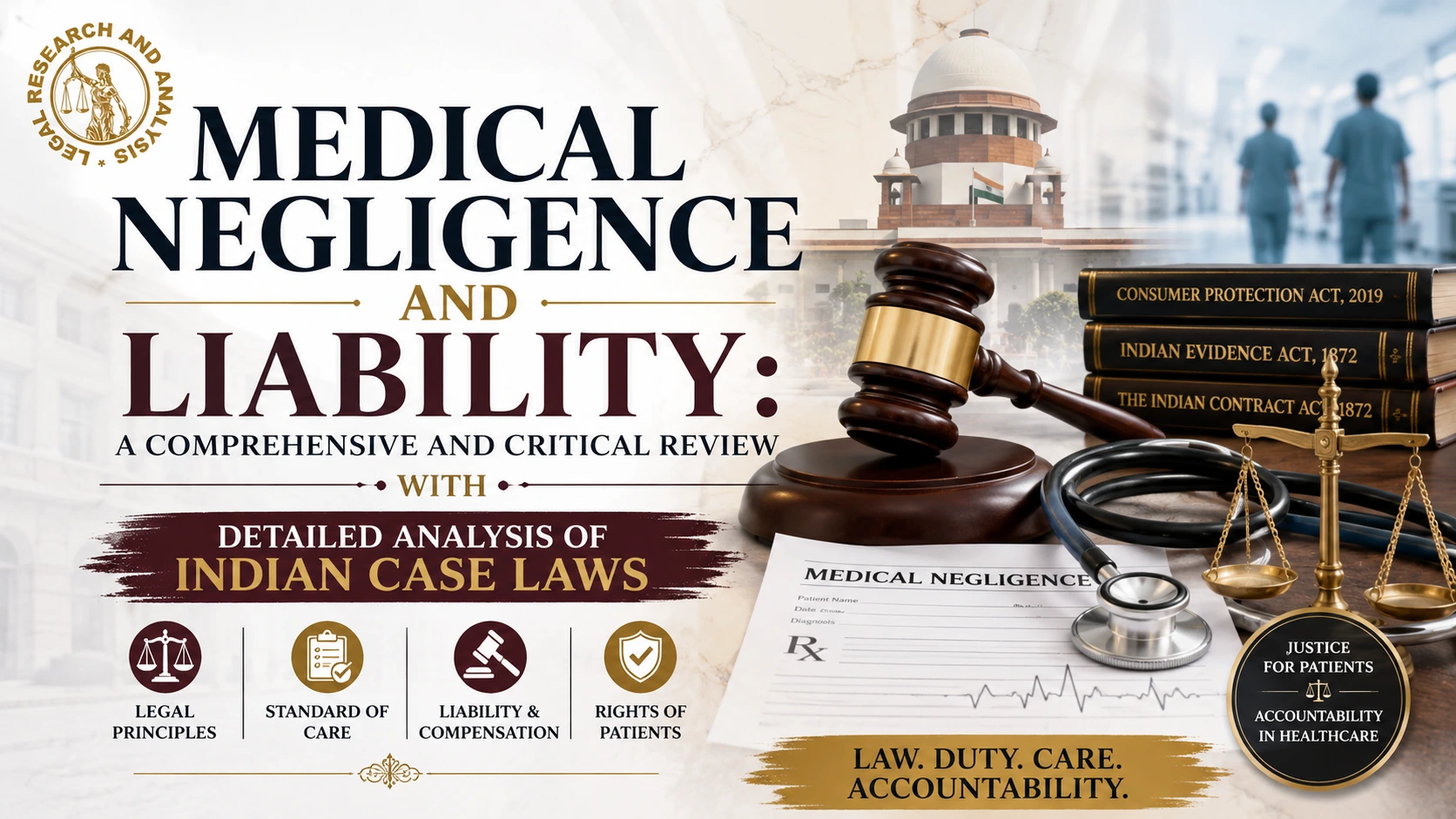
Table of Contents
ABSTRACT
Medical negligence is a crucial intersection of healthcare practice, legal accountability, and ethical responsibility. It arises when a healthcare provider fails to exercise the standard of care expected under particular circumstances, leading to patient harm. With increasing patient awareness, expansion of healthcare services, and judicial activism, the scope and interpretation of medical negligence have evolved significantly, particularly in India. This article provides a comprehensive and critical review of medical negligence and liability, examining its conceptual foundations, essential elements, classifications, and ethical implications. It places special emphasis on landmark Indian case laws, analysing their facts, legal reasoning, and broader implications. Through doctrinal analysis and integration of scientific and legal scholarship, the article highlights the need for a balanced approach that ensures patient protection without discouraging medical professionals.
KEYWORDS:
Patient Safety, Medical negligence, Medical ethics, Defensive medicine, Legal liability, Indian case laws
INTRODUCTION
The practice of medicine is inherently complex and uncertain, involving continuous decision-making under conditions of risk (Laurie et al.). Despite advances in medical science, adverse outcomes cannot always be prevented (Beauchamp & Childress, 2019)1. However, when such outcomes result from a failure to exercise reasonable care, they raise questions of medical negligence.
Historically, the doctor–patient relationship was characterize by trust and professional autonomy. However, modern developments such as commercialization of healthcare, technological advancements, and rising patient awareness have transformed this relationship into one increasingly governed by legal standards (Yogesh & Karthikeyan, 2022). Patients today are more likely to question medical decisions and seek legal remedies.
In India, the legal framework governing medical negligence has undergone significant evolution, particularly through judicial decisions. Courts have played a vital role in defining standards of care, establishing liability, and balancing competing interests. This article critically examines these developments.
LITERATURE REVIEW
Medical negligence has been extensively examined from legal, ethical, and healthcare perspectives. Study shown that the growing importance of consumer protection mechanisms in addressing medical negligence claims in India (Yogesh & Karthikeyan, 2022). There are many challenges involved in distinguishing medical errors from legally actionable negligence and the role of professional standards in determining liability (Agrawal, 2016). Previous analysis revealed the evolution of healthcare law and the increasing significance of patient autonomy and informed consent (Montgomery, 2005). Most ethical principles such as beneficence, non-maleficence, autonomy, and justice are closely linked to negligence claims in healthcare practice (Beauchamp & Childress, 2019). Courts also increasingly rely on expert evidence and established standards of care while adjudicating negligence claims (Laurie et al.). Existing literature demonstrates that medical negligence is a multidimensional issue involving legal liability, ethical obligations, patient rights, and institutional accountability.
RESEARCH METHODOLOGY
This study adopts a doctrinal research methodology based on the analysis of primary and secondary legal sources (Montgomery, 2005). Primary sources include judicial decisions of the Supreme Court of India and other relevant legal authorities concerning medical negligence and liability. Secondary sources include books, journal articles, legal commentaries, policy documents, and scholarly publications relating to healthcare law, medical ethics, and professional liability (Laurie et al.). The research relies on qualitative analysis of legal principles, judicial reasoning, and scholarly opinions. Landmark cases have been selected based on their significance in shaping the jurisprudence of medical negligence in India. The methodology is descriptive and analytical in nature, focusing on interpretation of legal doctrines and their practical application.
Historically, the doctor–patient relationship was characterized by trust and professional autonomy. However, modern developments such as commercialization of healthcare, technological advancements, and rising patient awareness have transformed this relationship into one increasingly governed by legal standards (Yogesh & Karthikeyan, 2022). Patients today are more likely to question medical decisions and seek legal remedies.
In India, the legal framework governing medical negligence has undergone significant evolution, particularly through judicial decisions. Courts have played a vital role in defining standards of care, establishing liability, and balancing competing interests. This article critically examines these developments.
CONCEPT AND SCOPE OF MEDICAL NEGLIGENCE
Medical negligence is a multifaceted concept that extends beyond simple errors (Agrawal, 2016). It refers to a failure by a healthcare professional to exercise reasonable skill and care, resulting in harm to the patient. However, it is essential to distinguish between negligence and unavoidable medical complications.
For instance, a surgeon performing a high-risk operation may encounter complications despite following all accepted protocols. Such outcomes do not necessarily indicate negligence. In contrast, failing to sterilize surgical instruments or ignoring clear symptoms would constitute negligence (Agrawal, 2016).
The concept also involves evaluation against professional standards rather than ordinary standards of care (Montgomery, 2005). This means that the conduct of a doctor is assessed based on what a reasonably competent professional would do under similar circumstances.
Medical negligence also includes failures in communication, such as lack of informed consent. For example, if a patient is not informed about significant risks associated with a procedure and suffers harm, liability may arise even if the procedure was technically correct (Beauchamp & Childress, 2019).
ESSENTIAL ELEMENTS OF MEDICAL NEGLIGENCE
To establish medical negligence, four essential elements must be proven.
Duty of Care
A duty arises when a doctor–patient relationship is established. This duty extends to diagnosis, treatment, and follow-up care (Laurie et al.).
Breach of Duty
A breach occurs when the doctor fails to meet the expected standard of care. For example, prescribing medication without checking for allergies constitutes a breach (Laurie et al.).
Causation
The plaintiff must prove that the breach caused the injury. This is often complex due to multiple contributing factors (Laurie et al.).
Damage
Actual harm must be demonstrated, including physical, emotional, or financial injury (Agrawal, 2016).
DETAILED ANALYSIS OF LANDMARK INDIAN CASE LAWS
Jacob Mathew v. State of Punjab (2005)2
The case of Jacob Mathew v. State of Punjab (2005) is widely regarded as the most authoritative judgment on medical negligence in India. It fundamentally clarified the distinction between civil and criminal liability in medical practice.
Facts
In this case, a patient suffering from cancer was admitted to a hospital and experienced breathing difficulties. The attending doctors attempted to provide oxygen support, but it was alleged that the oxygen cylinder was either empty or not functioning properly. The patient subsequently died. The complainant filed a criminal case against the doctors under Section 304A of the Indian Penal Code, alleging that the death was caused by their negligence.
Legal Issues
The primary issue before the Supreme Court was whether the actions of the doctors constituted criminal negligence. Specifically, the Court had to determine the threshold of negligence required to impose criminal liability on medical professionals.
Judgment and Reasoning
The Supreme Court held that criminal liability in cases of medical negligence requires a much higher degree of negligence than civil liability. It emphasized that only gross negligence or recklessness would attract criminal prosecution. The Court adopted the principles of the Bolam test, stating that a doctor cannot be held negligent if their conduct is in accordance with a practice accepted by a responsible body of medical professionals. Importantly, the Court recognized that medicine is an inexact science and that doctors often make decisions under uncertainty.
The Court also introduced a procedural safeguard by requiring that an independent and competent medical opinion be obtained before initiating criminal proceedings against a doctor. This was intended to prevent harassment of medical professionals through frivolous complaints.
Illustrative Example
Consider a situation where a doctor administers a drug that later causes an adverse reaction. If the drug was prescribed in accordance with accepted medical practice, the doctor would not be criminally liable. However, if the doctor knowingly ignored contraindications or acted recklessly, liability could arise.
Significance
This case is significant for several reasons:
- It clearly distinguishes between civil and criminal negligence
- It establishes that criminal liability requires gross negligence
- It protects doctors from unnecessary prosecution
- It reinforces reliance on expert medical opinion
The judgment has had a profound impact on medical jurisprudence in India, ensuring that healthcare professionals are not deterred from performing their duties due to fear of litigation.
Indian Medical Association v. V.P. Shantha (1995)3
This landmark case fundamentally transformed the legal landscape of medical negligence in India by bringing medical services within the scope of consumer protection law.
Facts
The case arose from multiple complaints regarding a deficiency in medical services. The central question was whether medical practitioners could be considered “service providers” under the Consumer Protection Act, 1986.
Legal Issue
Whether medical services fall within the definition of “service” and whether patients qualify as “consumers.”
Judgment
The Supreme Court held that medical services do constitute “services” under the Act, except where services are rendered free of charge to all patients. Consequently, patients were recognised as consumers entitled to seek redressal for negligence.
Reasoning
The Court reasoned that the relationship between doctor and patient often involves consideration (payment), making it similar to other service relationships. It rejected the argument that medical services should be excluded due to their noble nature.
Example
If a patient pays for surgery in a private hospital and suffers harm due to negligence, they can file a complaint in a consumer forum instead of pursuing lengthy civil litigation.
Significance
This judgment had far-reaching implications:
- It increased access to justice
- It simplified legal procedures
- It enhanced accountability of healthcare providers
However, it also led to a rise in litigation, raising concerns about defensive medicine.
Martin D’Souza v. Mohd. Ishfaq (2009)4
Facts
The case involved allegations of negligence in the treatment of a patient suffering from kidney failure. The complainant alleged improper administration of drugs leading to complications.
Judgment
The Supreme Court emphasized that before issuing notice to a doctor, courts must obtain an opinion from a competent medical expert.
Reasoning
The Court recognized that medical science is complex and beyond the understanding of laypersons. It warned against the tendency of courts to presume negligence without adequate evidence.
Example
A patient receiving dialysis may develop complications. Without expert evaluation, it would be incorrect to assume negligence merely based on the outcome.
Significance
- Reinforced protection for doctors
- Reduced frivolous litigation
- Strengthened reliance on expert evidence
Kusum Sharma v. Batra Hospital (2010)5
This case laid down detailed guidelines for adjudicating medical negligence claims
Key Principles
- Doctors are expected to exercise reasonable skill, not perfection
- Courts must consider the realities of medical practice
- Negligence must be clearly proven
Example
If two doctors adopt different treatment approaches, both may be valid if supported by medical opinion.
Significance
The case provided a structured framework, ensuring consistency in judicial decisions.
Spring Meadows Hospital v. Harjol Ahluwalia (1998)6
Facts
A child was administered the wrong drug, resulting in severe brain damage.
Judgment
The Court held both the hospital and doctor liable.
Example
If a nurse administers incorrect medication due to lack of supervision, the hospital is vicariously liable.
Significance
- Established vicarious liability
- Recognised compensation for family members
Achutrao Haribhau Khodwa v. State of Maharashtra (1996)7
Facts
A surgical mop was left inside a patient’s abdomen.
Judgment
The Court applied res ipsa loquitur, holding that such negligence speaks for itself.
Example
Leaving instruments inside a patient clearly indicates negligence without need for expert proof.
Significance
Simplified burden of proof in obvious cases.
ETHICAL DIMENSIONS OF MEDICAL NEGLIGENCE
Medical negligence is not merely a legal issue but is deeply rooted in ethical considerations that govern the practice of medicine. Ethical principles serve as the foundation for evaluating professional conduct, and violations of these principles often manifest as negligence. The four core principles of biomedical ethics—beneficence, non-maleficence, autonomy, and justice—provide a framework for analyzing medical conduct (Beauchamp & Childress, 2019).
Beneficence requires healthcare providers to act in the best interests of the patient. This involves not only providing appropriate treatment but also ensuring that decisions are guided by the patient’s welfare rather than personal or institutional interests. For instance, recommending an unnecessary surgical procedure for financial gain constitutes both ethical misconduct and negligence (Beauchamp & Childress, 2019).
Non-maleficence, commonly expressed as ““do no harm”,” is directly linked to negligence. Any act or omission that causes avoidable harm violates this principle. For example, administering a drug without verifying allergies or failing to sterilize surgical instruments demonstrates a clear breach of non-maleficence (Beauchamp & Childress, 2019).
Autonomy emphasizes the patient’s right to make informed decisions about their own healthcare. This principle underpins the doctrine of informed consent. Failure to disclose risks, alternatives, or potential outcomes deprives patients of their autonomy. For example, if a patient undergoes a high-risk surgery without being informed of possible complications such as paralysis or death, the doctor may be ethically and legally liable even if the procedure is technically successful (Montgomery, 2005).
Justice refers to fairness in the distribution of healthcare resources and treatment. Negligence may arise when patients are denied appropriate care due to discrimination, financial status, or systemic inequalities. For instance, delaying treatment for economically disadvantaged patients while prioritising paying patients raises ethical concerns and may amount to negligence (Beauchamp & Childress, 2019).
Ethical failures also arise from communication gaps lack of transparency, and inadequate documentation. Poor communication between healthcare providers and patients is one of the leading causes of malpractice claims. For example, failure to explain postoperative care instructions may result in complications that could have been avoided (Beauchamp & Childress, 2019).
Furthermore, modern healthcare systems face ethical challenges due to commercialisation and corporatization. Hospitals operating as profit-driven entities may inadvertently prioritize financial outcomes over patient care, increasing the risk of negligence.
Thus, ethical dimensions are inseparable from legal liability. Strengthening ethical awareness through medical education, institutional policies, and professional accountability is essential to reducing negligence.
DEFENSIVE MEDICINE
Defensive medicine refers to medical practices adopted primarily to avoid legal liability rather than to benefit the patient. It has emerged as a significant consequence of increasing medical negligence litigation and reflects the growing fear among healthcare professionals of being sued (Mello, Chandra, Gawande, & Studdert, 2010).
Defensive medicine can be categorized into two main types:
- Positive Defensive Medicine – This involves performing additional tests, procedures, or consultations that may not be medically necessary but are intended to create a legal safeguard. For example, a doctor may order multiple diagnostic tests for a minor condition to ensure that no potential issue is overlooked, even when clinical judgment suggests otherwise.
- Negative Defensive Medicine – This involves avoiding high-risk patients or procedures to minimize the risk of litigation. For instance, a surgeon may refuse to operate on a critically ill patient due to fear of complications and subsequent legal consequences.
While defensive medicine may appear to protect healthcare providers, it has several adverse implications:
- Increased Healthcare Costs: Unnecessary tests and procedures significantly raise the cost of treatment, placing a financial burden on patients and healthcare systems (Studdert et al., 2006).
- Patient Risk: Additional procedures may expose patients to unnecessary risks, such as radiation from imaging tests or complications from invasive procedures.
- Resource Misallocation: Overuse of diagnostic tools may strain limited healthcare resources, particularly in developing countries like India (Mello et al., 2010).
For example, a patient presenting with mild headache symptoms may undergo expensive imaging tests like CT scans or MRIs purely as a precautionary measure, even when clinical evaluation does not justify such interventions.
Defensive medicine also reflects a breakdown of trust in the doctor–patient relationship. Instead of focusing on patient welfare, decision-making becomes influenced by legal considerations (Mello et al., 2010).
However, it is important to note that not all precautionary measures constitute defensive medicine. In many cases, additional testing may be justified based on clinical uncertainty. The challenge lies in distinguishing between reasonable caution and excessive precaution driven by fear of litigation.
Addressing defensive medicine requires systemic reforms, including:
- Clear clinical guidelines
- Legal protections for doctors acting in good faith
- Alternative dispute resolution mechanisms
INSTITUTIONAL LIABILITY
Medical negligence is no longer viewed solely as an individual failure; it is increasingly recognized as a systemic issue involving healthcare institutions. Hospitals, clinics, and healthcare organizations can be held liable for negligence under both direct and vicarious liability principles (Laurie et al.). Vicarious liability arises when an institution is held responsible for the negligent acts of its employees. For example, if a nurse administers the wrong medication due to inadequate supervision, the hospital may be held liable for failing to ensure proper training and oversight.
Direct liability, on the other hand, arises from institutional failures such as:
- Inadequate infrastructure
- Faulty or poorly maintained equipment
- Insufficient staffing
- Lack of standard protocols
For instance, if a hospital fails to maintain sterilisation standards and patients develop infections, the institution can be held directly liable. Similarly, malfunctioning equipment, such as defective ventilators, can lead to catastrophic outcomes and legal liability.
Institutional negligence is often linked to system failures, as explained in the “Swiss cheese model” of error proposed by Reason (Reason, 2000). According to this model, adverse events occur due to multiple layers of failure rather than a single mistake.
An example would be a surgical error resulting from:
- Poor communication among staff
- Inadequate preoperative checks
- Lack of proper documentation
In such cases, responsibility extends beyond the individual surgeon to the entire healthcare system. The rise of corporate hospitals has further complicated issues of liability. Profit-driven models may lead to:
- Overburdened staff
- Reduced patient interaction time
- Compromised quality of care
Additionally, hospitals are responsible for implementing risk management systems, including:
- Standard operating procedures
- Quality control mechanisms
- Regular audits and training
Failure to implement such systems may be considered negligence.
Thus, institutional liability reflects a shift from individual blame to systemic accountability, emphasising the need for organisational reforms (Kohn, Corrigan, & Donaldson, 2000).
CRITICAL ANALYSIS
The legal framework governing medical negligence seeks to balance two competing objectives: protecting patients from harm and safeguarding healthcare professionals from undue harassment. While this balance is essential, achieving it remains a significant challenge. One of the major concerns is the rise in medical litigation, which has both positive and negative implications. On the one hand, it enhances accountability and empowers patients. On the other hand, it creates a climate of fear among healthcare providers, leading to defensive medicine and reduced willingness to take risks (Mello et al., 2010).
Another issue is the difficulty in establishing negligence. Medical cases often involve complex scientific evidence that is difficult for courts to interpret. This reliance on expert testimony can lead to inconsistencies, as different experts may provide conflicting opinions (Laurie et al.). The standard of care itself is not uniform and varies based on context, resources, and expertise. This variability makes it challenging to apply a consistent legal standard across different cases (Montgomery, 2005).
In India, additional challenges include:
- Delays in judicial processes
- Lack of specialised medical tribunals
- Inconsistent compensation awards
For example, two similar cases may result in significantly different compensation amounts due to judicial discretion. Furthermore, excessive focus on litigation may overshadow the importance of preventive measures such as quality improvement and patient safety initiatives.
A critical concern is the potential for over-deterrence, where fear of legal consequences discourages doctors from performing complex or high-risk procedures. This may ultimately harm patients by limiting access to necessary treatments.
To address these challenges, reforms should focus on:
- Establishing specialised medico-legal tribunals
- Promoting alternative dispute resolution mechanisms
- Standardizing clinical guidelines
- Enhancing medical education on legal and ethical issues
CONCLUSION
Medical negligence represents a complex and evolving area of law that reflects the dynamic interplay between healthcare practice, legal accountability, and ethical responsibility (Laurie et al.). While the legal framework aims to ensure justice for patients, it must also recognise the inherent uncertainties and challenges of medical practice.In India, judicial decisions have played a pivotal role in shaping medical negligence law, establishing principles that balance patient rights with professional protection. Landmark judgments have clarified standards of care, emphasised the importance of expert evidence, and introduced safeguards against frivolous litigation (Agrawal, 2016).
However, significant challenges remain, including rising litigation, defensive medicine, and systemic inefficiencies. Addressing these issues requires a holistic approach that integrates legal reforms, ethical awareness, and institutional accountability.
Ultimately, the goal of medical negligence law should not merely be to assign blame but to promote patient safety, improve healthcare quality, and foster trust between patients and healthcare providers. Achieving this objective requires collaboration among legal authorities, medical professionals, and policymakers.
REFERENCES
- Agrawal, A. (2016). Medical negligence: Indian legal perspective. Ann Indian Acad Neurol, 19(Suppl 1), S9-S14. doi: 10.4103/0972-2327.192889
- Beauchamp, T., & Childress, J. (2019). Principles of Biomedical Ethics: Marking Its Fortieth Anniversary. Am J Bioeth, 19(11), 9-12. doi: 10.1080/15265161.2019.1665402
- Kohn, L. T., Corrigan, J., & Donaldson, M. S. (2000). To err is human: building a safer health system. Washington, D.C.: National Academy Press.
- Laurie, G. T., Harmon, S., Dove, E. S., Mason, J. K., McCall Smith, A., & Mason, J. K. Mason & McCall Smith’s law & medical ethics (Eleventh edition. ed.).
- Mello, M. M., Chandra, A., Gawande, A. A., & Studdert, D. M. (2010). National costs of the medical liability system. Health Aff (Millwood), 29(9), 1569-1577. doi: 10.1377/hlthaff.2009.0807
- Montgomery, J. (2005). Health Care Law: Oxford University Press.
- Reason, J. (2000). Human error: models and management. BMJ, 320(7237), 768-770. doi: 10.1136/bmj.320.7237.768
- Studdert, D. M., Mello, M. M., Gawande, A. A., Gandhi, T. K., Kachalia, A., Yoon, C., .
- Brennan, T. A. (2006). Claims, errors, and compensation payments in medical malpractice litigation. N Engl J Med, 354(19), 2024-2033. doi: 10.1056/NEJMsa054479
- Yogesh, M. J., & Karthikeyan, J. (2022). Health Informatics: Engaging Modern Healthcare Units: A Brief Overview. Front Public Health, 10, 854688. doi: 10.3389/fpubh.2022.854688
FOOTNOTES
- Achutrao Haribhau Khodwa v State of Maharashtra (1996) 2 SCC 634. ↩︎
- Jacob Mathew v State of Punjab (2005) 6 SCC 1 ↩︎
- Indian Medical Association v V.P. Shantha (1995) 6 SCC 651. ↩︎
- Martin F D’Souza v Mohd Ishfaq (2009) 3 SCC 1. ↩︎
- Kusum Sharma v Batra Hospital (2010) 3 SCC 480. ↩︎
- Spring Meadows Hospital v Harjol Ahluwalia (1998) 4 SCC 39. ↩︎
- Achutrao Haribhau Khodwa v State of Maharashtra (1996) 2 SCC 634. ↩︎
+919458479236

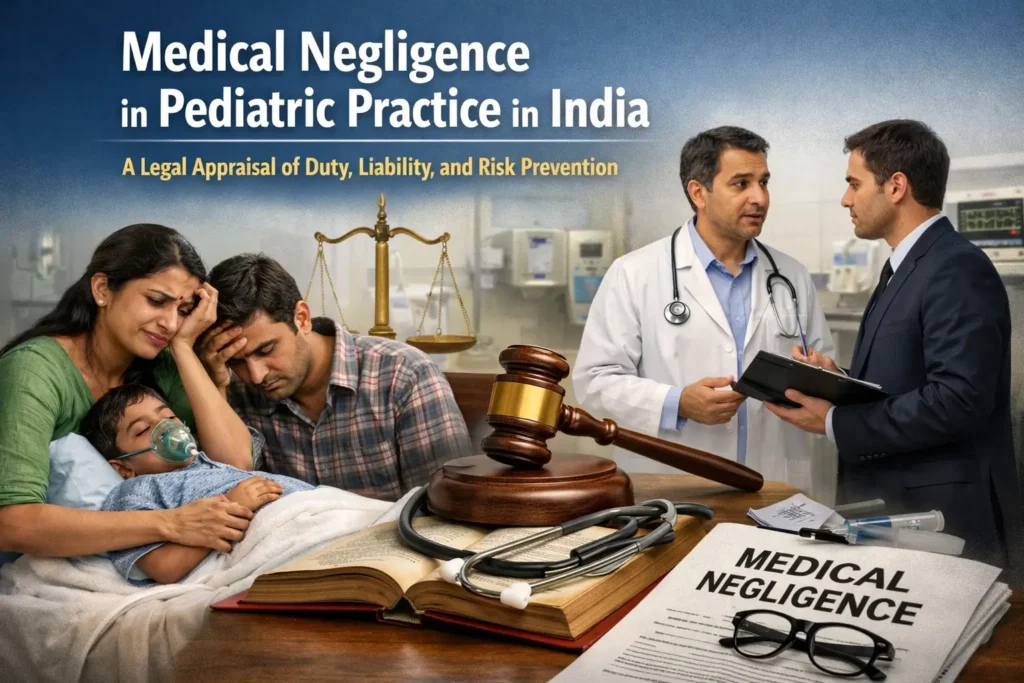

Questions of medical negligence have acquired increasing importance in India as healthcare has moved into a more rights-conscious and legally supervised environment.… Continue reading

Waste generation has emerged as one of the most serious environmental challenges facing India today. Population growth, rapid urbanization, and increasing consumption patterns have… Continue reading

Environmental protection has become a global priority as industrialization and urban development continue to expand rapidly. Industries contribute significantly to economic growth… Continue reading