
Certificate Course on
Taxation and GST
Practical GST & Tax Law Certification India
A practical, section-by-section certificate course on Taxation and GST — covering the constitutional basis of GST, meaning and scope of supply, levy and collection, reverse charge mechanism, composition levy, time and value of supply, input tax credit, registration, tax invoicing, and returns under the CGST Act, 2017. Designed for law students, CA/CS/CMA aspirants, business owners, and compliance professionals. 6 weeks, 12 sessions — just ₹1,500.
Taxation and GST in India — A Complete Introduction
Taxation and GST together cover how India taxes income, transactions, and the supply of goods and services. GST — the Goods and Services Tax — is the indirect tax framework introduced in 2017 under the dual structure of CGST, SGST, IGST, and UTGST, governed by Articles 246A, 269A, and 279A of the Constitution and operationalised through the CGST Act, 2017 — covering supply, levy, registration, input tax credit, invoicing, and returns.
India's tax landscape has grown significantly more complex since GST replaced a patchwork of state and central indirect taxes. With over 1.2 crore registered GST taxpayers and monthly gross GST collections now crossing ₹1.94 lakh crore, compliance, litigation, and advisory work around GST has become one of the fastest-growing areas of legal and financial practice in India.
For business owners and entrepreneurs, GST compliance is now a daily operational reality — registration, invoicing, reverse charge, and timely return filing directly affect cash flow and input tax credit. For law students and legal practitioners, GST litigation before appellate authorities and tribunals is a rapidly expanding practice area. For CA/CS/CMA aspirants, accountants, and compliance officers, section-wise command of the CGST Act is what separates a working professional from a thriving advisory career.
This certificate course on taxation and GST from Legal Research and Analysis gives you structured, practical, India-specific knowledge of GST — taught by practising tax and GST advocates, in just 6 weeks at ₹1,500.
Direct Tax vs Indirect Tax (GST)
| Aspect | Taxation (Direct Tax) | GST (Indirect Tax) |
|---|---|---|
| Nature | Tax on income or profit | Tax on supply of goods & services |
| Levied On | Individuals & companies directly | Suppliers, ultimately borne by consumers |
| Governing Law | Income Tax Act, 1961 | CGST / SGST / IGST Acts, 2017 |
| Point of Collection | At year-end / via advance tax | At each point of supply |
| Administered By | CBDT | CBIC & GST Council |
Why This is a Practical, Career-Ready GST & Taxation Course in 2026
Practising tax & GST advocates as faculty — complete CGST Act coverage — ₹1,500. Built for every career path that touches GST.
Practising Advocates as Faculty
Learn from advocates who practise tax and GST matters across India and litigate before the Jharkhand High Court — not just academic theory, but the practical reality of how GST disputes and compliance actually play out.
Complete CGST Act Coverage
From Section 2 definitions to Section 50 interest on delayed payment — every major chapter of the CGST Act, 2017 is covered in structured, session-wise detail across 6 weeks.
Constitutional Grounding, Not Just Procedure
Most GST courses jump straight to filing mechanics. This course starts with Articles 246A, 269A, and 279A — the constitutional basis of dual GST — so you understand why the law is structured the way it is.
Built for Every Career Path
Whether you're a law student, a CA/CS/CMA aspirant, a business owner, or a corporate compliance officer — the curriculum is structured to be equally useful across all these professional tracks.
ITC, Reverse Charge & Registration — In Depth
Dedicated sessions on input tax credit eligibility, blocked credits under Section 17(5), reverse charge mechanism, and the full registration procedure under Sections 22–30 — the areas where most compliance mistakes happen.
6 Weeks · ₹1,500 · Career-Ready Knowledge
Complete your taxation and GST certification in just 6 weeks, two classes a week — structured to fit around your job, practice, or studies.
From Constitutional Basis to GST Returns — Complete Coverage in 6 Weeks
Supply, Levy & Charging Provisions
The meaning and scope of "supply" under Section 7 and Schedules I–III, composite and mixed supply under Section 8, and the charging section — levy and collection under Section 9, including reverse charge and e-commerce operator liability.
Composition Levy & Exemptions
Eligibility, turnover thresholds, conditions and rate structure under the composition scheme (Section 10), and the power to grant exemptions under Section 11 — essential for advising small businesses and startups.
Time & Value of Supply
When tax liability arises — time of supply of goods (Section 12) and services (Section 13), changes in tax rate (Section 14) — and how transaction value is determined under Section 15, including inclusions, exclusions and related-party valuation.
Input Tax Credit (ITC) Mechanics
Eligibility and conditions for ITC under Section 16, blocked credits under Section 17(5), ITC in special circumstances under Section 18, job-work credit under Section 19, and ISD credit distribution under Section 20.
Registration Procedure
Who must register (Section 22), who is exempt (Section 23), compulsory registration triggers under Section 24 — including reverse charge, inter-state supply and e-commerce — and the full procedure for registration, amendment, cancellation and revocation (Sections 25–30).
Invoicing, Returns & Tax Payment
Tax invoices and credit/debit notes (Sections 31 & 34), furnishing of returns including GSTR-3B (Section 39), and payment of tax through the electronic cash and credit ledger, including interest on delayed payment (Sections 49 & 50).
Complete 6-Week Taxation & GST Curriculum
12 live sessions — from foundational definitions to GST returns and payment — structured section-by-section through the CGST Act, 2017.
Definitions (Section 2)
- Key terms: supply, business, consideration, goods, services, taxable person, input tax, output tax, recipient, taxable territory
Constitutional Basis
- Article 246A, 269A, 279A
- Concept of dual GST (CGST/SGST/IGST/UTGST)
Meaning and Scope of "Supply" (Section 7)
- Including Schedule I (deemed supplies without consideration)
- Schedule II (activities to be treated as goods/services)
- Schedule III (neither goods nor services)
- Composite and mixed supply (Section 8)
- Principal supply, bundling principles
Levy and Collection (The Charging Section)
- Levy and collection of CGST (Section 9)
- The charge, reverse charge mechanism [9(3) & 9(4)]
- E-commerce operator liability [9(5)]
- Exclusion of petroleum/alcohol
Composition Levy (Section 10)
- Eligibility, turnover thresholds, conditions, rate structure
- Power to grant exemption (Section 11)
Time of Tax Liability under GST
- Time of supply of goods (Section 12)
- Time of supply of services (Section 13)
- Change in rate of tax (Section 14)
Value of Taxable Supply (Section 15)
- Transaction value, inclusions, exclusions, discounts, related-party valuation
- Link to Valuation Rules
Eligibility and Conditions for ITC (Section 16)
- Four conditions
- 16(2)(c), 16(4) time limit
- Apportionment and blocked credits (Section 17)
- 17(5) blocked credits
- Exempt supply reversal
Availability of Credit in Special Circumstances (Section 18)
- New registration, scheme switching
- ITC for inputs sent for job work (Section 19)
- Distribution of credit by ISD – Input Service Distributor (Section 20)
Registration (Who Enters the System)
- Persons liable for registration (Section 22) – aggregate turnover thresholds
- Persons not liable for registration (Section 23)
- Compulsory registration in certain cases (Section 24) – RCM, inter-state, e-commerce, casual/non-resident taxable persons
- Procedure for registration, amendment, cancellation, revocation (Sections 25–30)
Tax Invoice, Credit and Debit Notes; Returns and Payment
- Tax invoice (Section 31) – when and how issued
- Credit and debit notes (Section 34) – adjusting value/tax post-supply
- Furnishing of returns (Section 39) – GSTR-3B, periodicity
- Payment of tax, interest, penalty (Section 49) – electronic cash/credit ledger, order of utilisation [49A, 49B], the mechanics that operationalise ITC
- Interest on delayed payment (Section 50)
Concluding and Feedback Session
12+ Key CGST Act Sections Covered in This Course
Every core provision of the CGST Act, 2017 that governs how GST actually applies in practice — from definitions to returns.
Section 2 — Key Definitions
Articles 246A, 269A, 279A — Constitutional Basis
Section 7 & Schedules I–III — Meaning of Supply
Section 8 — Composite & Mixed Supply
Section 9 — Levy & Collection (Incl. RCM)
Sections 10 & 11 — Composition Levy & Exemption
Sections 12–14 — Time of Supply
Section 15 — Value of Taxable Supply
Sections 16–20 — Input Tax Credit
Sections 22–30 — Registration
Sections 31 & 34 — Invoice, Credit/Debit Notes
Sections 39, 49 & 50 — Returns & Tax Payment
The Concepts That Trip Up Most Taxpayers — Explained in Depth
Not just theory — every concept is tied to the exact CGST Act provision and the practical compliance scenario it governs.
Reverse Charge Mechanism (RCM)
Under reverse charge, the liability to pay GST shifts from the supplier to the recipient in specified situations — including notified goods and services, and supplies from unregistered persons. Section 9(5) extends a similar liability to e-commerce operators for specified services. Getting RCM wrong is one of the most common and costly GST compliance errors for businesses.
Reverse ChargeBlocked Credits under ITC
Not every input tax paid is available as credit. Section 17(5) lists specific categories — like motor vehicles, food and beverages, and works contract services in certain cases — where ITC is expressly blocked, regardless of whether the expense is for business purposes. Misclaiming blocked credit is a frequent trigger for GST notices.
Blocked CreditComposition Scheme
Designed for small taxpayers, the composition scheme allows businesses below a prescribed turnover threshold to pay GST at a fixed, lower rate with simplified quarterly compliance — in exchange for giving up the right to collect GST from customers or claim input tax credit. Choosing this scheme correctly can significantly reduce compliance burden for small businesses.
Composition LevyITC Time Limit
Input tax credit isn't available indefinitely — Section 16(4) sets a strict time limit within which ITC for a financial year must be claimed, tied to the due date of filing the September return (or annual return, whichever is earlier) of the following year. Missing this deadline means the credit is permanently lost, regardless of eligibility.
Time-Barred ITCThis Taxation & GST Course is For You If…
Law Students
Add a high-value, exam-relevant specialisation to your CV. GST litigation and indirect tax are fast-growing moot court and placement topics.
Legal Practitioners
Build structured, section-wise GST expertise to handle compliance advisory and litigation before appellate authorities and tribunals.
CA/CS/CMA Aspirants & Professionals
Reinforce your professional curriculum with practical, advocate-led GST training that complements your formal qualification.
Business Owners & Entrepreneurs
Understand registration, invoicing, reverse charge, and ITC well enough to manage compliance confidently and avoid costly errors.
Corporate Compliance Officers
Master the registration, return filing, and ITC framework that underpins your organisation's GST compliance obligations.
Finance Professionals
Strengthen your understanding of how GST flows through invoicing, ledgers, and payment cycles — directly relevant to finance operations.
Accountants & Tax Consultants
Deepen your section-wise command of the CGST Act to advise clients with greater confidence on registration, ITC, and return filing.
Researchers & Academicians
Build a structured, provision-by-provision foundation in GST law to support research, teaching, and policy analysis.
Practising Tax & GST Advocates
Learn from advocates who handle tax and GST matters in practice — not just academic theory.
 Course Mentor
Adv. Pranav Ashutosh
Practising in Tax and GST Matters
All Over India
Adv. Pranav Ashutosh practises in tax and GST matters across India, bringing first-hand experience of how registration, compliance, and litigation actually unfold before tax authorities and tribunals. His sessions ground every CGST Act provision in real practice — from reverse charge to input tax credit disputes.
 Course Supervisor
Course Supervisor
Advocate, High Court of Jharkhand, Ranchi
Adv. Jha Pranav Kumar is a practising Advocate at the High Court of Jharkhand and serves as Course Supervisor for this programme. He oversees curriculum design, ensures all content meets professional legal standards, and coordinates the practical, provision-by-provision delivery of the course. His courtroom experience ensures the content stays directly relevant to legal practice.
Real Reviews from CAs, Business Owners & Law Students
"As a practising CA, I expected another theory-only GST refresher. Instead I got a proper section-by-section walkthrough of the CGST Act — the ITC and Section 17(5) blocked credits module alone was worth the fee. Highly recommend for anyone who actually files returns for clients."
"I run a small manufacturing business and GST compliance always felt like a black box managed entirely by my accountant. This course finally helped me understand registration, invoicing, and reverse charge well enough to ask the right questions and avoid costly mistakes."
"As a final-year law student, this course gave me a structured, exam-ready understanding of GST that my regular coursework never did — constitutional basis, supply, levy, registration, all tied together with practical drafting context. The faculty's litigation experience made every session feel real."
Taxation & GST Careers — Growing Demand in 2026
As GST compliance and litigation expand alongside India's growing tax base, structured knowledge of the CGST Act opens advisory, compliance, and litigation roles across industries.
- GST Practitioner₹3–10 LPA | Independent practice, tax consultancies
- Tax Consultant / Advisor₹5–15 LPA | CA firms, consultancies, advisory practices
- Indirect Tax Manager (Corporate)₹8–20 LPA | Corporate finance & tax teams
- GST Compliance Officer₹6–15 LPA | Businesses, e-commerce platforms, MSMEs
- Independent Tax Litigation Practice₹8–25 LPA | Appellate authorities, tribunals, High Courts
The Numbers Behind the Opportunity
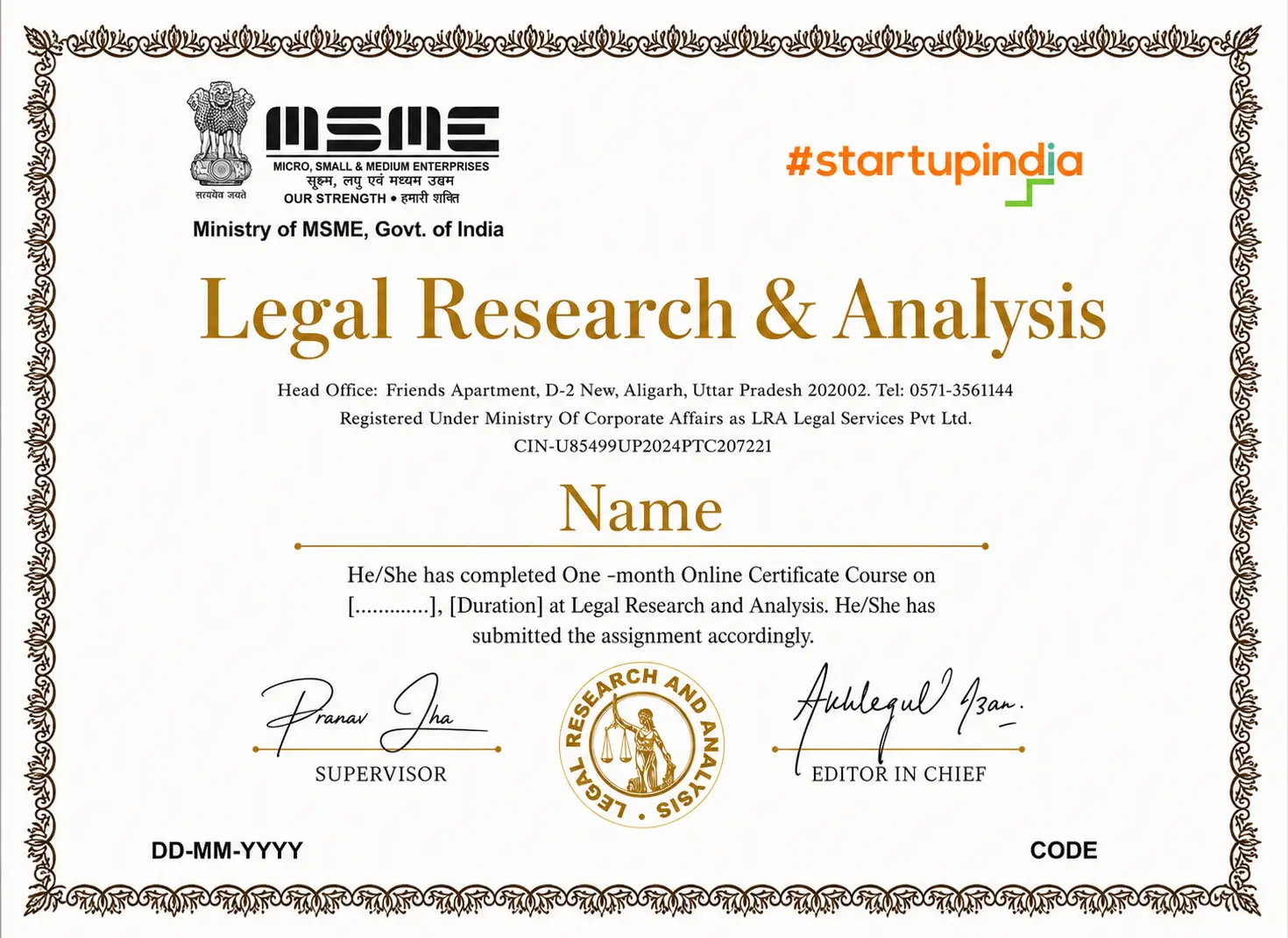
Sample E-Certificate
A verifiable e-Certificate of Completion you can add to your resume, LinkedIn profile, and professional portfolio.
Course Benefits
E-Certificate
A verifiable e-Certificate of Completion on finishing the course — recognised across your professional profile.
Internship Opportunity
Eligible participants get a practical internship opportunity with Legal Research and Analysis to apply what they've learned.
Recommendation Letter
Top-ranked participants receive a Recommendation Letter — a strong addition to your resume and applications.
Your Questions About the Taxation & GST Course, Answered
It's a 6-week online programme from Legal Research and Analysis covering the constitutional basis of GST, the meaning of supply, levy and collection, composition scheme, time and value of supply, input tax credit, registration, invoicing, and returns under the CGST Act, 2017 — taught by practising tax and GST advocates.
The total fee is ₹1,500 only — all-inclusive for all 12 live sessions across 6 weeks. The course runs from 22nd July to 27th August 2026, with classes on Wednesday and Thursday, 8:00–9:00 PM IST. The last date to apply is 21st July 2026.
This course is open to law students, legal practitioners, CA/CS/CMA aspirants and professionals, business owners, corporate compliance officers, finance professionals, entrepreneurs, accountants, tax consultants, and researchers. There is no fixed minimum academic eligibility.
Yes. Session 1 begins with foundational definitions under Section 2 of the CGST Act and builds progressively, so participants without a commerce or law background can follow the course alongside CA/CS/CMA aspirants and legal practitioners.
A taxation course typically covers direct tax — tax on income and profit under the Income Tax Act, administered by the CBDT. A GST course covers indirect tax — tax on the supply of goods and services under the CGST/SGST/IGST Acts, administered by the CBIC. This course combines both perspectives so you understand where direct and indirect tax obligations differ.
This is a private professional certificate course from Legal Research and Analysis — it is not a government-issued licence and does not, by itself, confer GST Practitioner registration, which requires separate enrolment under GST rules. It builds the practical, section-wise knowledge that strengthens both job readiness and exam preparation.
Reverse charge mechanism, under Section 9(3) and 9(4) of the CGST Act, shifts the liability to pay GST from the supplier to the recipient in specified situations, and extends to e-commerce operators under Section 9(5). It is covered in detail in Session 4 of this course.
Yes. Every participant who completes the course receives a verifiable e-Certificate of Completion. Top-ranked participants are also eligible for a Recommendation Letter and an internship opportunity with Legal Research and Analysis.
This certificate supports career paths such as GST Practitioner, Tax Consultant, Indirect Tax Manager in corporate finance teams, GST Compliance Officer, and independent tax litigation practice before appellate authorities and tribunals — and is equally useful for business owners managing in-house GST compliance.
The course is taught by Adv. Pranav Ashutosh, who practises tax and GST matters across India, and supervised by Adv. Jha Pranav Kumar, an Advocate at the High Court of Jharkhand, Ranchi.
Related Certificate Courses
Seats Are Limited — Enroll Before 21st July 2026
Join the Certificate Course on Taxation and GST and learn the CGST Act, 2017 section-by-section from practising tax and GST advocates — for just ₹1,500.