
SOCIAL MEDIA REGULATION: BALANCING FREEDOM, PRIVACY AND ACCOUNTABILITY
- RAJESH S K
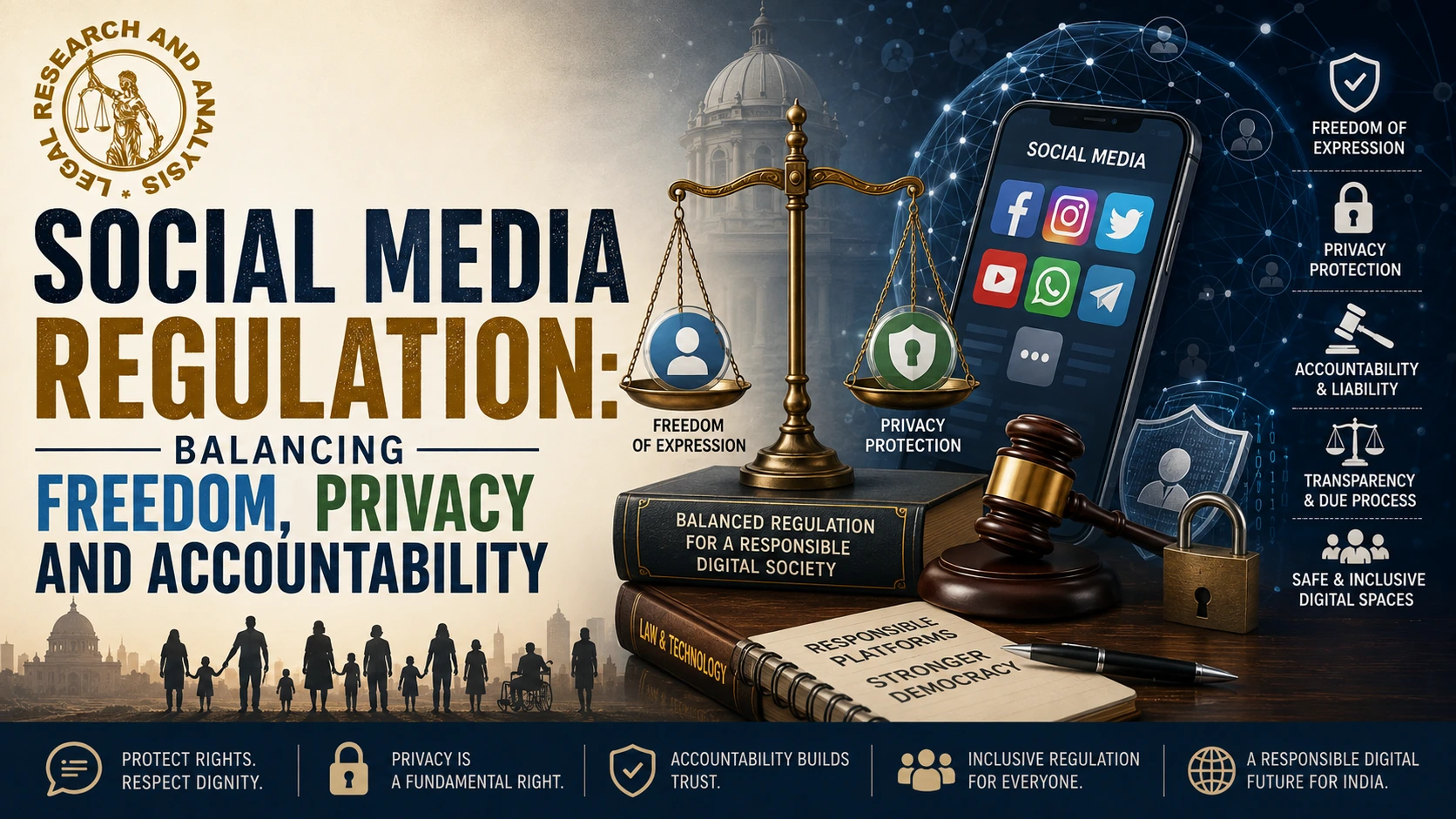
Table of Contents
ABSTRACT
Social media regulation has emerged as one of the most significant legal and policy concerns in the modern digital era. The rapid growth of social networking platforms has transformed the manner in which individuals communicate, exchange ideas, access information, participate in politics, conduct business, and engage with society. Platforms such as Meta Platforms, X Corp., YouTube, and Instagram have become central to public discourse and democratic participation. Social media has enabled instant communication across geographical boundaries and has empowered citizens to express opinions, organize movements, and share information in real time. However, the growing influence of these platforms has also intensified challenges relating to misinformation, hate speech, cyberbullying, privacy violations, online harassment, political manipulation, and digital surveillance.
Governments around the world, including India, have increasingly attempted to regulate social media through legal frameworks, intermediary liability rules, data protection laws, and content moderation obligations. The objective of such regulation is to create safer digital spaces, protect users from harmful content, and ensure accountability of online intermediaries. In India, social media regulation is primarily governed by the Information Technology Act, 2000, the Information Technology (Intermediary Guidelines and Digital Media Ethics Code) Rules, 2021, and the Digital Personal Data Protection Act, 2023. These legal mechanisms aim to balance freedom of speech with public order, national security, and privacy rights.
KEYWORDS: –
Intermediary Liability, Freedom of Expression, Information Technology Act, Digital Personal Data Protection, Content Moderation, Digital Surveillance
This paper critically examines the legal and regulatory framework governing social media in India, focusing on constitutional rights, platform accountability, intermediary liability, freedom of expression, and digital privacy. It further analyses concerns regarding algorithmic manipulation, fake news, online censorship, and governmental surveillance. The paper argues that while regulation is necessary to address harmful online activities, excessive state control over digital communication may threaten democratic values and constitutional freedoms. Therefore, a balanced and transparent regulatory framework that protects both public interest and individual liberties is essential for effective governance of social media platforms in a democratic society.
INTRODUCTION
The emergence of social media platforms has revolutionized communication and transformed the digital landscape globally. Over the past decade, social networking websites and applications have become integral to daily life, influencing politics, education, entertainment, journalism, commerce, and social interaction. Platforms such as Facebook, Instagram, X (formerly Twitter), WhatsApp, and YouTube allow users to create, share, and distribute content instantly to large audiences. The widespread availability of smartphones and affordable internet services has significantly increased digital participation, especially in developing countries like India.
India has become one of the world’s largest internet markets, with millions of active social media users. Social media platforms are widely used for political campaigns, business promotions, educational activities, entertainment, and public awareness initiatives. They have played an important role in promoting democratic participation by providing citizens with spaces to express opinions, criticize governments, and mobilize support for social causes. Social media has also empowered marginalized communities by enabling access to information and creating opportunities for social inclusion.
Despite these benefits, the rapid expansion of social media has generated serious legal, ethical, and social concerns. The unregulated spread of misinformation and fake news has threatened public order and electoral integrity. Online hate speech and communal content have contributed to social tensions and violence. Cyberbullying, trolling, revenge pornography, identity theft, and online harassment have increased significantly, particularly affecting women and children. Moreover, social media companies collect vast amounts of user data, raising concerns about privacy violations, surveillance, and unauthorized commercialization of personal information.
Another major concern relates to the role of algorithms in influencing user behavior. Recommendation systems often prioritize sensational or emotionally charged content to maximize user engagement, thereby creating echo chambers and spreading misinformation rapidly. Such algorithmic manipulation may distort democratic discourse and affect public opinion.
To address these challenges, governments across the world have introduced regulations aimed at ensuring accountability of social media platforms. In India, the Information Technology Act, 2000 and the Information Technology Rules, 2021 establish obligations for intermediaries regarding content moderation, grievance redressal, and cooperation with law enforcement authorities. Simultaneously, constitutional protections under Articles 19 and 21 safeguard freedom of speech and the right to privacy.
The central issue in social media regulation lies in balancing competing interests. While regulation is necessary to prevent misuse of digital platforms, excessive restrictions may lead to censorship and suppression of dissent. Therefore, an effective regulatory framework must strike a balance between protecting users from online harms and preserving democratic freedoms.
RESEARCH METHODOLOGY
This study employs a doctrinal and analytical research methodology to examine the legal framework governing social media regulation in India. The methodology is structured as follows:
- Secondary Sources: A comprehensive review of secondary literature was conducted, incorporating academic law review articles, government transparency reports, judicial commentaries, and global digital governance frameworks.
- Primary Sources: The research relies on primary legal texts, including the Information Technology Act, 2000, the IT (Intermediary Guidelines and Digital Media Ethics Code) Rules, 2021, and the Digital Personal Data Protection Act, 2023. It also analyzes fundamental constitutional provisions, specifically Article 19(1)(a) (Freedom of Speech) and Article 21 (Right to Privacy).
- Qualitative Approach: The study adopts a qualitative, evaluative approach. It interprets statutory provisions and subjects them to judicial scrutiny through landmark Supreme Court precedents to assess whether current regulations strike a proportionate balance between public order and individual liberties
LITERATURE REVIEW
The intersection of state regulation, platform accountability, and constitutional rights has generated substantial academic and legal discourse globally. The literature can be categorized into three core thematic areas:
The Evolution of Intermediary Liability vs. Freedom of Speech
Historically, digital intermediaries enjoyed broad immunity under “safe harbor” doctrines, treating platforms as passive conduits for user-generated content. However, scholars note that as platforms like Meta, X, and YouTube evolved into central pillars of public discourse, this absolute immunity became unsustainable.
In the Indian context, academic literature heavily focuses on Section 79 of the Information Technology Act, 2000. Early legal critiques argued that the subjective nature of online speech moderation often led to over-compliance and private censorship. This culminated in the landmark Shreya Singhal v. Union of India (2015) decision, where the Supreme Court struck down Section 66A, establishing that vague restrictions on online speech cause a “chilling effect” on free expression.
Algorithmic Governance, Misinformation, and Public Order
Modern research increasingly shifts focus from manual content curation to algorithmic manipulation. Literature reveals that recommendation systems are inherently designed to maximize user engagement by prioritizing sensationalist, emotionally charged, or polarizing content.
Scholars argue that this algorithmic architecture creates insular “echo chambers” that accelerate the viral spread of fake news, hate speech, and communal propaganda. Regulatory responses, such as India’s IT Rules, 2021, attempt to curb this by enforcing strict timelines for content removal and introducing automated filtering tools. However, digital rights scholars critique these measures, noting that automated moderation often lacks contextual awareness, resulting in the arbitrary suppression of political dissent, journalistic reporting, and minority voices.
Data Surveillance and the Constitutional Right to Privacy
The commercial business model of social media networks relies on the mass harvesting, processing, and monetization of personal behavioral data. Legal scholars have long raised alarms over the lack of meaningful user consent and the rise of corporate surveillance state models.
The constitutional landscape in India shifted dramatically following Justice K.S. Puttaswamy v. Union of India (2017), which elevated the right to privacy to a fundamental right under Article
21. Literature evaluating the subsequent Digital Personal Data Protection (DPDP) Act, 2023 acknowledges its steps toward establishing data fiduciary accountability and user rights. Nevertheless, a significant sub-section of legal literature criticizes the broad exemptions granted to state agencies under the Act, arguing they could legitimize unchecked state surveillance and dilute constitutional privacy protections.
**
RESEARCH QUESTION
To what extent do the compliance requirements and data traceability mandates under the Information Technology Rules, 2021, and the Digital Personal Data Protection Act, 2023, balance the state’s interest in national security and public order without disproportionately infringing upon the fundamental rights to freedom of speech (Article 19) and privacy (Article 21) as guaranteed under the Indian Constitution?
Context & Justification
This research question addresses the central dilemma highlighted in the text:
- The Constitutional Side: The supreme judicial precedents established in cases like Shreya Singhal v. Union of India (protecting free speech online) and Justice K.S. Puttaswamy v. Union of India (recognizing privacy as a fundamental right).
- The Legislative Side: The implementation of strict obligations for intermediaries, such as tracking the “first originator” of messages.
- The Core Tension: How to regulate platforms to eliminate online harms (like fake news and hate speech) while preventing “excessive state control” and “arbitrary censorship”.
NEED FOR SOCIAL MEDIA REGULATION
The increasing influence of social media in public life has created a pressing need for regulation. Digital platforms affect not only communication but also social stability, political systems, economic activities, and national security. Several reasons justify the regulation of social media platforms.
Spread of Fake News and Misinformation
One of the most serious concerns associated with social media is the rapid spread of false information. Fake news can influence elections, create panic, damage reputations, and disturb communal harmony. Due to the speed and reach of digital communication, misinformation often spreads faster than verified information. During emergencies and public health crises, misleading content may cause widespread confusion and fear. Therefore, regulatory mechanisms are necessary to ensure responsible dissemination of information.
Cyberbullying and Online Harassment
Social media platforms are frequently misused for cyberbullying, stalking, trolling, defamation, and gender-based harassment. Women, journalists, activists, and minority groups often become targets of abusive online behavior. Online harassment may have severe psychological and emotional consequences for victims. Regulation is necessary to establish mechanisms for reporting harmful content and ensuring timely action against offenders.
Data Privacy and Surveillance Concerns
Social media companies collect large quantities of personal data, including location details, browsing habits, preferences, and private communications. This data is often processed and monetized without fully informed user consent. Unauthorized data sharing and surveillance practices threaten the right to privacy. Regulatory frameworks are therefore required to ensure transparency, informed consent, and accountability in data processing practices. i.
Hate Speech and Extremism
Digital platforms may amplify communal hatred, extremist propaganda, and violent content. Hate speech targeting religious, ethnic, or social groups can lead to social unrest and violence. Since harmful content spreads rapidly online, governments seek to regulate social media to maintain public order and national security.
Child Safety and Protection
Children and teenagers are vulnerable to online predators, explicit content, cyber exploitation, and harmful digital challenges. Excessive exposure to social media may also negatively affect mental health and academic performance. Regulations aimed at age verification, parental control, and child protection are essential to create safer digital environments for minors.
National Security and Public Order
Social media platforms may be misused for spreading terrorist propaganda, inciting violence, or coordinating unlawful activities. Governments therefore consider digital regulation necessary for safeguarding national security and preventing cyber threats.
Accountability of Digital Intermediaries
Initially, social media companies enjoyed broad immunity regarding user-generated content. However, as platforms gained influence over public discourse, demands for accountability increased. Regulation seeks to ensure that intermediaries act responsibly in removing unlawful content and addressing user grievances.
LEGAL FRAMEWORK GOVERNING SOCIAL MEDIA IN INDIA
India has developed a legal framework to regulate digital communication and social media platforms. The primary laws governing social media include the Information Technology Act, 2000, the IT Rules, 2021, the Digital Personal Data Protection Act, 2023, and relevant provisions of criminal law.
Law / Regulation Key Provisions Impact
| Information Technology Act, 2000 |
Governs cyber offences and intermediary liability |
Foundation of digital regulation |
IT Rules, 2021, Due diligence obligations for intermediaries Platform accountability
| Digital Personal Data Protection Act, 2023 |
Protection of personal data and privacy |
User data safeguards |
| Indian Penal Code / Bharatiya Nyaya Sanhita provisions | Punishment for hate speech, threats, and defamation | Criminal liability for misuse |
Constitutional Articles 19 and 21, Freedom of speech and right to privacy
Information Technology Act, 2000
The Information Technology Act, 2000 serves as the foundational cyber law legislation in India. It provides legal recognition to electronic communication and establishes penalties for cyber offences. The Act also defines the liability of intermediaries under Section 79, which grants conditional immunity to platforms for third-party content, provided they exercise due diligence and comply with legal obligations.
The Act contains provisions dealing with hacking, identity theft, cyber fraud, publication of obscene material, and unauthorized access to computer systems. It empowers the government to block online content in the interest of sovereignty, national security, public order, and prevention of offences.
Information Technology Rules, 2021
The Information Technology (Intermediary Guidelines and Digital Media Ethics Code) Rules, 2021 introduced stricter obligations for social media intermediaries. Significant social media intermediaries are required to appoint grievance officers, nodal contact persons, and compliance officers. Platforms must remove unlawful content within prescribed timelines and establish grievance redressal mechanisms.
The Rules also require intermediaries to exercise due diligence in content moderation and cooperate with law enforcement agencies. Messaging platforms may be required to identify the “first originator” of certain messages in specific circumstances, raising concerns about encryption and privacy.
Digital Personal Data Protection Act, 2023
The Digital Personal Data Protection Act, 2023 aims to regulate the processing of personal data and strengthen user privacy rights. The law establishes obligations for data fiduciaries regarding consent, transparency, data security, and lawful processing. Users are granted rights relating to access, correction, and erasure of personal data.1
The legislation seeks to create a framework that balances innovation with privacy protection. However, critics argue that certain exemptions granted to government agencies may weaken privacy safeguards.
Constitutional Protections
The Indian Constitution guarantees freedom of speech and expression under Article 19(1)(a). However, Article 19(2) permits reasonable restrictions in the interests of sovereignty, public order, decency, morality, and national security.2
Additionally, the right to privacy has been recognized as a fundamental right under Article 21 by the Supreme Court. Therefore, social media regulation must comply with constitutional principles and avoid disproportionate interference with individual liberties.
POSITIVE IMPACTS OF SOCIAL MEDIA REGULATION
Reduction of Harmful Content
Regulatory frameworks encourage platforms to remove illegal content such as hate speech, child exploitation material, terrorist propaganda, and fake news. This contributes to safer online environments.
Protection of User Privacy
Data protection laws strengthen user control over personal information and restrict unauthorized data collection and sharing practices.
Increased Accountability
Social media companies are increasingly required to establish grievance mechanisms and respond to complaints efficiently. This improves platform accountability and transparency.
Prevention of Cybercrime
Regulation assists law enforcement agencies in addressing cyber offences such as identity theft, financial fraud, cyberstalking, and online harassment.
Promotion of Responsible Digital Governance
Rules relating to transparency reports, content moderation policies, and algorithmic accountability encourage ethical digital governance practices.
CHALLENGES IN SOCIAL MEDIA REGULATION
Despite its benefits, regulating social media presents several practical and constitutional challenges.
Threat to Freedom of Expression
Excessive governmental control over digital content may suppress dissent and restrict democratic debate. Broad or vague laws may result in censorship and chilling effects on free speech.
Arbitrary Content Moderation
Platforms often remove or restrict content based on internal policies that may lack transparency or consistency. Such decisions can disproportionately affect journalists, activists, and minority voices.
Jurisdictional Difficulties
Social media companies operate globally, making enforcement of national laws difficult. Differences in legal standards across countries create regulatory complexities.
Privacy Concerns
Requirements relating to traceability and surveillance may undermine encryption and violate user privacy rights.
Compliance Burden on Smaller Platforms
Smaller intermediaries may face financial and operational difficulties in complying with extensive regulatory requirements.
Algorithmic Bias and Manipulation
Recommendation systems may reinforce polarization, misinformation, and discriminatory practices. Lack of transparency regarding algorithms remains a major challenge.
LANDMARK JUDICIAL DECISIONS
Shreya Singhal v. Union of India
The Supreme Court struck down Section 66A of the Information Technology Act3 for violating freedom of speech and expression. The Court held that vague restrictions on online speech were unconstitutional.4
Justice K.S. Puttaswamy v. Union of India
The Court recognized privacy as a fundamental right under Article 21. This judgment significantly influenced debates regarding surveillance, data protection, and digital privacy.5
Anuradha Bhasin v. Union of India
The Supreme Court emphasized that internet access is integral to freedom of speech and trade. The judgment highlighted the importance of proportionality in restrictions on digital communication.6
SUGGESTIONS FOR EFFECTIVE SOCIAL MEDIA REGULATION
- Regulations should be transparent, proportionate, and consistent with constitutional values.
- Independent oversight mechanisms should monitor governmental and platform actions.
- Digital literacy programs should educate users about misinformation and online safety.
- Strong data protection standards should ensure informed consent and privacy safeguards.
- Social media companies should improve transparency in content moderation and algorithmic practices.
- International cooperation is necessary to address cross-border cyber threats and digital crimes.
- Judicial review should remain available to prevent arbitrary censorship or misuse of regulatory powers.
CONCLUSION
Social media regulation has become essential in the digital age due to the growing influence of online platforms on society, governance, democracy, and individual rights. Social media has transformed communication by enabling instant access to information, encouraging political participation, and promoting economic and social interaction. However, these benefits have been accompanied by serious challenges such as misinformation, cybercrime, hate speech, online harassment, privacy violations, and algorithmic manipulation.
India has responded to these concerns through legal mechanisms such as the Information Technology Act, 2000, the Information Technology Rules, 2021, and the Digital Personal Data Protection Act, 2023. These frameworks aim to create safer digital spaces and ensure accountability of social media intermediaries. At the same time, constitutional protections relating to freedom of speech and privacy continue to play a crucial role in limiting excessive state control.7 The regulation of social media requires a careful balance between competing interests. Overregulation may threaten democratic freedoms and lead to censorship, while absence of regulation may permit harmful online behavior and misuse of digital platforms. Therefore, the objective of regulation should not be to suppress free expression but to promote responsible digital governance. A transparent, rights-based, and balanced regulatory framework supported by judicial oversight, ethical platform governance, and public awareness is necessary to ensure that social media remains safe, inclusive, and democratic. As technology continues to evolve, laws governing digital communication must adapt to emerging challenges while safeguarding constitutional values, individual liberties, and the fundamental principles of democracy.
REFERENCES
- Information Technology Act, 2000 (India). https://www.indiacode.nic.in/bitstream/123456789/13116/1/it_act_2000_updated.pdf
- Information Technology (Intermediary Guidelines and Digital Media Ethics Code) Rules, 2021 (India).https://www.meity.gov.in/static/uploads/2026/02/550681ab908f8afb135b0ad42816a1c9.p df
- Digital Personal Data Protection Act, 2023 (India). https://www.meity.gov.in/static/uploads/2024/06/2bf1f0e9f04e6fb4f8fef35e82c42aa5.pdf
- Shreya Singhal v. Union of India, 2015 SCC 5 (India). https://indiankanoon.org/doc/110813550/
- Justice K.S. Puttaswamy (Retd.) v. Union of India, 2017 SCC 10 (India). https://indiankanoon.org/doc/91938676/
- Anuradha Bhasin v. Union of India, 2020 SCC 3 (India). https://indiankanoon.org/doc/82461587/
- Ministry of Electronics and Information Technology (India). (2021). IT Rules for intermediaries.
- Supreme Court of India. (2015). Judgments on freedom of speech and IT Act. https://indiankanoon.org/doc/110813550/
- Government of India.(2023). Digital Personal Data Protection Act overview. https://www.meity.gov.in/static/uploads/2024/06/2bf1f0e9f04e6fb4f8fef35e82c42aa5.pdf
- Constitution of India (1950), Articles 19 and 21. https://indiankanoon.org/doc/1218090/
CASE LAW
Shreya Singhal v. Union of India (2015)
Ruling: The Supreme Court of India struck down Section 66A of the Information Technology Act, 2000. https://indiankanoon.org/doc/110813550/
Significance: The Court held that vague restrictions on online speech were unconstitutional, ruling that the section directly violated the fundamental right to freedom of speech and expression.
Justice K.S. Puttaswamy v. Union of India (2017)
Ruling: The Supreme Court explicitly recognized privacy as a fundamental right. https://indiankanoon.org/doc/127517806/
Significance: The Court grounded the right to privacy under Article 21 of the Constitution, heavily influencing ongoing legislative and policy debates regarding state surveillance, data protection, and digital privacy.
Anuradha Bhasin v. Union of India (2020)
Ruling: The Supreme Court examined the legality of internet shutdowns and restrictions. https://indiankanoon.org/doc/82461587/
Significance: The Court emphasized that internet access is integral to exercising both freedom of speech and the freedom to carry out trade. It highlighted that any government restrictions placed on digital communication must strictly adhere to the principle of proportionality.
FOOTNOTES
- The Digital Personal Data Protection Act, No. 22 of 2023, INDIA CODE. ↩︎
- INDIA CONST. art. 19, cl. 1(a), art. 21. ↩︎
- The Information Technology Act, No. 21 of 2000, INDIA CODE. ↩︎
- Shreya Singhal v. Union of India, (2015) 5 S.C.C. 1 (India). ↩︎
- Justice K.S. Puttaswamy (Retd.) v. Union of India, (2017) 10 S.C.C. 1 (India). ↩︎
- Anuradha Bhasin v. Union of India, (2020) 3 S.C.C. 1 (India). ↩︎
- The Information Technology Act, No. 21 of 2000, INDIA CODE. ↩︎
+919458479236



Questions of medical negligence have acquired increasing importance in India as healthcare has moved into a more rights-conscious and legally supervised environment.… Continue reading

Waste generation has emerged as one of the most serious environmental challenges facing India today. Population growth, rapid urbanization, and increasing consumption patterns have… Continue reading

Environmental protection has become a global priority as industrialization and urban development continue to expand rapidly. Industries contribute significantly to economic growth… Continue reading