
Certificate Course on
POCSO Law
Online Child
Protection Law Certification India
Follow the complete POCSO case journey — reporting, FIR registration, investigation, child-friendly procedure, evidence, Special Court trial, bail, remedies, and institutional safeguarding through 8 live case-centric classes plus orientation and concluding sessions. Designed for legal professionals, HR & compliance teams, teachers, healthcare staff, and NGO workers. 4 weeks, 10 sessions — just ₹1,000.
What Is POCSO Law?
POCSO Law is designed as a practical programme rather than a purely section-wise study. It traces the progression of a POCSO matter from reporting and investigation through evidence, trial and remedies, while also examining institutional safeguarding in schools, healthcare organisations, NGOs, and other child-facing establishments.
Statutory Framework
The POCSO Act, POCSO Rules, and their interaction with general criminal and child-protection laws.
POCSO Offences
Penetrative and aggravated sexual assault, sexual harassment, and technology-facilitated exploitation.
Full Legal Lifecycle
Traces POCSO cases step-by-step from initial reporting and FIR registration through trial and appeal.
Child-Friendly Safeguards
Special evidentiary rules, forensic and medical evaluation, digital evidence, and protection during court proceedings.
Special Court Practice & Bail
Jurisdiction, prosecution and defense strategies, and judicial approaches to bail and sentencing.
Institutional Safeguarding
Practical guidance on handling disclosures, reporting duties, and child-protection protocols for organisations.
Why POCSO Knowledge Is Essential Today
Rising cases, growing digital exposure, and expanding institutional accountability mean anyone dealing with children — as a lawyer, educator, healthcare provider, HR professional, or NGO worker — needs working knowledge of the following, which is exactly what this course is structured around.
POCSO Act, 2012
Defines offences, procedures, and Special Court mechanisms for child sexual offences.
POCSO Rules
Procedural safeguards, support persons, and compensation mechanisms.
Mandatory Reporting
Legal duty to report, and consequences of failure to report under the Act.
Special Juvenile Police Units
Dedicated police mechanisms for sensitive, child-friendly investigation.
Digital & Cyber Offences
Online grooming, technology-based exploitation, and links with the IT Act.
Special Courts
Designated courts with in-camera trials and child-friendly procedures.
Institutional Compliance
Safeguarding obligations for schools, healthcare bodies, and corporate HR teams.
Victim Compensation
Remedies, rehabilitation, and access to legal aid for survivors.
Who Should Enroll In This Course
A Practical Certificate Course, Not Just Theory
This Certificate Course on POCSO Law is designed as a practical programme rather than a purely section-wise study. Participants follow the progression of a POCSO matter from reporting and investigation through evidence, trial and remedies, while also examining institutional safeguarding in schools, healthcare organisations, NGOs and other child-facing establishments — covering the comprehensive statutory framework, the full legal lifecycle of a case, child-friendly safeguards and forensics, Special Court practice and bail, and institutional safeguarding and compliance.
What Makes This Course Different
Comprehensive Statutory Framework
Covers the POCSO Act, POCSO Rules, and interdisciplinary criminal frameworks.
Full Legal Lifecycle
Traces POCSO cases step-by-step from initial reporting, FIR registration, and investigation to trial and appeal.
Child-Friendly Safeguards & Forensics
Focuses on special evidentiary rules, forensic and medical evaluation, digital evidence, and child protection during court proceedings.
Special Court Practice & Bail
Examines jurisdiction, prosecution, defense strategies, and judicial approaches to bail and sentencing.
Institutional Safeguarding & Compliance
Delivers practical guidance on handling disclosures, reporting duties, and child-protection protocols for schools, healthcare, NGOs.
Case Studies & Simulations
Develops practical skills through case studies, drafting, and simulations.
Live + Recorded Classes
Attend live on Google Meet or catch up anytime with session recordings.
Assignment-Based Certification
A structured assignment ensures practical application before the e-certificate is issued.
Internship & LOR Pathway
Full attendance and timely submission open the door to an internship and recommendation letter.
POCSO Legislative Framework
Develop a sound understanding of the POCSO legislative framework.
Offences & Duties
Understand principal offences, statutory duties and procedural safeguards.
Reporting & Investigation
Study reporting, FIR registration, investigation and evidence collection.
Institutional Roles
Examine the roles of police, Special Juvenile Police Units, prosecutors and Special Courts.
Evidence & Forensics
Study medical, forensic, documentary and electronic evidence.
Trial & Remedies
Examine bail, trial, judgment, appeal, compensation and rehabilitation.
4 Weeks · 8 Classes + 2 (Orientation & Concluding)
Exact curriculum as designed by LRA faculty — every session pairs statute with case-based, practice-oriented discussion.
WEEK 1Foundations & Statutory Offences
Orientation Session
- Welcome and Course Overview
- Introduction to Child Protection and the Relevance of POCSO
- Course Structure, Learning Outcomes & Assessment
- Introduction to Faculty and Participants
Introduction to POCSO Law & Child Protection
- Historical background, need, objectives, scope, applicability, and key definitions — establishing the Act's gender-neutral and child-centric legal base
- Consent and age criteria, relationship between victim and accused, structure of the Act and Rules, and its interaction with general criminal and child-protection laws
Sexual Offences, Abetment, Attempt & Punishment
- Encompasses penetrative and aggravated penetrative sexual assault, sexual assault and aggravated sexual assault, sexual harassment, and exploitation through pornography or technology
- Covers abetment, attempt, essential ingredients, statutory distinctions, and the punishment structure defining liability and sentencing under POCSO
WEEK 2Reporting, Investigation & Victim Support
Reporting, FIR & Investigation
- Mandatory reporting framework, persons authorized to report, consequences of non-reporting, and registration of FIR with prompt police response
- Role of police and Special Juvenile Police Unit, recording of the child's statement, and ensuring a sensitive, child-friendly investigation
- Collection and preservation of physical, documentary, medical, and digital evidence, plus proper documentation through witnesses, case diary, and charge-sheet/final report
Child-Friendly Procedure, Medical Examination & Victim Support
- Recording the child's statement with protection against intimidation, ensuring the supportive role of parents, guardians, and trusted persons
- Statement before Magistrate with procedural safeguards, and medical examination covering purpose, process, documentation, and forensic aspects
- Emphasizes the responsibilities of doctors and medical professionals in evidence collection and victim support within a coordinated child-protection framework
WEEK 3Evidence, Digital Offences & Special Courts
Evidence, Forensics & Digital Offences
- Oral, documentary, medical, forensic, and electronic proof; child testimony, credibility, admissibility, and legal presumptions
- Online grooming, social-media and mobile evidence, technology-based exploitation, and links with the IT Act and cyber-investigation
Special Courts, Bail & Trial Practice
- Designation, jurisdiction, and functioning of Special Courts; role of Special Public Prosecutor; cognizance and trial process
- Safeguards in courtroom environment and recording of evidence ensuring protection and comfort of child victims
WEEK 4Trial, Remedies & Institutional Safeguarding
Trial, Judicial Approach & Remedies
- Framing of charges, examination-in-chief, cross-examination, re-examination, and roles of medical, expert, and investigating witnesses
- Age determination, delayed reporting, medical contradictions, presumptions, sentencing, and judicial approach in final arguments and judgment
- Appeal, revision, compensation, rehabilitation, and access to legal aid for victims
POCSO for HR, Education, Healthcare & Institutional Safeguarding
- HR responsibilities in child protection, reporting and escalation, handling misconduct, documentation, confidentiality, and risk management
- School safeguarding protocols, staff conduct codes, reporting concerns, and student protection measures
- Integration of child-safety standards across HR, education, and healthcare sectors to ensure accountability and preventive frameworks
Concluding Session
- Recap of all modules and open Q&A with faculty
- Career guidance and next steps in POCSO and child-protection law
- E-Certificate, recommendation letter and internship process explained
Key Statutes & Instruments You'll Study
This course is built around real statutory text, procedure and institutional practice — not just definitions. You will engage with the following instruments across the 4 weeks:
Reporting & Investigation Under POCSO
Every legal professional, HR manager, teacher, and healthcare worker needs to know exactly what happens the moment a disclosure is made. This course covers:
Duty to Report
Who is legally required to report, and the consequences of failing to do so.
FIR Registration
Prompt police response and correct procedure for registering a POCSO FIR.
Special Juvenile Police Unit
The dedicated police mechanism responsible for child-sensitive investigation.
Child's Statement
Recording the statement with protection against intimidation and re-traumatisation.
Medical Examination
Purpose, process, documentation, and forensic aspects of the medical evaluation.
Evidence Preservation
Collection of physical, documentary, medical, and digital evidence for trial.
How a POCSO Case Proceeds — Complete Process Workflow
POCSO Law was enacted to build a child-centric, time-bound process for justice. Here is how a case typically moves from disclosure to resolution:
Disclosure & Mandatory Reporting
A person with knowledge of an offence is legally bound to report it to the police or SJPU.
FIR Registration
Police promptly register the FIR and initiate a child-sensitive investigation.
Child's Statement & Support
The child's statement is recorded with safeguards, in the presence of a trusted support person.
Medical Examination
A forensic and medical evaluation is conducted following prescribed protocols.
Evidence Collection & Charge-Sheet
Physical, documentary, medical and digital evidence is collected and compiled into a final report.
Special Court Trial
The case proceeds before a designated Special Court with in-camera, child-friendly procedure.
Judgment & Sentencing
The court delivers judgment applying statutory presumptions and sentencing guidelines.
Appeal, Compensation & Rehabilitation
Aggrieved parties may appeal, while victims can access compensation and rehabilitation support.
| Aspect | POCSO Special Court | Regular Criminal Court |
|---|---|---|
| Trial mode | In-camera, child-friendly trial | Open court proceedings |
| Prosecution | Special Public Prosecutor | Regular Public Prosecutor |
| Timeline | Time-bound disposal intended under POCSO | Ordinary CrPC/BNSS timelines |
POCSO Law — Key Comparisons
| Aspect | Sexual Assault | Aggravated Sexual Assault |
|---|---|---|
| Nature | Basic offence under the Act | Committed with aggravating circumstances |
| Examples of aggravation | Not applicable | By a person in authority, during communal violence, causing grievous hurt, etc. |
| Punishment | Lower prescribed sentence | Enhanced sentence under the Act |
| Aspect | POCSO Act | IPC / BNS |
|---|---|---|
| Scope | Specialised law for offences against children | General criminal law for all persons |
| Trial forum | Designated Special Courts | Regular criminal courts |
| Procedure | Child-friendly, in-camera safeguards | Standard criminal procedure |
| Aspect | POCSO Bail | Regular Criminal Bail |
|---|---|---|
| Judicial approach | Stringent scrutiny given the vulnerability of the victim | General bail principles apply |
| Special Court role | Decided by the designated Special Court | Decided by the trial or sessions court |
| Aspect | Child Witness | Adult Witness |
|---|---|---|
| Statutory presumption | Presumption of culpable mental state under POCSO in specified cases | No comparable statutory presumption |
| Recording of testimony | Child-friendly safeguards, breaks, and support person present | Standard courtroom examination procedure |
| Aspect | Institutions (Schools, Hospitals, NGOs) | Individuals |
|---|---|---|
| Obligation | Formal safeguarding policy and designated reporting channel | Personal legal duty to report knowledge of an offence |
| Consequence of failure | Institutional liability alongside individual liability | Individual penalty under the Act |
Child-Friendly Safeguards & Victim Support
Support Person
The role of parents, guardians, and trusted persons during statement recording and trial.
In-Camera Proceedings
Trial safeguards that protect the identity and comfort of the child victim.
Breaks & Non-Intimidating Environment
Courtroom safeguards preventing aggressive cross-examination of child witnesses.
Statutory Presumptions
Presumption of culpable mental state and, in specified cases, presumption as to certain offences.
Victim Compensation
Interim and final compensation schemes available to survivors under the framework.
Rehabilitation & Legal Aid
Access to rehabilitation support and free legal aid throughout the case journey.
Emerging Trends In Child Protection Law
Child protection law is evolving fast with technology and stronger institutional accountability — these are the topics shaping practice and career relevance in the years ahead.
Online Grooming
Growing focus on technology-facilitated exploitation and social-media evidence.
POCSO & the IT Act
Increasing overlap between cyber law and child protection prosecutions.
NCPCR Guidelines
Evolving national guidance shaping institutional safeguarding standards.
Institutional Safeguarding Policies
Mandatory child-protection policies across schools, hospitals, and workplaces.
Special Court Digitisation
Video-conferencing and digital evidence protocols in POCSO trials.
Corporate Child-Safety Compliance
HR and compliance teams building POCSO-aligned safeguarding frameworks.
Victim Rehabilitation Models
Strengthening compensation and psycho-social support mechanisms for survivors.
Cross-Border & Online Exploitation
Emerging challenges in tackling exploitation across jurisdictions and platforms.
Career Opportunities After This Course
POCSO Advocate / Litigator
₹5-16 LPAIndependent practice or law firm role handling POCSO cases before Special Courts.
Special Public Prosecutor
₹6-18 LPAProsecuting POCSO cases on behalf of the State before designated Special Courts.
Legal Researcher (Child Rights)
₹4-12 LPAResearch on child-protection law, case law, and policy for think tanks and firms.
Police / SJPU Legal Advisor
₹5-14 LPAAdvising Special Juvenile Police Units on procedure and evidentiary compliance.
Child Protection Officer (NGO)
₹4-10 LPACoordinating case support, reporting, and rehabilitation for child-rights organisations.
Institutional Compliance Officer
₹6-15 LPABuilding POCSO-compliant safeguarding policies for schools, hospitals, and corporates.
HR Safeguarding Officer
₹5-13 LPAManaging child-protection compliance and reporting duties within organisations.
Judicial Officer Aspirant
₹7-20 LPABuilding specialised POCSO knowledge relevant to judiciary examinations and roles.
Medical-Legal / Forensic Consultant
₹5-14 LPASupporting medical evidence and forensic evaluation processes in POCSO matters.
Policy & Training Consultant
₹6-16 LPADesigning training and institutional safeguarding frameworks for organisations.
Independent Consultant
Fee-basedFreelance advisory for schools, NGOs, and corporates on child-protection compliance.
Freelance Researcher
Fee-basedRemote research and publication support on POCSO and child-rights law.
Who Hires POCSO & Child Protection Professionals
At A Glance
| Provider | Legal Research & Analysis |
| Duration | 4 Weeks |
| Classes | 8 Classes + 2 (Orientation & Concluding) |
| Days | Monday & Tuesday |
| Time | 7:00 PM – 8:00 PM |
| Mode | Online — Google Meet |
| Course Fee | ₹1,000 |
| Course Starts | 26 October 2026 |
| Course Ends | 26 November 2026 |
| Last Date to Apply | 25 October 2026 |
Course Benefits
E-Certificate
Internship Opportunity
Letter of Recommendation
Recorded Sessions
Notes & Study Material
Case-Based Learning
Assignment-Based Assessment
Expert Mentorship
Your Faculty For This Course
Meet the expert mentors who bring extensive knowledge and real-world experience in child protection law to guide your learning journey.

Ujjaini Chatterji

Adv. Jha Pranav Kumar
Sample Certificate
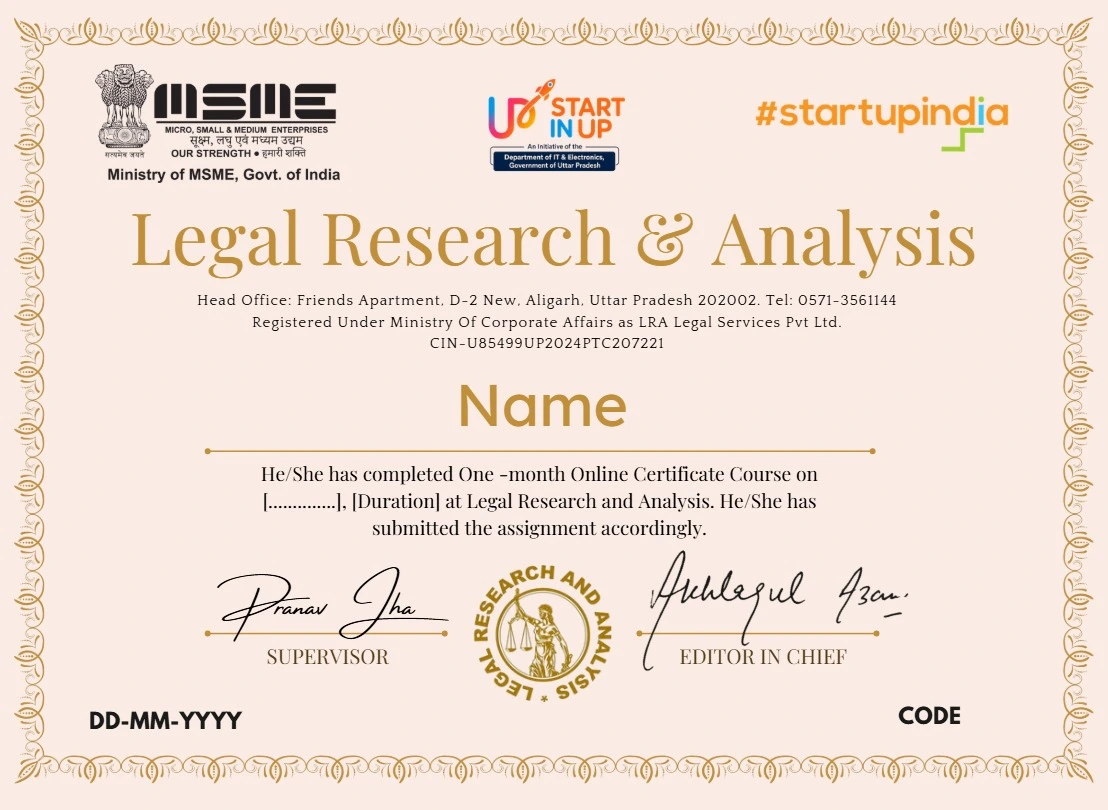
Issued On Completion
Your e-certificate is issued once all sessions and the assignment are completed.
Independently Verifiable
Each certificate carries a unique code that employers and institutions can verify.
Resume Enhancement
A recognised credential in POCSO and child protection law strengthens your resume.
LinkedIn Profile Value
Add a specialised, in-demand certification to your LinkedIn credentials section.
Internship Applications
Use this certificate to support internship and job applications in child protection law.
Why Choose Legal Research & Analysis
Expert Faculty
Learn from a dedicated POCSO expert and practising advocates with real litigation experience.
Live Classes
Interactive live sessions on Google Meet, not pre-recorded video dumps.
Case-Based Learning
Hands-on case studies and simulations, not just theory-heavy lectures.
Internship Support
Internship opportunity and recommendation letter for eligible participants.
Updated Curriculum
Reflects current POCSO practice, procedure, and recent case law.
Full Case-Lifecycle Coverage
From reporting and investigation to trial, remedies, and institutional safeguarding.
Industry-Ready Training
Built to make you job-ready for POCSO litigation and child-safeguarding roles.
Career Guidance
Ongoing support and community for career direction after the course.
Related Certificate Courses
If child-protection law interests you, you may also want to strengthen your understanding with our Women's Rights course, or build a broader foundation with our Criminal Laws course. HR and compliance professionals often pair this with our POSH course and our Cyber Law course for a well-rounded institutional safeguarding skill set. Litigation-focused learners may also explore our Complaint Filing & Procedural Law course and Alternative Dispute Resolution course.
Your Questions, Answered
The Protection of Children from Sexual Offences Act, 2012 (POCSO) is a specialised, gender-neutral legal framework concerning sexual offences against children, covering reporting, investigation, medical examination, Special Courts, evidence, child-friendly procedures and victim protection.
POCSO covers penetrative sexual assault, aggravated penetrative sexual assault, sexual assault, aggravated sexual assault, sexual harassment, and exploitation through pornography or technology, along with abetment and attempt.
Legal professionals, law students, judicial aspirants, HR managers, compliance officers, corporate legal teams, teachers, school administrators, healthcare professionals, NGO workers, social workers, government aspirants, and parents.
Yes. A dedicated module covers POCSO for HR, education, and healthcare settings, including institutional safeguarding, reporting duties, staff conduct codes, and child-protection protocols.
Yes, covering the mandatory reporting framework, persons authorized to report, FIR registration, the role of police and the Special Juvenile Police Unit, and evidence collection.
Yes, examining the designation and jurisdiction of Special Courts, the role of the Special Public Prosecutor, cognizance and trial process, and judicial approaches to bail and sentencing.
Yes, a dedicated session covers online grooming, social-media and mobile evidence, technology-based exploitation, and the interplay between POCSO and the IT Act.
4 weeks, from 26 October to 26 November 2026, with 8 live classes plus an orientation and a concluding session, every Monday and Tuesday, 7 PM to 8 PM, on Google Meet.
Rs.1,000 only — covering all live sessions, study material, e-certificate, internship opportunity, and letter of recommendation for eligible participants.
Yes, participants who attend all sessions and submit the assignment on time are eligible for an internship opportunity, with a Letter of Recommendation on successful completion.
Yes, every participant who attends the sessions and submits the assignment receives a verifiable e-Certificate of Completion in POCSO Law.
It builds a focused foundation for careers in child-protection and POCSO-related legal practice, investigation, prosecution, institutional safeguarding, policy, research, and training.
Yes, a dedicated session covers HR responsibilities in child protection, school safeguarding protocols, staff conduct codes, and integration of child-safety standards across sectors.
Yes, the trial and remedies module covers appeal, revision, compensation, rehabilitation, and access to legal aid for victims under the POCSO framework.
You can enroll by paying the registration fee of Rs.1,000 through the official Razorpay link on this page before the last date to apply, 25 October 2026.
Enroll in the Certificate Course on POCSO Law — Starting 26 October 2026
Join 20,000+ professionals trained by Legal Research and Analysis. Master POCSO offences, reporting and investigation, child-friendly procedure, evidence and digital offences, Special Court practice and bail, trial and remedies, and institutional safeguarding — at just ₹1,000. Limited seats.
⚡ Last date to apply: 25 October 2026 · Monday & Tuesday · 7:00–8:00 PM · Google Meet