
COPYRIGHT IN THE AGE OF GENERATIVE AI: RETHINKING OWNERSHIP, AUTHORSHIP AND INFRINGEMENT UNDER INDIAN INTELLECTUAL PROPERTY LAW
- Adv. Nisha Ismail
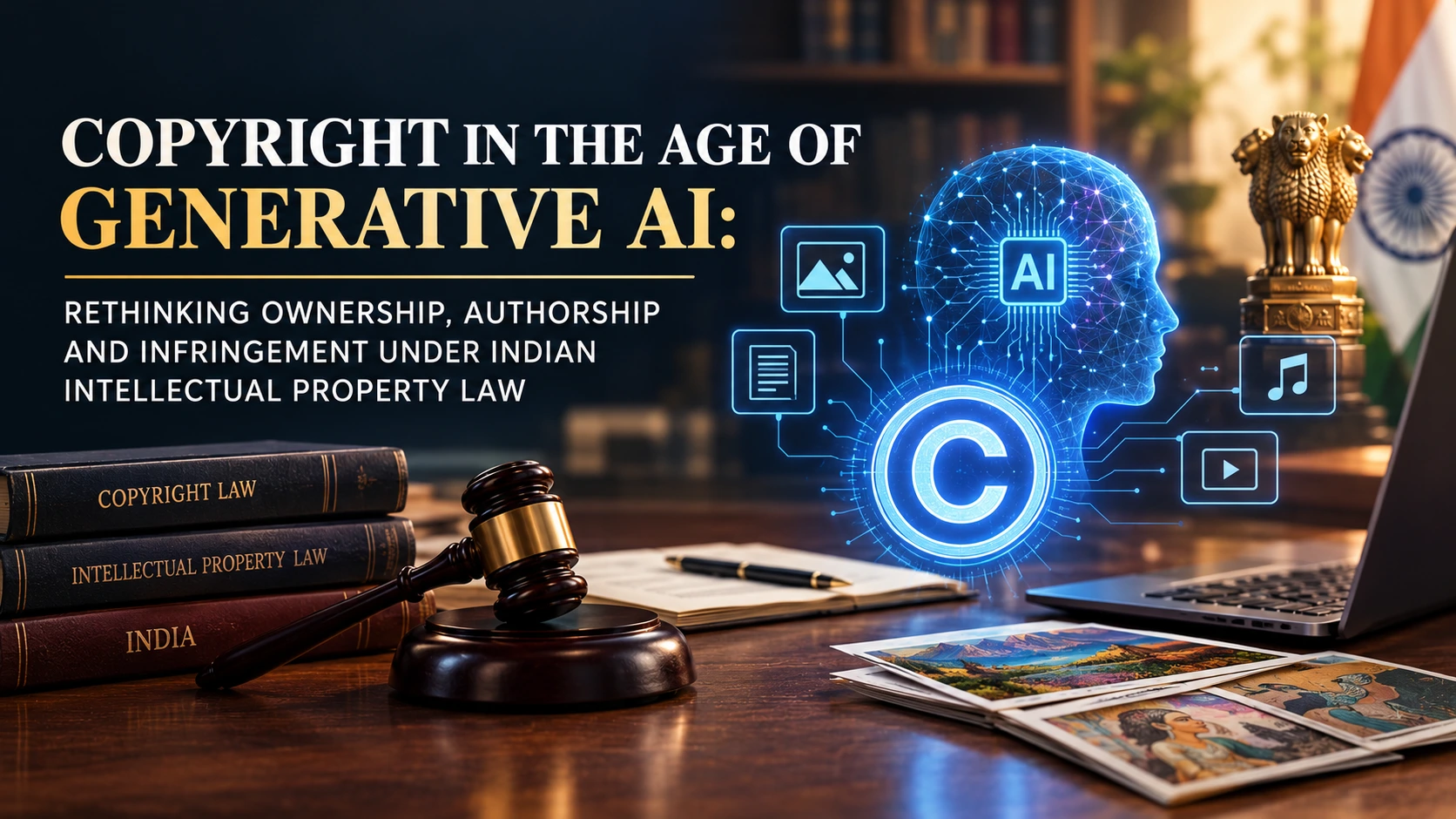
Table of Contents
Abstract
Generative AI (GenAI) is transforming the relationship between creativity, technology, and intellectual property. By producing text, images, music, and other content using vast datasets that often include copyrighted material, it challenges traditional copyright laws that are built around human authorship and creativity.
The Indian Copyright Act, 1957 does not provide a comprehensive framework for generative AI. However, Section 2(d)(vi)[1which refers to the person who causes a computer-generated work to be created, offers a possible starting point for addressing AI-generated content. This provision is important but cannot by itself answer whether every AI-generated output is copyrightable. Authorship and originality remain distinct inquiries.
This article examines four key issues: ownership of AI-generated works, the legal status of AI as an author, the use of copyrighted material for AI training, and the growing link between AI-generated deepfakes and personality rights. The article analyses statutory provisions of India, originality jurisprudence of the Supreme Court, recent Delhi High Court judgments on AI-generated identity misuse, and the landmark judgment in the case of ANI Media Pvt Ltd v OpenAI OpCo LLC (2026)2 and comparative approaches adopted in the United States and European Union.
The article proposes clarification of Section 2(d)(vi), human-contribution guidance, training-data transparency, and licensing mechanisms.
Introduction
Indeed, copyright laws have had to evolve with technological advances, but generative AI is a completely different ballgame since it has the ability to create complete works of art without human input. The main question is whether human involvement is enough to warrant copyright protection, not whether the machine can make creative contributions. Using a single prompt to generate an entire work is very different from a person who selects, modifies, and combines AI- generated pieces. This is also true for training the machines since the machines use data containing copyrighted work.
Indian law already provides relevant concepts. Section 133 identifies works in which copyright subsists; Section 144 defines exclusive rights; Section 175 generally identifies the author as first owner; Section 516 concerns infringement; and Section 527 contains exceptions. Section 2(d)(vi) addresses computer-generated works—these provisions, however, predate foundation models and large-scale generative systems.
The central argument of this article is that Indian copyright law should not respond to generative AI by simply declaring either that “AI owns everything” or that “AI owns nothing”. Instead, the law should distinguish between human creativity assisted by AI, autonomous machine-generated material, and the unauthorised use of protected works to develop AI systems.
The Indian copyright framework and the authorship problem
The Copyright Act, 1957 grants protection to original literary, dramatic, musical and artistic works, cinematograph films and sound recordings under Section 13. Section 14 defines copyright through a bundle of exclusive rights, including reproduction, communication to the public, adaptation and other forms of exploitation.
Section 17 generally establishes the author as the first owner of copyright, subject to statutory exceptions. Consequently, the concepts of author, ownership and originality are closely connected.
Section 2(d)(vi) is particularly important because it states, in relation to a literary, dramatic, musical or artistic work that is computer-generated, that the “author” means the person who causes the work to be created. At first glance, this provision appears capable of accommodating computer-generated works. However, it was drafted in an era when “computer-generated” works generally involved conventional software tools rather than contemporary generative AI systems capable of producing unexpected and autonomous expressive outcomes.
This provision thus raises an important ambiguity. Where a person feeds in a very specific prompt and edits and rearranges AI outputs multiple times, that person can be said to have met the definition of the person who causes the work to be made as per the statutory definition. However, what would be the case when the person simply enters “Create a painting of a futuristic Indian city” and accepts the result?
Indian copyright law focuses on the element of originality and not just effort. As stated by the Supreme Court in Eastern Book Company vs. D.B. Modak8Copyright in India requires some form of intellectual creation, not merely effort.
This aspect is particularly important for AI. Rather than asking whether the person clicked the “generate” button, one must ask whether there was any intellectual input into the generated output. This article therefore asks whether Indian copyright law is ready for the generative AI economy.
Research questions
The research is organised around four principal questions:
- Who owns copyright in works generated through generative AI under the Copyright Act 1957?
- Is the AI system capable of being considered as the “author” according to Indian copyright law?
- Is the use of copyrighted materials for training AI systems an infringement, or does it come under the fair dealing exceptions under Section 52?
- Where AI-generated content reproduces an individual’s face, voice, likeness, or persona, should copyright law operate independently or alongside personality and privacy rights?
Research Methodology
The study adopts a doctrinal and comparative methodology. Indian primary materials include the Copyright Act, Supreme Court originality jurisprudence, and Delhi High Court decisions, particularly ANI Media v OpenAI. Comparative materials include the U.S. Copyright Office’s AI reports, Thaler v. Perlmutter9 and Regulation (EU) 2024/1689 (EU AI Act).
Literature Review
The U.S. Copyright Office’s 2025 report concludes that AI assistance does not automatically defeat copyrightability, but protection depends on human authorship and sufficient human determination of expressive elements; mere prompting is insufficient. Thaler v. Perlmutter similarly confirms the human-authorship requirement for an autonomously generated work. The EU AI Act addresses a different part of the problem. Article 5310 requires providers of general-purpose AI models to maintain copyright-compliance policies and publish sufficiently detailed summaries of training content. Recital 107[1] connects transparency with the interests of copyright holders while recognising trade-secret concerns.
Indian originality doctrine provides the necessary foundation. In Eastern Book Company v D.B. Modak, the Supreme Court required a minimum degree of creativity and rejected labour alone as sufficient. The present article develops this principle for GenAI by asking who made the expressive choices for which protection is claimed.
The statutory foundation: authorship and originality
Section 2(d)(vi)
Section 2(d)(vi) includes an author but does not automatically render every computer-generated output as copyrightable because originality is necessary. The person who gives specific directions, picks outputs, and makes substantial modifications to the final product is more likely to qualify as an author than someone who only receives a simple AI output. Hence, causes the work to be created” must be read in conjunction with the necessity of originality.
Ownership and originality
Section 17 generally makes the author the first owner, but ownership depends on copyright subsisting in the work. The judgment of the Eastern Book Company confirms that originality requires more than mere effort. In GenAI cases, courts should therefore identify the claimed expression and assess whether it reflects human creative choices or is predominantly generated by the AI system.
Who Owns AI-Generated Works?
There are three main approaches to ownership of AI-generated content:
- User as the Copyright Holder
- AI can be viewed as a creative tool, similar to a camera or design software. If the user makes meaningful creative choices in producing the work, they may own the copyright. This aligns with the U.S. Copyright Office’s view that AI-assisted works can be protected when there is sufficient human creativity involved.
- Developer as the Copyright Holder
- Under this model, copyright would belong to the developers of the AI system. However, this approach is generally difficult to justify because developers create the technology, not the specific content generated by users.
- No Copyright for Fully Autonomous AI Outputs
- If a work is created entirely by AI without significant human creative input, it may not qualify for copyright protection and could remain in the public domain. This position is increasingly influential internationally. In Thaler v. Perlmutter, the United States Court of Appeals for the District of Columbia Circuit affirmed in 2025 that copyright requires human authorship and rejected registration of a work autonomously generated by an AI system. Moreover, the court clarified that human use of AI does not itself prevent copyright protection; the problem arises where the work is generated without sufficient human authorship.
A good option is therefore one which considers the extent of human creativity involved.
Can AI itself be an author
The proposition that AI should become an independent author is theoretically attractive but legally problematic.
The difficulties are particularly evident with moral rights. Section 57 of the Indian Copyright Act protects the author’s right to claim authorship and to restrain distortion or modification prejudicial to the author’s honour or reputation. Indian jurisprudence, particularly Amar Nath Sehgal v. Union of India11 has recognised the significance of moral rights as an extension of the author’s relationship with the work. Treating an algorithm as an independent author would raise unresolved questions about ownership, moral rights, liability, royalties, and enforcement.
Currently, there is no sound doctrinal basis on which to approach these problems using the legal personality of AI. The US Copyright Office’s 2026 decision concerning Stephen Thaler’s DABUS12 application reinforces this position. The Office reportedly rejected recognition of DABUS as the legal author, emphasising the statutory concept of a “person” and the necessity of human authorship. The decision followed directions from the Delhi High Court requiring the issue of AI authorship to be considered.
This trend is important as it makes India one of the countries participating in the current international trend of recognizing human authorship instead of machine authorship.
Therefore, AI currently should be viewed as an instrument of creation.
The meaningful human contribution test
There needs to be an express seven-factor test for Indian law which is based on meaningful human creative contribution. The following factors could be considered:
- Extent of human intervention — consider the conception, creation, selection, editing, and finalisation of work. Drafts and versions might show this.
- Precision and originality of the instructions — does the instruction call for particular expressive qualities or just the subject matter? Length alone does not settle the issue.
- Selection and exclusion — multiple creations followed by creative selection might demonstrate the human’s creative control, especially when there are considerable differences between the products.
- Creative selection and sequencing — consider whether selection, sequence, cropping, or other arrangement involves creativity and thus indicates the exercise of creative control.
- Editing by humans — significant editing, rewriting, redrawing, composing, and restructuring weigh more heavily than minor changes in favour of human authorship.
- Combination of AI-generated and human-created material — ascertain the human-created elements and whether the arrangement of those elements is itself expressive and original.
- Final expressive result of control — does the human exercise creative control over the expression being protected?
None of these factors should automatically determine the result. The question is whether the human exercised creative control over the protectable expression.
Does AI training on copyrighted material constitute infringement?
On the other hand, the problem of copyright infringement becomes more complicated when it is associated with the training of artificial intelligence due to the vast quantity of copyrighted data that is analyzed and stored within the system. Developers of the artificial intelligence system can argue that training is nothing but a statistical analysis. Exceptions can be found in Section 52.
ANI Media v OpenAI: the Indian turning point
Section 52(1)(a) safeguards certain kinds of fair dealings, which include personal use and research, in accordance with statutory language. The concept of fair dealing in India should be analyzed through Indian laws, rather than simply applying the American fair use doctrine.
The case of ANI Media Pvt Ltd v OpenAI OpCo LLC is important because it marks the first instance where the issue of AI training has been examined by the Delhi High Court, during a copyright lawsuit. This case dates back to 24 July 2026 and it related to an application for interim injunction in the case, rather than the entire matter. Regarding the interim matter, the Court found that OpenAI’s storage of literary works of ANI for training LLMs behind ChatGPT constituted Section 52(1)(a). There was also a lack of substantial similarity, memorisation, and regurgitation in the outputs examined. Therefore, the interim injunction application was rejected. Notably, the Court mentioned that its observations only applied to the interim application and would not decide the ultimate case.
The judgment thus cannot be seen as an authorisation for commercial training of AI. Its significance is rather in providing an indication of how Section 52 can be interpreted in relation to AI training, acknowledging that the two are different issues. Legislation is also needed to regulate large-scale commercial training.
Training, output and the problem of substantial reproduction
Analysis of training versus output is required separately. The training phase can include the activities of accessing, reproducing, storing, and processing copyrighted works. Output-phase infringement concerns the question of whether a certain generated output has reproduced protected expression from a certain source.
Stage One — Training: Which works have been accessed/copied? Was there any permission, license, or exception to copy? Why was the reproduction done? What was the purpose, storage, and processing?
Stage Two — Output: Is the output a reproduction of protected expression? Is it a substantial similarity? Is the source copyrighted expression or just facts/ideas? Has the output infringed the copyrighted work?
A finding that the training was legitimate does not automatically exempt all outputs. Similarly, the fact that a certain output has been found to be an infringement does not automatically mean that all the training processes were illegitimate.
Deepfakes, copyright and personality rights
The development of generative AI highlights deficiencies in copyright law concerning the protection of identity. Deepfake technology can potentially damage identity, dignity, privacy, reputation and persona even where there is no reproduction of a copyrighted work. The recent cases of Anil Kapoor v. Simply Life India13 and Ravi Shankar v. John Doe14 have resulted in injunctions against unauthorised use of names, images, voices, and other characteristics by AI in the Delhi High Court. Such cases indicate the need to separate the three types of protection: copyright, personality rights, and privacy and dignity.
Comparative perspectives
United States
In its report for 2025, the U.S. Copyright Office draws a distinction between AI assistance and autonomous generation. Expressions that include human creation, human selection and arrangement, and human modifications may be capable of supporting copyright; mere prompting by itself is insufficient where there is no sufficient human determination of expressive elements.
This approach is valuable for India not as a binding norm but as an analytical tool. It focuses on human input into protected expression. Training cases in the United States tend to be fact-specific, underscoring the need to distinguish training copying from infringement of the output.
European Union
Under the EU AI Act, a model of general-purpose artificial intelligence shall have a policy that complies with Union copyright legislation and publish a sufficiently detailed description of training data. In Recital 107, the need for transparency in connection with the legitimate interests of rightsholders is coupled with considerations of confidentiality and trade secrets.
The EU approach does not tell anything about the copyrightability of AI outputs under Indian law. However, it is relevant institutionally, as training-data transparency may balance the evidentiary asymmetry between creators and artificial intelligence providers.
This means that India can adopt the American perspective on human authorship with the European one of transparency.
Proposed reforms for India
The following are suggestions for reform; they are not present in the law as it currently stands.
- Section 2(d)(vi) can be reformed to separate AI-assisted works from those that are not assisted, maintaining the criteria of originality.
- The Indian government could adopt statutory or administrative guidance through a framework involving the seven factors that demonstrate meaningful human contribution, where version histories, prompts, drafts, failed outputs, and edit histories would be considered relevant.
- Companies that provide commercial general-purpose AI systems can be required to maintain sufficient categorization and documentation of their training data, with appropriate confidentiality considerations.
- Parliament can consider the use of collective or extended licensing schemes for commercial use of copyrighted databases.
- India can adopt special protection for the unauthorized reproduction by an AI system of faces, voices, and other unique identity characteristics, with exceptions made for parody, satire, criticism, and journalism
Conclusion
There is no need to opt for either of the two options when using GenAI that acknowledges that AI is the author and therefore does not extend protection to the work created through the assistance of AI. While section 2(d)(vi) will determine the human author, copyright does not necessarily follow; the necessity of originality still holds. The seven-factor approach takes into account human control and recognises protection in human editing.
ANI Media vs OpenAI marks an important interim step forward; however, its procedural nature should be maintained. It did not end the case nor provide a blanket license to train AI. The logic behind it provides grounds for the distinction between copying during the training phase and infringement during the output phase.
Human Authorship of U.S. law and Transparency of EU law can provide each other’s complementary lessons for comparison. However, the future framework in India can utilize the ideas without deviating from its own legal structure. Therefore, a coherent framework should include all four aspects mentioned above.
References
- The Indian Copyright Act, 1957. Sec. 2(d)(vi), 13, 14, 17, 51, 52.https://copyright.gov.in/documents/copyrightrules1957.pdf
- EU Artificial Intelligence Act,2024 https://eur-lex.europa.eu/legal-content/EN/TXT/?uri=CELEX:32024R1689
- ANI Media Pvt Ltd v OpenAI OpCo LLC https://www.scobserver.in/wp-content/uploads/2026/08/DHC-OpenAI-v-ANI-Judgement.pdf
- Eastern Book Company v. DB Modak https://indiankanoon.org/doc/1062099/
- Anil Kapoor v. Simply Life India https://www.scconline.com/blog/post/2025/12/05/india-personality-rights-evolving-law-celebrity-protection/
- Ravi Shankar v John Doe(s) https://iprmentlaw.com/2025/10/06/personality-rights-and-bollywood-when-identity-meets-the-law/
- Amar Nath Sehgal v. Union of India https://www.ijllr.com/post/case-comment-amar-nath-sehgal-vs-union-of-india
- Thaler v Perlmutter https://media.cadc.uscourts.gov/opinions/docs/2025/03/23-5233.pdf
- US Copyright Office, Copyright and Artificial Intelligence. https://www.copyright.gov/ai/
FOOTNOTES
- The Indian Copyright Act sec 2(d)(vi)in relation to any literary, dramatic, musical or artistic work which is computer-generated, the person who causes the work to be created. ↩︎
- ANI Media Pvt. Ltd. v. OpenAI Op Co LLC, CS(COMM) 1028/2024 (2026 DHC 5900) ↩︎
- The Indian Copyright Act, Sec. 13 - Works in which copyright subsists. ↩︎
- The Indian Copyright Act, Sec. 17 - First owner of copyright. ↩︎
- The Indian Copyright Act, Sec. 14 - Meaning of Copyright. ↩︎
- The Indian Copyright Act, Sec. 51 - When copyright is infringed ↩︎
- The Indian Copyright Act, Sec. 52 - Certain acts not to be infringement of copyright. ↩︎
- Eastern Book Company vs. D.B. Modak (2008) 1 SCC 1 ↩︎
- Thaler v. Perlmutter, No. 23-5233 (D.C. Cir. 2025) ↩︎
- EU AI Act (Regulation (EU) 2024/1689) Article 53: Obligations for providers of general-purpose AI models ↩︎
- Amar Nath Sehgal v. Union of India is 2005. ↩︎
- The AI System: DABUS (Device for the Autonomous Bootstrapping of Unified Sentience). ↩︎
- Anil Kapoor v. Simply Life India is CS(COMM) 652/2023 ↩︎
- Ravi Shankar v John Doe CS(COMM) 889/2025 ↩︎
+919458479236



Questions of medical negligence have acquired increasing importance in India as healthcare has moved into a more rights-conscious and legally supervised environment.… Continue reading

Waste generation has emerged as one of the most serious environmental challenges facing India today. Population growth, rapid urbanization, and increasing consumption patterns have… Continue reading

Environmental protection has become a global priority as industrialization and urban development continue to expand rapidly. Industries contribute significantly to economic growth… Continue reading