INTRODUCTION
The cruel and protracted Sierra Leone Civil War, which ranged from 1991 to 2002, left a path of devastation and suffering that is still felt by the nation and the world community today.
The Revolutionary United Front (RUF), a group of rebels with the intention of overthrowing the government and seizing control of Sierra Leone’s diamond mines, started this conflict.
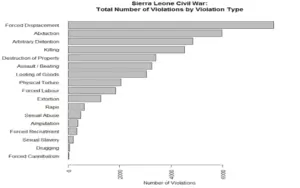
A full-fledged civil war swiftly developed as many factions fought for dominance and control of the available resources. Widespread violations of human rights occurred during the war, including the deployment of child soldiers, mass murder, rape, mutilation, and forced labour.
The world was appalled by the atrocities committed during the conflict, which inspired the international community to take action. Both the African Union and the United Nations made substantial contributions to the effort to end the conflict and bring those accountable for war crimes and crimes against humanity.
In this article, we will examine the Sierra Leone Civil War from the standpoint of humanitarian law, covering the transgressions of international law, the initiatives taken by the international community to stop the conflict, and the impact of the conflict on the evolution of international law. We will also talk about the ongoing initiatives to strengthen international humanitarian law and stop similar tragedies from happening in the future.
BACKGROUND OF THE CONFLICT
Sierra Leone was an African country from 1991 to 2002. Ethnic tensions, economic inequality, political corruption, and outside influences—particularly the involvement of neighbouring nations and international corporations—all contributed to the conflict’s emergence.
Inequality and corruption were major issues in Sierra Leone’s economy. While the bulk of the population lived in poverty, the great mineral riches of the nation, particularly its diamonds, was under the grip of corrupt officials and international businesses.
Many Sierra Leoneans believed they were being exploited and oppressed by a wealthy and powerful minority, which was a major cause of the conflict. The Revolutionary United Front (RUF), a group of rebels, attacked the little town of Bomaru in eastern Sierra Leone in March 1991, which marked the start of the actual battle.
Foday Sankoh, a former army corporal who had received training in Libya and had previously taken part in an aborted coup attempt in 1987, led the RUF.
Large areas of the countryside were swiftly taken over by the RUF, which terrorised the populace by mutilating and amputating body parts. Also, they frequently forcedfully enlisted children as troops, and they were financially supported by diamond smuggling.
The already ineffective and dishonest Sierra Leonean administration was powerless to halt the RUF’s march. Due to the involvement of nearby nations backing the RUF, such as Liberia and Burkina Faso, the conflict swiftly spread internationally.
These nations’ involvement in Sierra Leone was motivated by a variety of factors, including regional power disputes and economic interests. To combat the rebels, the government of Sierra Leone hired foreign mercenaries and private military companies. Elections were promised for February 1996 by the young officers.
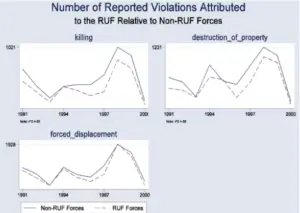
Both sides engaged in horrible atrocities against people for more than ten years of the battle. The majority of the violence was caused by the RUF, although there was also mistreatment by the Sierra Leonean army and numerous international forces.
The RUF and the Sierra Leonean government reached a peace agreement in 2002, formally ending the battle, although its effects are still felt in Sierra Leone today. The struggle in Sierra Leone was intricate and varied, with its origins in a long history of racial conflict, economic injustice, and political corruption.
Even though the conflict was officially over almost 20 years ago, its effects may still be seen in the social, political, and economic climate of Sierra Leone today.
PARTIES TO THE CONFLICT IN SIERRA LEONE
The Revolutionary United Front (R.U.F./S.L.) and the Republic of Sierra Leone Military Forces are the main parties involved in the conflict in Sierra Leone. At various times and to varying degrees, other Parties have also been involved.
They include the Civil Defense Forces (of which the Kamajo2 s militia is the most well-known member), fighters from other nations, and the regional peacekeeping group Economic Community of West African States Monitoring Group (E.C.O.M.O.G.).
Rebel Groups
- The Revolutionary United Front – The main rebel organisation throughout the fight was the Revolutionary United Front (RUF). The RUF was established in 1991 by former Sierra Leonean army corporal Foday Sankoh with the main goal of overthrowing the current administration and establishing a communist state.
- In order to accomplish its objectives, the group swiftly shifted to violent methods, including the employment of child soldiers and the targeting of people. Rape, mutilation, and amputation were just a few of the cruel methods used by the RUF.
- Armed Forces Revolutionary Council (AFRC)- In 1997, the AFRC organised a military coup against President Ahmad Tejan Kabbah’s administration. Up until the intervention of the military force of the Economic Community of West African States (ECOWAS), ECOMOG, the AFRC, which had allied itself with the RUF, had ruled the nation.
Governmental Forces
- Sierra Leone Army- The international community, especially the United Kingdom and the United Nations, supported the government’s military force, the Sierra Leone Army. The RUF’s tactics proved difficult for the army to handle at first, and the battle swiftly got out of hand.
- Civil Defense Forces (CDF)- The Civil Defense Forces (CDF) were a pro-government militia made up of local volunteers, many of whom had formerly belonged to the RUF but now supported the government. In the latter stages of the fight, the CDF was crucial, especially in the countryside. The CDF was accused of committing its share of human rights abuses during the conflict.
International actors
- Economic Community of West African States Monitoring Group (ECOMOG)- ECOMOG was a military group created by the Economic Community of West African States (ECOWAS) to bring peace to Sierra Leone. In order to defeat the AFRC/RUF combination and reinstate the democratically elected government, ECOMOG was crucial.
- United Nations Mission in Sierra Leone (UNAMSIL)- The United Nations established the United Nations Mission in Sierra Leone (UNAMSIL) in 1999 to aid with the execution of the Lomé Peace Accord, which put an end to the violence. Although UNAMSIL had a limited mandate and encountered difficulties carrying out its duties, it was crucial in disarming militants and creating a secure atmosphere.
- Private Military Companies- A number of private military firms, including as Executive Outcomes and Sandline International, participated in the conflict by offering the government of Sierra Leone military support. Critics said that the engagement of these firms jeopardised the UN’s efforts at peacekeeping.
Neighbouring nations
- Liberia- Liberia was charged with giving training, weapons, and other forms of support to the RUF as well as letting RUF fighters to utilise Liberian soil as a base. For its involvement in the conflict, Liberia was subject to sanctions from the UN in 2001.
- Guinea- Guinea was charged with assisting the AFRC and giving RUF fighters a safe haven. Tension between the two countries was greatly exacerbated by Guinea’s involvement in the battle, and Guinea was also charged with assisting rebel organisations after the fight was over.
All of these parties took part in the brutal civil war in Sierra Leone, which also featured numerous violations of human rights. Tens of thousands of people died and millions were forced from their homes as a result of the conflict, which had a terrible effect on Sierra Leonean society.
CHARACTERIZATION OF THE CONFLICT IN SIERRA LEONE
The conflict in Sierra Leone was intricate and multifaceted, with a variety of distinct elements and participants. The dispute is described in full below, along with its underlying causes, distinguishing characteristics, and lasting effects.
Root causes- Combinations of historical, economic, and political elements are to blame for the conflict in Sierra Leone’s origins. They consist of:
- Colonial Legacy- Up until gaining independence in 1961, Sierra Leone was a British colony. The country’s resources were exploited during colonial rule for the profit of the colonisers, which resulted in economic and social inequality.
- Economic Inequality- With high rates of unemployment and poverty, Sierra Leone is one of the world’s poorest nations. The economy of the nation is heavily dependent on the export of natural resources like diamonds, which are frequently governed by foreign elites or corporations.
- Political stability- In the years following independence, coups and countercoups were frequent in Sierra Leone. The country’s one-party system, which repressed political opposition and helped to concentrate power in the hands of a small elite, made this instability worse.
Key features- Some significant characteristics of the Sierra Leone civil war include:
- Brutality and Violence- Extreme brutality and violence were hallmarks of the struggle, with rape, mutilation, and torture committed by both parties. Child soldiers were frequently employed.
- Resource Extraction- The ambition to dominate Sierra Leone’s natural resources, particularly its diamonds, was a contributing factor in the conflict. Diamond sales revenue was utilised by rebel factions to finance their activities.
- External Involvement- Although the conflict originated in Sierra Leone, it spread to its neighbours, including Liberia and Guinea, which supported the rebel factions. In the battle, there were also private military firms that supported the government of Sierra Leone militarily.
- Humanitarian Crisis- As a result of the fighting, millions of people were forced to flee their homes and tens of thousands were slaughtered. Basic services including healthcare and education were denied to many areas.
Ultimately, the conflict in Sierra Leone was intricate and multifaceted, with a variety of distinct fundamental causes, distinguishing characteristics, and lasting effects. Although though there has been a lot of progress achieved in dealing with the effects of the conflict, there are still problems, notably with regards to attaining justice and reconciliation and fostering sustainable economic development.
IMPACT OF INTERNATIONAL HUMANITARIAN LAW
The formation of humanitarian law was significantly influenced by the Sierra Leone civil war. The establishment of the ICC, which came about as a result of the failure of pre-existing international systems to bring war crime perpetrators accountable, was one of the most important developments.
Since then, the ICC has been essential in promoting war criminal responsibility and upholding IHL. The growing focus on civilian security during armed conflict is another development.
Many crimes against civilians were committed throughout the Sierra Leone conflict, including sexual assault, forced relocation, and the enlistment of children as soldiers. As a result, the protection of civilians has been elevated to a core principle of humanitarian law, and policies and procedures to stop and address violations have been developed.
CONCLUSION
The difficulties encountered when putting humanitarian law into practise during the Sierra Leone civil war emphasise the necessity for a coordinated effort to encourage the efficient application of humanitarian law in post-conflict states.
Key components of this approach include creating effective institutional structures, guaranteeing access to impacted communities, encouraging accountability for violations of humanitarian law, and addressing the root causes of conflict.
Post-conflict societies should concentrate on creating efficient institutions for rule of law, security, and governance in order to strengthen institutional frameworks. This entails creating guidelines and practises for looking into and prosecuting violations of humanitarian law as well as making sure that these guidelines are followed. Also important in ensuring accountability and transparency in government institutions are civil society organisations.
The difficulties encountered in putting humanitarian law into practise during the civil war in Sierra Leone emphasise the necessity for a comprehensive strategy to support the efficient application of humanitarian law in post-conflict nations.
Building solid institutional structures, ensuring access to impacted populations, encouraging accountability for transgressions of humanitarian law, and addressing the root causes of conflict should be the main objectives of this strategy. In post-conflict cultures, we may encourage justice, peacemaking, and lasting peace by collaborating to put these tactics into practise.