
ARTIFICIAL INTELLIGENCE AND INTELLECTUAL PROPERTY RIGHTS
- HEENA ANITA PRAVIN BHANEJ
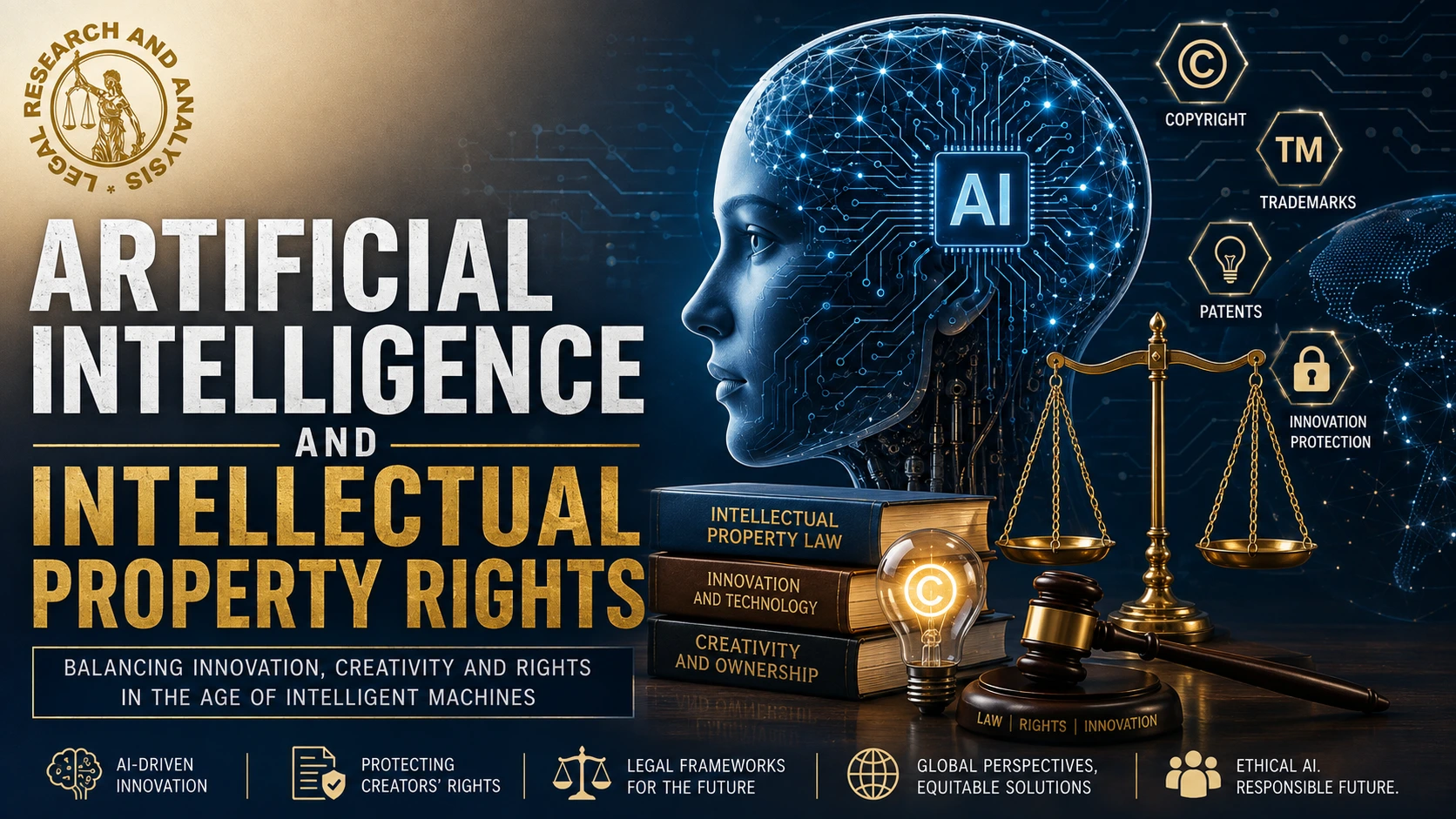
Table of Contents
ABSTRACT
Artificial intelligence is rapidly entering every field of human activity and is changing the way people create, invent and innovate. While AI brings great benefits, it also raises a very critical and crucial question — can AI take over the inventions and creative works of human beings? This paper argues that human creativity and invention cannot simply be replaced by artificial intelligence. However, as we enter a new era of AI development, the law must adapt to protect intellectual property rights from misuse and misguidance. The growing misuse of AI across industries makes it urgent for governments and legal systems around the world to develop strong and protected laws that safeguard human creativity while regulating artificial intelligence responsibly. This paper adopts a qualitative and doctrinal research methodology to examine these challenges and propose concrete directions for reform.
INTRODUCTION
Artificial intelligence refers to the ability of computer systems to perform tasks that normally require human thinking and creativity. From writing articles to creating music and filing patents, AI systems are now doing things that only humans could do before. As AI grows more powerful every day, it is becoming urgent to address the legal gaps it creates, especially in the field of intellectual property rights.
The application of AI is vast in the fields of healthcare, finance, automotive, retail, education, taxation, banking, and intellectual property rights. The intersection of AI and intellectual property rights will give rise to a new era of legal challenges — raising serious questions about the protection of trademarks, patents, copyrights, and other forms of IP in a world where machines are increasingly doing the creating. Copyright law, for instance, stems from the idea that creative expression is a manifestation of human intellect, personality, and labour. Similarly, patent law recognizes the inventor as the one who conceives of and reduces to practice a novel and useful process, machine, manufacture, or composition of matter. The requirement of human inventorship is a cornerstone of patentability, reflecting the societal value placed on human ingenuity and the incentive structure designed to reward such efforts The main challenge lies in reconciling the rapid advancement of artificial intelligence with intellectual property frameworks that were designed for a human-centred world. This paper explores those challenges and proposes directions for reform.
LITERATURE REVIEW
This section reviews existing literature on artificial intelligence and intellectual property rights, drawing upon leading scholarly works, judicial decisions and legislative frameworks from both Indian and international jurisdictions.
The ability of computers to imitate human behaviour has drawn wide attention through AI and IPR. The advancement of data science and computing has made AI more accessible in every field, including self-driving vehicles, surgical robots, and automated recommendations. IP regimes are designed to balance various economic interests and moral ethics.
WIPO and the AI-IP Interface
The World Intellectual Property Organization (WIPO) has recognized artificial intelligence as one of the most significant challenges facing global intellectual property law today. WIPO acknowledges that there exists a thin but critical line between AI-driven technology and human creativity — a distinction that is fundamental to determining copyright ownership. When a person provides a command or prompt to an AI system, the resulting output is driven by that human instruction — much like any other tool or application used by a creator. In this context, the creative intent originates from the human, not the machine. Therefore, WIPO emphasizes that the credit for invention and creative output must remain human-centric. The organization calls for a careful and transparent balance between artificial intelligence and human authorship — ensuring that copyright protection is granted to the human source of the creative command rather than to the AI system itself.
Lee, Hilty and Liu (2021)
Lee, Hilty and Liu highlight that artificial intelligence has become omnipresent across industries, raising fundamental questions about ownership, authorship and protection under existing intellectual property frameworks.1 The authors acknowledge that while AI participation in creative and inventive fields is acceptable to a certain extent, the concern remains whether AI will eventually replace human contribution across all domains — including trademark, copyright and intellectual property rights. A powerful analogy can be drawn from the computer era — when computers first emerged, humanity did not abandon human intelligence but rather accepted and integrated computers as tools working alongside human beings. The same principle must apply to artificial intelligence — a balanced and distributed framework must be established where AI and human creativity coexist, complement each other and flow together in an equitable and legally recognized manner.
Chohan, Farooqi and Raza (2024)
Chohan, Farooqi and Raza argue that giving artificial intelligence full involvement and authority over creative output does not justify the true concept of innovation.2 Granting complete control of copyright, trademark, patents and intellectual property rights to AI systems raises a fundamental and alarming legal question: does such recognition deprive human creators of rights over works that originate from their own intellect, effort and imagination? The authors highlight that innovation, by its very nature, is a human-centric concept rooted in original thought and creativity. Chohan, Farooqi and Raza therefore call for urgent legal reform both in India and internationally to address the shortcomings of existing IP frameworks in the face of rapidly advancing artificial intelligence.
Abbott (2022)
Abbott provides comprehensive theoretical and practical insights into the need for stringent rules and regulations governing the protection of artificial intelligence under existing patent law frameworks.3 Abbott argues that patent law must be strengthened and updated to safeguard the interests of human creators and inventors in the rapidly growing AI arena. Abbott further highlights that while AI has the potential to gain significant advantages in innovation and invention, the absence of uniform and well-defined legal standards creates the risk of uninformed and unregulated practices that could undermine human intellectual rights.
Kappos and Kling (2021) and Picht and Thouvenin (2022)
Kappos and Kling examine the ground-level pressing issues at the intersection of AI and IP, highlighting that the fourth industrial revolution has created unprecedented legal challenges that existing frameworks are ill-equipped to address.4 Picht and Thouvenin similarly note that the interaction between AI and intellectual property rights has become one of the most urgent areas of legal development globally, calling for a rethinking of both theory and policy in this domain.5
The European Union AI Act 2024
The European Union AI Act 2024 represents the world’s first comprehensive legal framework specifically designed to regulate artificial intelligence.6 It combines rules and policies to govern AI systems across multiple domains including intellectual property rights. The EU AI Act establishes a risk-based hierarchical approach — categorizing AI applications by their potential harm and imposing corresponding obligations. India must study and adapt the synchronization model of the EU AI Act to address the shortcomings and loopholes currently present in its own AI and IP regulatory structure.
India’s Position on AI and Intellectual Property Rights
India, as a far-reaching and diverse nation, has embraced every major technological advancement with innovation and a positive outlook. Being a country with a vast demographic population, India has accepted artificial intelligence in a relatively simple and widespread manner — much like its global acceptance. However, India is still lacking in the progressive adoption of AI within a comprehensive legal framework. Whether in healthcare, education, the political arena, or the public and private sector, India is at a stage of acceptance and learning — moving visionary plans toward an AI revolution. Yet, this revolution must come with a robust regulatory framework and stringent laws that address the needs of its vast population at a pace that allows for genuine and effective implementation.
The critical question that arises is whether India is giving full authority and control to a software system at the expense of its vast human-centric capacity for innovation, invention and discovery. Every creator and innovator must retain recognition and credit for their contributions — even in an AI-assisted world. India’s legal framework must therefore evolve to protect this fundamental human right of attribution and recognition in the age of artificial intelligence.
Indian Legal Gap
In India, there is currently no specific recognition of AI authorship, meaning there is no legal protection for fully AI-generated works. The Digital Personal Data Protection Act, 20237 requires that AI systems need permission to use personal data, creating a bridge gap between what the law covers and what it does not. Indian law remains largely silent on questions of who owns AI output when human involvement is minimal. On the question of patents, only natural persons can be recognized as inventors in India under the Patents Act, 1970.8 Indian laws were written long before the AI era emerged. This gap must be filled by updating current laws and regulations to address the challenges posed by artificial intelligence and to clarify ownership of AI-generated works and inventions under the Copyright Act, 1957.9
RESEARCH METHODOLOGY
This paper adopts a qualitative and doctrinal research methodology. The study is based purely on secondary sources including academic journals, books, peer-reviewed articles, and authoritative case laws from both Indian and international jurisdictions. No primary data collection, personal interviews, or surveys have been conducted.
The research draws upon leading scholarly works, judicial decisions, and legislative frameworks to analyse the intersection of artificial intelligence and intellectual property rights. Sources include journals accessed through Google Scholar, SSRN, and Columbia Academic Commons, as well as statutory materials from the Government of India and international regulatory bodies.
A comparative legal analysis approach has been adopted throughout this paper. Since India is a developing country with a large and diverse population, its legal frameworks have historically been adapted and evolved from international models. This paper argues that as India moves towards an AI-driven era, it must similarly adopt and adapt global best practices in IP law — while tailoring them to suit India’s unique legal, social, and economic context.
The primary objective of this research is to highlight the urgent need for transparent, stringent, and updated legal frameworks that protect individual rights in the age of artificial intelligence — replacing outdated laws such as the Copyright Act, 1957 and the Patents Act, 1970 with comprehensive legislation that addresses current challenges including AI-generated works, data privacy, copyright, trademarks, and patent protection.
MAIN BODY
Artificial Intelligence and Copyright Law
Copyright law protects the creative and original work of a person who has developed it through their own skill and effort. Copyright has always belonged to human beings because it is based on the concept of human creativity and individual expression. When artificial intelligence creates something such as a painting, music or written work, it cannot receive copyright protection unless specific laws are introduced to permit it. This is because copyright requires creativity and uniqueness — qualities that come from human thought, emotion and experience — which an AI system fundamentally lacks.
When AI generates a painting, story or piece of music, a fundamental question arises about who truly owns that creation. In the landmark case of Thaler v. Perlmutter (2023),10 the United States Copyright Office ruled that copyright protection cannot be extended to works generated autonomously by AI, firmly establishing that human authorship remains a basic requirement for copyright protection. This decision highlights a significant gap in existing legal frameworks as AI-generated works continue to multiply rapidly.
In Emergent Genetics India Pvt. Ltd. v. Shailendra Shivam (2011),11 the Delhi High Court held that copyright protection requires human authorship. This case established an important precedent in Indian IP law that is now relevant in the context of AI-generated works.
Determining authorship in the AI era requires careful legal consideration. When a human being provides a prompt or instruction to an AI system, the creative intent and direction clearly originate from the human mind — making the creativity fundamentally human in nature, albeit expressed through an AI medium. The Skill and Judgment doctrine cannot be attributed to an AI system. Furthermore, the Modicum of Creativity standard, established in Feist Publications, Inc. v. Rural Telephone Service Co.12 raises the question of whether merely prompting an AI constitutes the creative spark necessary for copyright protection.
Artificial Intelligence and Patent Law
A patent is a legal right granted to a person who invents something new and original through their own skills, knowledge and creativity under the Patents Act, 1970. Patent law has always been built around the concept of human inventorship — recognising the effort and ingenuity of individual creators. An AI system cannot be named as an inventor because invention requires human thought, imagination and original contribution.
This was clearly established in the landmark DABUS case — Thaler v. Vidal (2022)13 — where Stephen Thaler attempted to name an AI system called DABUS as the inventor on patent applications filed in multiple countries including the United States, the United Kingdom and Europe.
All jurisdictions rejected the application on the grounds that an inventor must be a natural human person. In India, the Patents Act, 1970 similarly requires that an inventor must be a human being, leaving AI-generated inventions without any legal protection or recognition.
In Ericsson v. Intex Technologies (2015),14 the Delhi High Court heard a landmark case where Ericsson sued Intex for using their mobile technology patents without permission. This case serves as an important reference point for Indian patent law and shows how courts in India approach the protection of technological inventions.
Artificial Intelligence and Training Data
Phase I: The Training Phase
The legality of AI training raises serious questions under Section 52 of the Indian Copyright Act, 1957, which governs the concept of Fair Dealing. Fair Dealing permits the use of copyrighted works only within a balanced and legally defined framework. This was clearly demonstrated in Getty Images, Inc. v. Stability AI, Inc. (2023),15 where Getty Images sued Stability AI for using millions of its copyrighted photographs without authorization. Similarly, in The New York Times Co. v. OpenAI, Inc. (2023),16 the New York Times filed a lawsuit against OpenAI for training ChatGPT on its copyrighted articles without consent. Both cases establish that AI training on copyrighted data without permission constitutes infringement.
Phase II: The Output Phase
The output phase of AI creation presents a fundamentally different legal challenge. As established in Thaler v. Perlmutter (2023)17 and the DABUS case — Thaler v. Vidal (2022)18 — no jurisdiction has yet accepted AI as an author or inventor. Until a specific law is enacted recognizing AI as a legal entity capable of holding rights, the ownership of AI-generated works must vest in the human being who created, invented or directed the AI system that produced the output.
PROPOSED REGULATORY ROADMAP FOR INDIA
In light of the legal gaps and challenges identified in this paper, the following regulatory measures are proposed for the Indian legal framework:
First, Human Rights Protection in AI must be enshrined in law. A specific provision must be introduced in the Copyright Act, 195719 and the Patents Act, 197020 to explicitly safeguard human authorship and inventorship in the age of AI.
Second, Transparency and Non-Bias must be made mandatory. The Digital Personal Data Protection Act, 202321 must be amended to explicitly address AI training data obligations and ensure that AI developers obtain proper authorization before using personal or copyrighted data for training purposes.
Third, a Balanced Framework between AI and Human Creativity must be legislatively established. India must introduce a dedicated AI and Intellectual Property Rights Policy, drawing inspiration from the European Union AI Act 2024,22 that formally recognises the coexistence of artificial intelligence and human creativity.
CONCLUSION
This paper has examined the growing and complex relationship between artificial intelligence and intellectual property rights. AI is transforming every field of human activity including law, business and creative industries. While AI brings enormous benefits, it also creates serious problems for intellectual property rights that existing laws were simply not built to handle.
It is clear that we cannot avoid or ignore artificial intelligence — it has become an essential part of modern life. However, AI must be used wisely and responsibly. Strict laws must be established to govern how AI systems are used, who owns what they create, and what penalties apply when AI is misused to violate intellectual property rights or invade personal privacy.
India in particular must urgently update its legal framework. The Copyright Act, 195723 and the Patents Act, 197024 are outdated in the context of AI and must be reformed to address AI-generated works and inventions specifically. India should take inspiration from the European Union AI Act 202425 and develop its own comprehensive AI legislation.
While protecting human-centric creativity is paramount, policymakers must also consider the broader economic reality of artificial intelligence. Just as a pinch of salt has a small presence but a great involvement in any dish, AI has a seemingly limited but profoundly significant role in the future of innovation and creativity. A balanced regulatory framework must be established — ensuring that human creators are never deprived of their intellectual property rights on account of non-tangible AI outputs.
Ultimately, the law must strike a careful balance — embracing the enormous potential of artificial intelligence while protecting the creative rights, privacy and intellectual property of human beings. Strong, clear and enforceable legal protocols are the need of the hour in the age of artificial intelligence.
FOOTNOTES
- J.A. Lee, R.M. Hilty & K.C. Liu, Artificial Intelligence and Intellectual Property (Google Books, 2021). ↩︎
- M.A. Chohan, M.A. Farooqi & A. Raza, Artificial Intelligence and Intellectual Property Rights: From Content Creation to Ownership, J. Soc. Sci. (2024). ↩︎
- R. Abbott, Research Handbook on Intellectual Property and Artificial Intelligence (Google Books, 2022). ↩︎
- D. Kappos & A. Kling, Ground Level Pressing Issues at the Intersection of AI and IP, Columbia Academic Commons (2021). ↩︎
- P.G. Picht & F. Thouvenin, AI and IP: Theory to Policy and Back Again, SSRN (2022). ↩︎
- European Union Artificial Intelligence Act, Regulation (EU) 2024/1689 of the European Parliament and of the Council (2024). ↩︎
- The Digital Personal Data Protection Act, 2023, No. 22, Acts of Parliament, 2023 (India). ↩︎
- The Patents Act, 1970, No. 39, Acts of Parliament, 1970 (India). ↩︎
- The Copyright Act, 1957, No. 14, Acts of Parliament, 1957 (India). ↩︎
- Thaler v. Perlmutter, No. 22-cv-1564, 2023 WL 5332000 (D.D.C. Aug. 18, 2023). ↩︎
- Emergent Genetics India Pvt. Ltd. v. Shailendra Shivam, (2011) Delhi High Court. ↩︎
- Feist Publications, Inc. v. Rural Telephone Service Co., 499 U.S. 340 (1991). ↩︎
- Thaler v. Vidal, 43 F.4th 1207 (Fed. Cir. 2022). ↩︎
- Ericsson v. Intex Technologies (India) Ltd., (2015) Delhi High Court. ↩︎
- Getty Images, Inc. v. Stability AI, Inc., No. 23-cv-00135 (D. Del. 2023). ↩︎
- The New York Times Co. v. OpenAI, Inc., No. 23-cv-11195 (S.D.N.Y. Dec. 27, 2023). ↩︎
- Thaler v. Perlmutter, No. 22-cv-1564, 2023 WL 5332000 (D.D.C. Aug. 18, 2023). ↩︎
- Thaler v. Vidal, 43 F.4th 1207 (Fed. Cir. 2022). ↩︎
- The Copyright Act, 1957, No. 14, Acts of Parliament, 1957 (India). ↩︎
- The Patents Act, 1970, No. 39, Acts of Parliament, 1970 (India). ↩︎
- The Digital Personal Data Protection Act, 2023, No. 22, Acts of Parliament, 2023 (India). ↩︎
- European Union Artificial Intelligence Act, Regulation (EU) 2024/1689 of the European Parliament and of the Council (2024). ↩︎
- The Copyright Act, 1957, No. 14, Acts of Parliament, 1957 (India). ↩︎
- The Patents Act, 1970, No. 39, Acts of Parliament, 1970 (India). ↩︎
- European Union Artificial Intelligence Act, Regulation (EU) 2024/1689 of the European Parliament and of the Council (2024). ↩︎
+919458479236



Questions of medical negligence have acquired increasing importance in India as healthcare has moved into a more rights-conscious and legally supervised environment.… Continue reading

Waste generation has emerged as one of the most serious environmental challenges facing India today. Population growth, rapid urbanization, and increasing consumption patterns have… Continue reading

Environmental protection has become a global priority as industrialization and urban development continue to expand rapidly. Industries contribute significantly to economic growth… Continue reading