Rapid industrialization, urbanization, and consumerism have significantly increased waste generation in India. Traditional waste management systems largely depended on municipal authorities, which often lacked the capacity and resources to manage growing volumes of waste. In response to this challenge, India adopted the concept of Extended Producer Responsibility (EPR), which shifts responsibility for the collection, recycling, and environmentally sound disposal of post-consumer waste from consumers and municipalities to producers. Under EPR frameworks, producers, importers, and brand owners are required to ensure that waste generated from their products is collected and processed through authorized recycling systems.
This paper examines the evolution of EPR regulations in India across major sectors including plastic waste, electronic waste, battery waste, and tyre waste. It traces the development of regulatory frameworks from early waste management rules to the introduction of mandatory EPR obligations and digital compliance systems through online portals. The paper further analyzes implementation mechanisms and evaluates the effectiveness of EPR policies through selected case studies. While EPR regulations have significantly improved accountability and recycling infrastructure, challenges related to enforcement, monitoring, and integration of the informal sector continue to affect their overall effectiveness. Strengthening regulatory oversight and improving stakeholder participation will be essential for the long-term success of EPR in India.
1. Introduction
Waste generation has emerged as one of the most serious environmental challenges facing India today. Population growth, rapid urbanization, and increasing consumption patterns have resulted in an unprecedented rise in solid waste, plastic waste, electronic waste, and other forms of hazardous waste. Municipal waste management systems alone have proven insufficient to handle this growing burden.
To address these issues, environmental policy has gradually shifted toward the concept of Extended Producer Responsibility (EPR). EPR is a policy approach in which producers are given significant responsibility—financial and operational—for the treatment, recycling, or disposal of products after they reach the end of their life cycle.
The concept was first proposed internationally by Swedish scholar Thomas Lindhqvist in 1990 and later adopted by several countries as an effective waste management strategy. The central idea behind EPR is that producers should take responsibility for the environmental impacts of their products throughout the product life cycle, including the post-consumer stage.
In India, EPR has been incorporated through various rules issued under the Environment (Protection) Act, 1986. Over time, EPR frameworks have expanded to cover several sectors including plastics, electronic equipment, batteries, and tyres. These regulations aim to reduce environmental pollution, promote recycling, and encourage sustainable product design.
2. Legal Framework Governing EPR in India
The legal foundation for Extended Producer Responsibility in India lies in the Environment (Protection) Act, 1986, which empowers the central government to take measures for protecting and improving environmental quality. Under this Act, the government has issued several rules addressing different categories of waste.
The key regulatory frameworks incorporating EPR include:
- Plastic Waste Management Rules
- E-Waste Management Rules
- Battery Waste Management Rules
- Hazardous and Other Wastes (Management) Rules
- Tyre Waste Management provisions
These rules impose responsibilities on producers, importers, and brand owners (PIBOs) to ensure that the waste generated from their products is collected and recycled in an environmentally sound manner.
The Central Pollution Control Board (CPCB) functions as the primary regulatory authority responsible for monitoring EPR compliance at the national level. State Pollution Control Boards assist in implementation and enforcement at the state level.
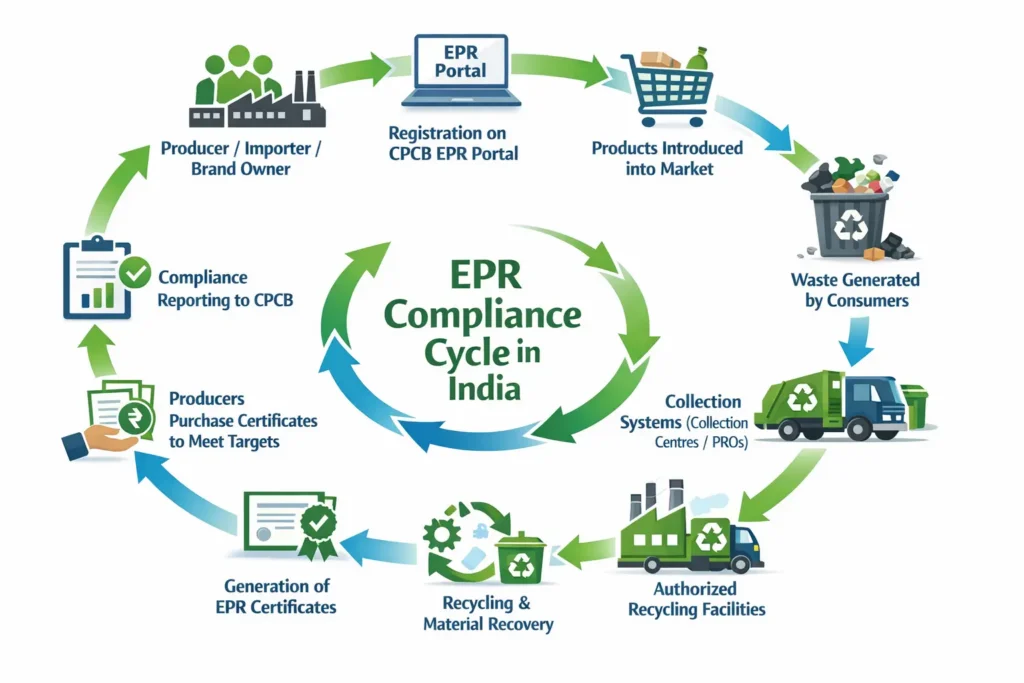
In recent years, digital compliance systems have been introduced through online EPR portals, which allow producers to register, report waste generation data, purchase recycling certificates, and demonstrate compliance with regulatory targets.
3. Evolution of EPR Regulations Across Sectors in India
The development of EPR in India has occurred gradually, with different sectors adopting EPR obligations at different stages.
Sector-wise Timeline of EPR Development
This timeline demonstrates how EPR policy in India has expanded progressively across different sectors. The expansion of Extended Producer Responsibility across multiple sectors demonstrates India’s evolving approach to waste governance. Initially introduced for plastic and electronic waste, the EPR framework has gradually expanded to cover additional waste streams such as batteries, tyres, used oil, and end-of-life vehicles. The introduction of digital compliance systems through CPCB portals has improved transparency, monitoring, and accountability. These portals allow producers to register, generate recycling certificates, report waste management data, and demonstrate compliance with regulatory targets. The gradual expansion of EPR across sectors reflects India’s commitment to transitioning toward a circular economy and strengthening environmental accountability among producers.
4. Sectoral Implementation of EPR
4.1 Plastic Waste Management
Plastic waste is one of the most visible environmental problems in India. The government initially addressed this issue through the Plastic Waste (Management and Handling) Rules, 2011. These rules focused mainly on municipal waste management and did not impose strong obligations on producers.
A major reform occurred with the Plastic Waste Management Rules, 2016, which formally introduced Extended Producer Responsibility (EPR). Under these rules, Producers, Importers and Brand Owners (PIBOs) became responsible for collecting and recycling plastic packaging waste generated from their products.
Further amendments in 2022 strengthened the framework by introducing mandatory recycling targets and a centralized CPCB EPR portal for digital registration and compliance monitoring.
4.2 E-Waste Management
Electronic waste has become one of the fastest-growing waste streams due to rapid technological advancement and consumer demand for electronic devices.
India first introduced the E-Waste (Management and Handling) Rules, 2011, which established a basic regulatory structure. However, Extended Producer Responsibility was formally strengthened through the E-Waste Management Rules, 2016.
Under these rules, producers must establish collection mechanisms such as take-back programs, collection centers, and partnerships with authorized recyclers. In 2023, a revised EPR system was introduced through a digital portal operated by the Central Pollution Control Board (CPCB), which allows producers to meet their recycling targets through tradable EPR certificates.
4.3 Battery Waste Management
Battery waste poses serious environmental risks due to the presence of hazardous materials such as lead, lithium, and other heavy metals.
Initially, battery recycling in India was governed by the Batteries (Management and Handling) Rules, 2001, which mainly addressed lead-acid batteries.
In 2022, the government introduced the Battery Waste Management Rules, 2022, which established a comprehensive EPR framework. These rules apply to various categories of batteries including portable batteries, industrial batteries, automotive batteries, and electric vehicle batteries.
Under these regulations, producers must ensure that an equivalent quantity of battery waste is collected and recycled through authorized recyclers. A digital EPR portal has also been introduced for registration, reporting, and certificate trading.
4.4 Tyre Waste Management
Tyre waste has emerged as an important environmental concern due to the rapid growth of the automobile sector.
Initially, tyre waste was regulated under the Hazardous and Other Wastes (Management and Transboundary Movement) Rules, 2016. However, in 2022, the government introduced a specific EPR framework for waste tyres through amendments to these rules.
Under this framework, tyre manufacturers and importers must ensure that a specified percentage of waste tyres are recycled annually through registered recyclers. Compliance is monitored through the CPCB Tyre EPR portal, which tracks recycling certificates generated by authorized recyclers.
4.5 End-of-Life Vehicles (ELV)
One of the most recent developments in India’s EPR policy framework is the introduction of EPR obligations for End-of-Life Vehicles (ELVs) through the Environment Protection (End-of-Life Vehicles) Rules, 2025. These rules came into effect on 1 April 2025.
The ELV rules establish a comprehensive system for managing vehicles that have reached the end of their operational life. They apply to vehicle manufacturers, vehicle owners, scrapping facilities, and other stakeholders involved in the vehicle lifecycle.
Under these rules, vehicle manufacturers are required to fulfill Extended Producer Responsibility obligations by ensuring that vehicles sold by them are eventually dismantled and recycled in environmentally sound facilities. Producers must meet annual scrapping targets and report compliance to regulatory authorities.
The rules also promote the establishment of Registered Vehicle Scrapping Facilities (RVSFs) and collection centres where old vehicles are dismantled and valuable materials such as steel, aluminum, and plastics are recovered. This framework aims to promote resource efficiency and reduce environmental pollution from obsolete vehicles.
4.6 Used Oil Management
Another important recent development in India’s EPR framework is the introduction of Extended Producer Responsibility for Used Oil.
The government introduced this mechanism through the Hazardous and Other Wastes (Management and Transboundary Movement) Second Amendment Rules, 2023, notified by the Ministry of Environment, Forest and Climate Change. The EPR system for used oil came into force on 1 April 2024.
Under these rules, producers and importers of base oil or lubrication oil are responsible for ensuring that used oil generated from their products is collected and recycled through authorized recyclers.
A centralized CPCB Used Oil EPR Portal has been established to facilitate registration of producers, recyclers, collection agents, and importers. The portal also enables the generation and trading of EPR certificates, submission of compliance reports, and monitoring by regulatory authorities.
The EPR obligations require producers to recycle a specified percentage of the oil sold or imported in previous years. These targets increase gradually over time, encouraging the development of recycling infrastructure and reducing environmental risks associated with improper disposal of used oil.
5. EPR Compliance Mechanism
The implementation of EPR follows a structured compliance process.
EPR Compliance Cycle
This system ensures that producers remain responsible for their products throughout the entire life cycle.
6. Case Studies on EPR Implementation
Case Study 1: Plastic Waste Management by FMCG Companies
Large consumer goods companies operating in India have adopted EPR compliance strategies to manage plastic packaging waste. Companies such as Hindustan Unilever and Nestlé India have partnered with Producer Responsibility Organizations to collect and recycle plastic waste equivalent to the amount they introduce into the market.
These companies finance waste collection networks and recycling infrastructure. As a result, the amount of plastic waste formally recycled in India has increased significantly. However, many experts argue that the effectiveness of these systems still depends heavily on informal waste collectors who play a major role in waste recovery.
Case Study 2: E-Waste Recycling Industry
The implementation of EPR in the electronics sector has led to the growth of formal recycling facilities in India. Companies such as Attero Recycling collaborate with electronics manufacturers to process discarded electronic products.
Through advanced recycling technologies, valuable metals such as gold, copper, and lithium are recovered from electronic waste. This not only reduces environmental pollution but also contributes to resource efficiency and the circular economy.
Despite these improvements, a large proportion of e-waste is still processed in the informal sector where environmental and health safeguards are often inadequate.
Case Study 3: Tyre Recycling under EPR
The introduction of tyre EPR regulations in 2022 created a structured system for recycling waste tyres. Tyre manufacturers must now meet annual recycling targets through authorized recyclers.
Recycling companies process waste tyres into materials such as crumb rubber, pyrolysis oil, and recovered carbon black. The CPCB digital tracking system has improved transparency in the recycling process.
However, the sector still faces challenges due to the presence of illegal pyrolysis units operating outside regulatory oversight.
7. Challenges in EPR Implementation
Despite the progress achieved through EPR policies, several challenges remain.
First, enforcement remains a significant issue because monitoring thousands of producers across different sectors requires substantial regulatory capacity.
Second, India’s recycling industry is largely dominated by the informal sector, which operates outside formal regulatory frameworks.
Third, reliable data on waste generation and recycling rates is still limited, making it difficult to accurately assess compliance levels.
Finally, consumer awareness regarding product return systems and recycling programs remains relatively low.
8. Policy Significance of EPR in India
The adoption of Extended Producer Responsibility represents a significant transformation in India’s environmental governance. Instead of relying solely on municipal authorities, the responsibility for waste management is redistributed to producers who introduce products into the market.
This approach encourages manufacturers to design products that are easier to recycle and generate less waste. By linking environmental responsibility with market participation, EPR also promotes the transition toward a circular economy, where materials are reused, recycled, and reintegrated into production processes.
9. Conclusion
Extended Producer Responsibility has become a key policy instrument for waste management in India. Over the past decade, the country has progressively expanded EPR obligations across sectors such as plastics, electronics, batteries, and tyres.
The introduction of digital EPR portals and recycling certificates has improved transparency and accountability in waste management systems. At the same time, challenges related to enforcement, informal sector integration, and data accuracy continue to affect the effectiveness of these policies.
Strengthening regulatory oversight, promoting public awareness, and investing in recycling infrastructure will be essential for ensuring the long-term success of EPR in India. If implemented effectively, EPR can play a crucial role in reducing environmental pollution and supporting India’s transition toward sustainable development.
References
- Government of India. Environment (Protection) Act, 1986. Ministry of Environment, Forest and Climate Change (MoEFCC), New Delhi.
- Ministry of Environment, Forest and Climate Change. Plastic Waste Management Rules, 2016 (as amended in 2022). Government of India.
- Ministry of Environment, Forest and Climate Change. E-Waste Management Rules, 2016 and E-Waste Management Rules, 2022.
- Ministry of Environment, Forest and Climate Change. Battery Waste Management Rules, 2022. Government of India.
- Ministry of Environment, Forest and Climate Change. Hazardous and Other Wastes (Management and Transboundary Movement) Rules, 2016.
- Ministry of Environment, Forest and Climate Change. Hazardous and Other Wastes (Management and Transboundary Movement) Second Amendment Rules, 2023 (introducing EPR framework for Used Oil).
- Government of India. Environment Protection (End-of-Life Vehicles) Rules, 2025. Ministry of Environment, Forest and Climate Change.
- Central Pollution Control Board (CPCB). (2023). Guidelines for Extended Producer Responsibility (EPR) Implementation in India.
- Central Pollution Control Board. (2022). Annual Report on Plastic Waste Management in India.
- Central Pollution Control Board. EPR Portal for Plastic Packaging, Battery Waste, Tyre Waste, E-Waste and Used Oil. Available at CPCB official website.
- Organisation for Economic Co-operation and Development (OECD). (2016). Extended Producer Responsibility: Updated Guidance for Efficient Waste Management.
- Lindhqvist, Thomas. (2000). Extended Producer Responsibility in Cleaner Production: Policy Principle to Promote Environmental Improvements of Product Systems. Lund University, Sweden.
- Gupta, S., & Sahay, A. (2015). “Extended Producer Responsibility in India: Policy Challenges and Opportunities.” Journal of Environmental Policy and Law.