
Designing a Compliant Full & Final Settlement Framework under India’s Four Labour Codes: A Conceptual Approach to Operational Risk, Asset Recovery, and Notice Pay Management
- Havish Chandra B
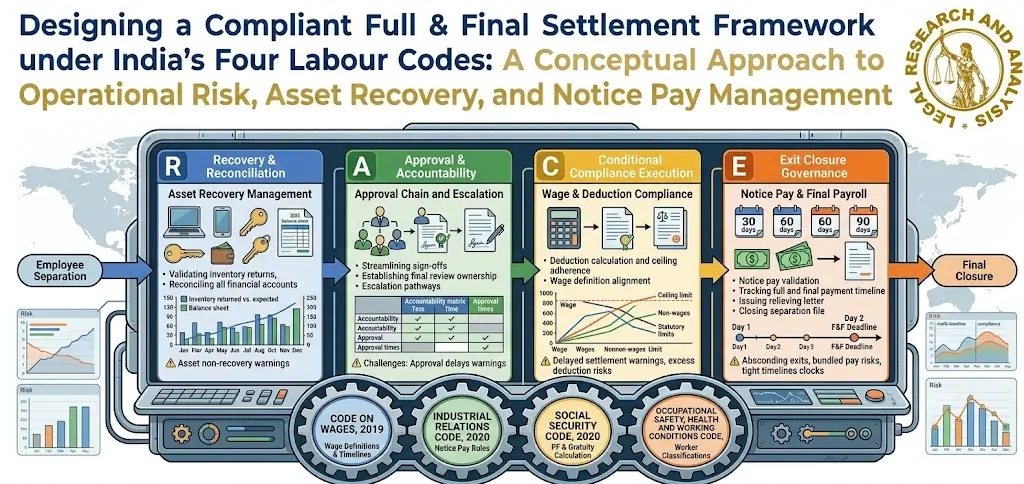
Table of Contents
ABSTRACT
Background: India has introduced four Labour Codes to simplify and consolidate its labour laws, by bringing important changes to the employment practices across organizations. These include the Code on Wages, 2019, the Industrial Relations Code, 2020, the Code on Social Security, 2020, and the Occupational Safety, Health and Working Conditions Code, 2020. A major reform is introduced through the Section 17(2) of the Code on Wages, 2019 which requires employers to complete the payment of all wages due to an employee within two working days of separation. This requirement has changed the employee separation and Full & Final (F&F) settlement processes which compels the organizations to streamline their exit procedures and payroll operations to ensure a timely compliance.
Problem: Although the Labour Codes require the employers to settle employee wages within two working days of separation, many organizations still follow the traditional Full & Final (F&F) settlement process which typically takes around 30–45 days. This difference between legal requirements and current workplace practices creates compliance challenges. Delays caused by the pending asset returns, notice pay calculations, multiple approval stages and absconding employees often slow down the settlement process which makes it difficult for the organizations to meet the prescribed timeline.
Framework: In order to overcome these challenges, this study proposes a RACE Framework which brings together four key stages those are Recovery & Reconciliation, Approval & Accountability, Conditional Compliance Execution, and Exit Closure Governance to support a faster and more compliant Full & Final (F&F) settlement process. It offers a structured way for the organizations to complete settlements within the statutory timeline while ensuring the regulatory compliance, clear accountability and effective operational control throughout the employee exit process.
Contribution: The contributions of this study come in two ways. In practical terms, it provides the first comprehensive framework for swift F&F settlement compliance in line with India’s four Labour Codes in a manner that is coherent with the legal framework of Section 17(2) and realistic in light of organisational realities. At a conceptual level, this study shows that it is possible to comply with the requirement of two days’ pay without foregone rights if the two-track principle is built into the exit process management system starting with the act of separation. From a theoretical perspective, this study fills a gap left open by the literature, which concentrates largely on legislative interpretation and workers’ rights issues.
KEYWORDS:
Code on Wages, Full & Final Settlement (F&F), Labour Compliance, Operational Governance, Recovery Governance, Notice Pay Management, Exit Governance, RACE Framework
INTRODUCTION
The consolidation of 29 central labour laws into four Labour Codes which marks one of the most significant reforms in India’s labour regulatory framework in the recent decades. While the reforms were introduced with the objective of simplifying and streamlining the labour compliance, they have also created new operational challenges for the organisations particularly in the areas of employee separation, payroll administration and the compliance management. Among the many changes introduced under the Labour Codes, Section 17(2) of the Code on Wages, 2019 is one of the most significant for the employers. It requires organisations to pay all the wages due to an employee within the two working days of separation, regardless of whether the employee resigns, is dismissed, retrenched or removed from service. This marks a major shift from the traditional Full & Final (F&F) settlement process followed by many Indian organisations where the settlements often take 30 to 45 days to complete. As a result, the employers need to rethink and streamline their separation and payroll processes to ensure a timely compliance with the new legal requirement. Historically, the organisations have taken 30–45 days to complete Full & Final (F&F) settlements because the process involves several essential operational steps. These include reconciling attendance and leave records, recovering company assets, calculating notice pay, obtaining the approvals from HR, finance and reporting managers, and processing statutory dues and other terminal benefits, many of which follow a different legal timeline. Although the Code on Wages has introduced a much shorter deadline for wage payments after separation, these operational activities have not disappeared. As a result, the real challenge for the employers is not simply complying with the new legal requirement but redesigning their existing the F&F processes so they can be completed accurately within the much shorter timeframe.The challenge becomes even more complex because organisations must comply with multiple Labour Codes at the same time. While the Code on Wages, 2019 requires the wages to be paid within two working days of an employee’s separation, other Labour Codes impose additional obligations that follow different timelines. For example, the Industrial Relations Code, 2020 introduces specific provisions relating to the employee separation including cases such as absconding employees and notice period management. Similarly, the Code on Social Security, 2020 governs the payment of statutory benefits such as gratuity and provident fund which each of it has its own prescribed timelines.
As a result, the employers are required to manage several interconnected compliance requirements simultaneously while ensuring that every legal obligation is completed accurately and within the timeline specified under the respective law.
Existing research on India’s Labour Codes has largely focused on their legal provisions and broader policy implications (Dubey, 2020; Chaudhary & Remesh, 2021).However, there is a limited research on how organisations can practically implement these reforms in their day-to-day operations. Important aspects such as redesigning Full & Final (F&F) settlement processes, establishing the effective governance mechanisms, coordinating across HR, finance, payroll and business teams, and managing compliance risks have received little scholarly attention. This gap is particularly important from a practitioner perspective. How can organisations meet the statutory requirement of paying the wages within two working days while simultaneously managing the recovery claims, notice pay adjustments, approval workflows and the statutory benefit obligations?
This paper addresses this gap by proposing the RACE Framework – Recovery & Reconciliation, Approval & Accountability, Conditional Compliance Execution and Exit Closure Governance. This framework provides a practical approach to manage the Full & Final (F&F) settlements within the statutory timelines by aligning the legal requirements with operational processes while ensuring governance, accountability and compliance.
REVIEW OF LITERATURE, RESEARCH GAP, OBJECTIVES & METHODOLOGY
Review of Literature
| Author(s) & Year | Focus Area | Key Contribution | Limitation / Gap Left |
|---|---|---|---|
| Dubey (2020) | Code on Wages, 2019 | Analyses revised wage definitions and their governance implications under the new code | Does not extend analysis to operational or implementation challenges |
| Chaudhary & Remesh (2021) | 4 Labour Codes Workers’ Rights | Critiques the four-code consolidation from a workers’ rights and employment regulation perspective | Stops short of addressing practical compliance and process realities for employers |
| Malathi (2026) | HR Implementation Challenges | Most recent academic work acknowledging that the real difficulty lies in operationalising the codes, not reading them | Does not propose a structured governance or operational framework |
| Ascent HR (2025) | Industry Practice F&F Compliance | Confirms that the two-day F&F requirement is operationally unmet across a large segment of Indian employers | Industry report; lacks academic rigour and framework-level analysis |
| Parker & Nielsen (2011) | Responsive Regulation & Compliance Theory | Argues that durable compliance requires statutory intent embedded into operational workflows, not treated as a downstream check | Developed in a Western regulatory context; not applied to Indian labour compliance |
| Krawiec (2003) | Cosmetic Compliance | Demonstrates that rule-following programmes without operational integration produce surface adherence that fails under real pressure | Does not address multi-timeline or payroll-specific compliance scenarios |
| ILO (2024) | Wage Protection Standards | Situates timely wage payment within the decent work framework; notes effectiveness depends on enforcement mechanism strength | Does not address India-specific multi-code compliance or operational design |
| Malik (2019) | Employment Contracts & Notice Pay | Notes that Indian employment contracts routinely embed notice pay recovery clauses | Analysis predates the four-code regime; does not address interaction of contractual clauses with the new statutory deduction ceiling |
| Pocket HRMS (2026) | Industry Practice – F&F Settlement | Confirms most organisations continue to treat multi-timeline obligations as a single bundled F&F event | Practitioner guide only; does not propose any framework to resolve the compliance failure this practice creates |
Note: Note. Comparative statutory reference: The UK Employment Rights Act 1996 and Singapore Employment Act (Cap. 91A) are referenced in Section 5 as comparative design precedents. Both statutes treat wage payment and recovery actions as legally independent obligations a deliberate legislative separation that informs the two-track model proposed in this paper. The Payment of Gratuity Act, 1972 and the Code on Social Security, 2020 are analysed as primary statutory sources in Section 3.3.
Identified Research Gap
Despite the growing importance of a timely Full and Final (F&F) settlement under India’s four Labour Codes, no published study has proposed an operational framework to support the rapid compliance. A question remains unanswered: how can organisations simultaneously comply with the wage payment requirement under the Section 17(2), safeguard their recovery rights, manage notice pay adjustments within the prescribed statutory limits and coordinate with the approvals across multiple functions within a two-working-day timeframe? This study seeks to mitigate this gap by proposing a structured framework for the rapid and compliant F&F settlement.
Research Objectives
- To analyse the operational implications of rapid F&F settlement compliance under four Labour Codes of India.
- To examine the governance and compliance challenges associated with the asset recovery, notice pay recovery, absconding employees and the terminal benefits governed by the multiple labour laws.
- To evaluate the limitations of a traditional F&F settlement practices in the context of the four-code regime.
- To develop a structured framework that enables the organisations to achieve legally compliant and timely F&F settlements.
Research Methodology
This study uses a doctrinal research methodology, its primary objective is to develop an operational and governance principles from statutory provisions rather than test hypotheses through empirical methods (McKerchar, 2008). The doctrinal approach involves a detailed examination of the primary legal sources, including statutes and their relevant provisions.
The analysis was carried out in three stages.
- The first stage is involved examining the relevant provisions of each Labour Code independently, including Section 17(2) and Section 18(3) of the Code on Wages, 2019 provisions relating to the notice periods and standing orders under the Industrial Relations Code, 2020 and the timelines governing terminal benefits under the Code on Social Security, 2020 and the Payment of Gratuity Act, 1972.
- The second stage focused on analysing the interaction between these provisions to identify the overlapping obligations, conflicting timelines and areas where organisations may face the compliance risks.
- The third stage involved is developing the RACE Framework as a practical response to the operational challenges that is identified through the legal analysis.
All statutory materials used in this study were obtained from the India Code, the official repository of Indian legislation maintained by the Ministry of Law and Justice, Government of India. The scope of the research is limited to the key provisions of the Labour Codes which is relevant to the F&F settlement. State-specific regulations and the sector-specific requirements are beyond the scope of this study.
LEGAL AND COMPLIANCE FOUNDATION
Code on Wages, 2019: Wage Timeline and Deduction Ceiling
As per Section 17(2) of the Code on Wages, 2019, employers are to pay wages within two working days of separation of an employee, whether due to resignation, dismissal, retrenchment or any other mode of termination. This obligation is specific to the “wages” as defined under Section 2(y), which broadly covers basic pay and dearness allowance but not all components of a Full and Final (F&F) settlement. Certain terminal benefits, such as gratuity and specific reimbursements continue to be governed by the separate statutory provisions and timelines.
Section 18 specifies the deductions that may legally be made from the wages. Another practical challenge arises from Section 18(3), which restricts total deductions in any wage period to 50 percent of the wages payable. This provision creates difficulties in cases of short-notice resignations, where the amount recoverable towards notice pay or unreturned company assets may be higher than the wages payable to the employee. As a result, employers cannot recover the entire amount through the Full & Final (F&F) settlement alone and may need to use alternative recovery methods while ensuring compliance with the statutory requirements.
Industrial Relations Code, 2020: Notice Period Governance
The Industrial Relations Code, 2020 requires the organisations to establish clear procedures for employee separation and abandonment through certified standing orders or internal policies. Different separation scenarios give rise to different compliance requirements:
- Full notice period served: The F&F settlement proceeds under the normal terms without any recovery implications.
- Short notice resignation by the employee: The employer may recover the notice pay for the unserved portion of the notice period subject to the contractual provisions and the deduction limits prescribed under Section 18 of the Code on Wages.
- Notice period exempted by employer: A separate assessment is required to determine if the employee is entitled to the wages for the unserved part of the notice period.
- Employee absconding: A formal recovery and disciplinary process may be However, this does not absolve the employer’s obligation to pay the wages for the period actually worked. Proper classification of the separation scenario at the outset is critical. Any error at this stage can affect subsequent compliance actions, including wage settlement, recoveries and statutory benefit processing.
Code on Social Security, 2020: Multiple Terminal Timelines
The Code on Social Security, 2020 governs employee benefits such as gratuity, provident fund, and Employees’ State Insurance (ESI) at the time of separation. The Payment of Gratuity Act, 1972 continues to apply in most of the states and Section 7(3) permits gratuity to be paid within 30 days from the date it becomes payable. Provident fund settlements through the Employees’ Provident Fund Organisation (EPFO) generally take between 10 and 20 days depending upon the processing requirements.
As a result, the organisations must manage multiple statutory timelines simultaneously i.e. wages settlement in within two working days, gratuity within 30 days and provident fund settlements through the EPFO process. Traditional F&F practices often treat these obligations as a single bundled settlement process. Such an approach can create compliance risks because each component is governed by a different legal timeline.
Code on Social Security, 2020: Multiple Terminal Timelines
The Code on Social Security, 2020 governs employee benefits such as gratuity, provident fund, and Employees’ State Insurance (ESI) at the time of separation. The Payment of Gratuity Act, 1972 continues to apply in most of the states and Section 7(3) permits gratuity to be paid within 30 days from the date it becomes payable. Provident fund settlements through the Employees’ Provident Fund Organisation (EPFO) generally take between 10 and 20 days depending upon the processing requirements.
As a result, the organisations must manage multiple statutory timelines simultaneously i.e. wages settlement in within two working days, gratuity within 30 days and provident fund settlements through the EPFO process. Traditional F&F practices often treat these obligations as a single bundled settlement process. Such an approach can create compliance risks because each component is governed by a different legal timeline.
State-Level Implementation Status
| State | Code on Wages | IR Code | SS Code | OSH Code |
|---|---|---|---|---|
| Maharashtra | Notified | Notified | Notified | Notified |
| Karnataka | Notified | Notified | Notified | Notified |
| Andhra Pradesh | Notified | Notified | Pending | Notified |
| Telangana | Notified | Notified | Partial | Notified |
| Tamil Nadu | Notified | Partial | Pending | Pending |
| Gujarat | Notified | Notified | Notified | Notified |
| Uttar Pradesh | Notified | Notified | Notified | Pending |
Note. Notified = Final rules notified by the respective State Government; Partial = Draft rules issued and/or implementation in progress; Pending = Final notification not identified as of June 2026.
Adapted from state labour code implementation trackers and labour law compliance databases, including KSK Labour & Employment (2026), iPleaders (2026), Data represent implementation status available during May–June 2026.
OPERATIONAL CHALLENGES IN RAPID F&F COMPLIANCE
Payroll Dependency and Multi-Timeline Settlement
Most Indian organisations continue to process the Full and Final (F&F) settlements through the monthly payroll cycle. Activities such as attendance closure, leave settlement, payroll verification and final payment processing are usually completed one after another as part of a single process. This approach does not fit within the 48-hour wage payment requirement under the Section 17(2) and does not account for the different timelines applicable to the employee separation payments. These include wage payment within two working days of the last working day, gratuity payment within 30 days of termination and provident fund settlement as per the EPFO regulations.
Although these obligations are governed by a different timeline, many organisations still treat them as a single settlement process. According to the (Pocket HRMS (2026)), a majority of the organisations continue to follow practices that are developed before the introduction of the Labour Codes where all separation-related payments are processed together. As a result, the organisations often struggle to meet the statutory wage payment deadline while also completing gratuity and provident fund formalities.
Asset Recovery Governance
Physical asset recovery such as laptops, access cards and system credentials remains an important organisational responsibility. However, it can no longer be treated as a condition for releasing the Full & Final settlement. Under Section 17(2), the wages must be paid within the prescribed timeline regardless of whether assets have been returned. With the remote work and absconding cases making recovery more difficult, the organisations should manage asset recovery as a separate, well-documented process without delaying the wage payments.
Notice Pay Recovery and the Deduction Ceiling
Notice pay recovery is usually straightforward when the amount falls within the legally permitted deduction limit. The challenge arises when the recoverable amount exceeds the 50% of the wages due, which often happens when an employee leaves without serving the required notice period or has already received salary in advance. In such cases, the employers cannot recover the full amount through the wage deductions alone. The remaining balance must be recovered separately such as by adjusting eligible terminal benefits or using other lawful recovery methods. Recovering more than the statutory deduction limit from wages can create an additional compliance risk and further complicate the Full & Final settlement process.
Cross-Functional Approval Dependencies
Rapid Full & Final (F&F) settlement requires close coordination between HR, payroll, finance, IT, administration and the reporting manager. However, in many organisations, approvals are completed one after another instead of running simultaneously making it difficult to meet the statutory two-working-day timeline. The challenge becomes even greater in absconding cases, where employers must process wages for the period actually worked while simultaneously initiating notice pay and asset recovery procedures, as well as complying with the requirements of the Industrial Relations Code, despite having no cooperation or communication from the departing employee.
The RACE Framework for Rapid F&F Compliance
Conceptual Foundation
Reconciliation
- Validating asset returns
- Identifying any missing items
- Reconciling all financial accounts
Accountability
- Obtaining all required sign-offs
- Verifying documentation completeness
- Establishing final review ownership
Compliance
Execution
- Resolving complex case details
- Addressing pay and multi-code issues
- Ensuring adherence to regulatory guidelines and contracts
Governance
- Performing the final payroll settlement
- Issuing the relieving letter
- Formally closing the separation file
Layer-R Recovery & Reconciliation
The first layer requires all separation cases to be assessed for financial obligations and recovery exposures before the settlement processing begins. This assessment includes notice pay liabilities, leave encashment, outstanding loans, authorised deductions within Section 18 limits and the company asset accountability.
- To support the timely processing, the employee separations are classified into five categories:
- Standard Exits – Full notice period has to be served with no recovery
- Recovery-Sensitive Exits – Cases which involves the short notice, outstanding loans or any unreturned company assets.
- Disputed Exits – Cases which involves disagreements relating to the notice pay, leave balances or the settlement calculations.
- Absconding Exits – Employees who cease reporting to work without a formal
- High-Risk Exits – Cases which involves a combination of recovery exposures, disputes and potential legal proceedings.
Classification takes place at the point of separation rather than at the end of the settlement process.
Layer-A Approval & Accountability
| Function | Governance Responsibility |
|---|---|
| HR | Separation coordination, notice scenario classification, multi-code compliance oversight |
| Payroll | Settlement computation, wage/non-wage classification, deduction calculation, Track A processing |
| Finance | Recovery validation, deduction ceiling compliance, non-wage offset authorisation |
| IT / Admin | Asset clearance, demand notice issuance for absconding cases, access revocation |
| Reporting Manager | Functional separation authorisation, exit knowledge transfer sign-off |
| Compliance / Legal | Notice pay scenario review, recovery dispute governance, standing order compliance |
Layer-C Conditional Compliance Execution (Two-Track Model)
Layer C introduces a two-track approach for the settlement processing. The objective is to make sure that statutory wage payment requirements are met within the prescribed timeline while allowing recovery-related matters to continue separately wherever necessary.
- Track A-Statutory Wage Settlement: Under this track, the payroll calculates and disburses earned wages within two working days of separation, and applying only those deductions that are authorised by law and within the prescribed 50 percent limit. Any amount that cannot be recovered within these limits is transferred to Track B. Wage settlement will proceed regardless of the pending asset recovery, notice pay disputes or incomplete approvals by ensuring the compliance with statutory wage payment requirements.
- Track B-Long-Tail Recovery and Non-Wage Settlement: This track deals with the matters that may continue beyond the statutory wage payment period, which includes asset recovery, civil demand notices, notice pay balances which exceeds the deduction limit and the settlement of non-wage terminal benefits. Outstanding amounts may be adjusted against the leave encashment, variable pay or other eligible non-wage components in accordance with their applicable timelines. Wherever required, recovery may also be pursued through the independent civil proceedings. The distinction between the two tracks shows the separation between wage payment obligations and employer recovery rights. Section 17(2) of the Code on Wages prescribes a specific timeline for wage payment, whereas the recovery actions are governed through a separate process. Recognising this distinction will allow the organisations to meet statutory payment requirements without foregoing their right to pursue the legitimate recoveries.
Layer-E Exit Closure Governance
The final layer outlines on documentation and record-keeping across the employee separation process. The records which are maintained under this layer include:
- Adjustment payslips that document the post-settlement reconciliations and dispute- related
- Recovery records that cover all the Track B actions, demand notices and recovery
- Settlement disclosures provided to the departing employees that detail the basis of computation, deductions applied and any pending recovery items.
- Records which are related to the completion of statutory settlement activities which covers the wage disbursement within two working days of separation, gratuity settlement within 30 days and provident fund processing through EPFO in accordance with the applicable regulatory requirement
Operational Risk Matrix
| Operational Risk | Compliance Exposure | RACE Control |
|---|---|---|
| Delayed wage settlement | Section 17(2) non-compliance | Track A: Conditional Compliance Execution |
| Deductions exceeding ceiling | Section 18(3) breach | Recovery validation governance (Layer R) |
| Asset non-recovery | Financial exposure | Independent Track B recovery pathway |
| Absconding exits | Settlement and recovery ambiguity | Separate wage settlement and demand notice workflows |
| Approval chain delays | Section 17(2) exposure | Accountability matrix with escalation (Layer A) |
| Gratuity/PF bundled with wages | Multi-timeline non-compliance | Independent compliance tracking (Layer E) |
Practical Implementation
Organisational Prerequisites
Successful implementation of the RACE Framework requires certain organisational foundations to be established in advance. Organisations that have not yet aligned their separation processes with the four labour codes should consider the following as the essential prerequisites:
- Employment contracts and offer letters that clearly specify the notice period requirements, authorised deduction provisions and employee obligations which are related to the return of company assets, in line with the Code on Wages and the Industrial Relations Code.
- Exit SOPs should adopt a two-track settlement approach, with clearly defined roles and responsibilities, processing timelines and escalation procedures to ensure a timely completion of pending actions.
- Notice pay classification matrices covering the different notice pay scenarios are recognised under the Industrial Relations Code.
- Recovery authorisation controls that are aligned with Section 18 deduction provisions, supported by payroll system controls that prevent deductions beyond the prescribed limits.
- A state-wise labour code notification tracker for organisations which are operating across multiple states are reviewed and updated on a regular basis.
Sector-Specific Considerations
Although the framework can be applied across industries, its implementation should reflect the specific requirements of different sectors. In the IT and GCC sectors, where the remote work is common and employee movement is relatively high, the Track B recovery processes may require procedures for collecting company assets through courier services and ensuring timely removal of the system access. In manufacturing organisations, where a larger number of employee exits may need to be handled, the approval and accountability process should be integrated with existing HR systems to ensure there is smooth and efficient administration. In startups and small and medium-sized enterprises (SMEs) where a dedicated compliance or legal teams may not be available, HR teams can manage these responsibilities within a simplified process. However, to ensure compliance the wage settlement and post-exit recovery activities should continue to operate as separate and parallel processes.
Implementation Barriers
The organisations may face various challenges while implementing the framework. First, existing payroll systems may not be equipped to process wage payments outside the regular payroll cycle within the required 48-hour period while making system modifications necessary. Second, managers who have traditionally linked Full and Final (F&F) settlement with asset recovery may require clear policy direction and training to adopt the revised approach. Third, the absence of the clear judicial guidance on whether the completion of Track A affects an organisation’s right to pursue the recoveries under Track B may lead some organisations to hesitate in releasing employee dues before all recovery-
related matters have been resolved. To organisations should establish clear internal policies and obtain appropriate legal guidance that clearly defines their rights and obligations. Such measures can provide a greater clarity and confidence in the implementation process and ensure the compliance with an applicable statutory requirement.
Conclusion
The Labour Codes have changed the expectations surrounding Full and Final (F&F) settlements in India. Many organisations are not yet structured to comply with these requirements effectively. Section 17(2), which requires wage payments to be completed within two working days of separation establishes a mandatory compliance obligation rather than a recommended timeline. The challenge for organisations is therefore not understanding the legal requirement, but adapting the existing processes to meet it.
Traditional F&F settlement practices often combine wage payments, asset recovery, notice pay adjustments and other recoveries into a single process that is completed only after all outstanding issues have been resolved. Under the revised legal framework, this approach may lead to delays that are not aligned with the prescribed statutory timelines. Organisations must therefore review their existing exit management practices and adopt the processes that enable the settlement obligations and recovery activities to be handled separately, wherever its necessary.
This paper is restricted to an examination of the key provisions of India’s Labour Codes and does not take into the account variations arising from the state-level implementation which continue to evolve across several jurisdictions as of June 2026. In addition to this, the proposed framework has not been empirically tested across the different industries or organisational contexts. The recommendations relating to the Track A exemptions are also based primarily on the legal interpretation rather than an established judicial precedent. These limitations will define the scope of the study and showcase the areas where the further research and practical evaluation would be valuable.
Future Scope
Several opportunities exist for future research. First, the RACE Framework can be evaluated through empirical studies like including surveys and case studies across sectors such as IT, manufacturing, Global Capability Centres (GCCs) and startups. Such studies would help assess its practical applicability under the different organisational conditions.
Second, the relationship between Section 17(2) and an employer’s contractual right to recover dues requires closer legal examination. As judicial decisions under the Labour Codes begin to emerge, particularly on whether timely wage settlement has any bearing on an employer’s ability to recover outstanding amounts,a further doctrinal research will help bring greater clarity to an area that is likely to become increasingly relevant in practice.
Third, it would also be useful to examine how differences in the implementation of the Labour Codes across states influence organisational compliance practices and Full & Final (F&F) settlement timelines. Since labour law enforcement often varies across the jurisdictions, such research could offer a better understanding of the practical challenges organisations face while implementing the new legal framework.
Finally, another area that deserves attention is the integration of the proposed two-track settlement model into HRMS and payroll systems. Studying how this approach affects process efficiency, compliance monitoring, audit readiness and recovery management could provide useful insights for organisations looking to make their employee separation processes more efficient, compliant and easier to administer in practice.
References:
- Ascent (2025). 2-day final settlement (F&F) requirement under the Code on Wages [Industry report] https://ascent-hr.com/wp-content/uploads/2025/12/10-AHR-Labour-Codes-2-Day-Final-SettlementFF-Requirement.pdf
- Malathi, S. (2026). The new labour codes: Navigating implementation challenges in India’s HR landscape. NHRD Network Journal. Advance online publication https://journals.sagepub.com/doi/10.1177/26314541261431424
- Chaudhary, , & Remesh, B. (2021). Changing scenario of Indian labour and new labour codes: A critical analysis. Christ University Law Journal, 10(2), 1–18 https://journals.christuniversity.in/index.php/culj/article/view/3251/2158
- Dubey, (2020). A Critical Analysis of the Code on Wages, 2019. International Journal of Law Management & Humanities, 3(4), 1670–1677.https://www.ijlmh.com/wp-content/uploads/A-Critical-Analysis-of-the-Code-on-Wages-2019.pdf
- Government of (1972). The Payment of Gratuity Act, 1972. Ministry of Law and Justice. https://www.indiacode.nic.in/bitstream/123456789/15318/1/payment-of-gratuity-act-1972.pdf
- (2019). The Code on Wages, 2019. https://www.indiacode.nic.in/bitstream/123456789/15793/1/aA2019-29.pdf
- Industrial Relations Code, (2020, September 28) https://www.indiacode.nic.in/handle/123456789/22040
- Code on Social Security, (2020, September 28) https://www.indiacode.nic.in/handle/123456789/16823
- The protection of (2024, December 5). International Labour Organization https://www.ilo.org/resource/other/protection-wages
- Krawiec, K. D. (2003). Cosmetic compliance and the failure of negotiated governance. Washington University Law Quarterly, 81(2), 487–544. https://scholarship.law.duke.edu/faculty_scholarship/2046/
- Malik, L. (2019). Industrial law (27th ed.). Eastern Book Company.
- Parker, , & Nielsen, V. L. (2011). Explaining compliance: Business responses to regulation. Edward Elgar Publishing https://www.researchgate.net/publication/298451802_Explaining_Compliance_Business_Response s_to_Regulation
- Pocket (2026, May 13). Full and final settlement (FnF) in India: Complete guide 2026.
- (2026). Labour codes 2026 implementation: Complete guide https://blog.ipleaders.in/labour-codes-2026-implementation-complete-guide-to-what-is-in-force-what-changed-and-what-to-do-now/
- KSK Labour & (2026). State-wise implementation guide: Navigating the patchwork of state rules and multi-state compliance https://ksandk.com/employment-law/guides/state-implementation/
- McKerchar, M. (2008). Philosophical paradigms, inquiry strategies and knowledge claims: Applying the principles of research design and conduct to eJournal of Tax Research, 6(1), 5–28
- Employment Rights Act 1996 (c. 18). (1996). UK https://www.legislation.gov.uk/ukpga/1996/18/contents
- Employment Act 1968 (Cap. 91A, 2009 Ed.). (2009). Singapore Statutes Online https://sso.agc.gov.sg/Act/EmA1968
+919458479236




Questions of medical negligence have acquired increasing importance in India as healthcare has moved into a more rights-conscious and legally supervised environment.… Continue reading
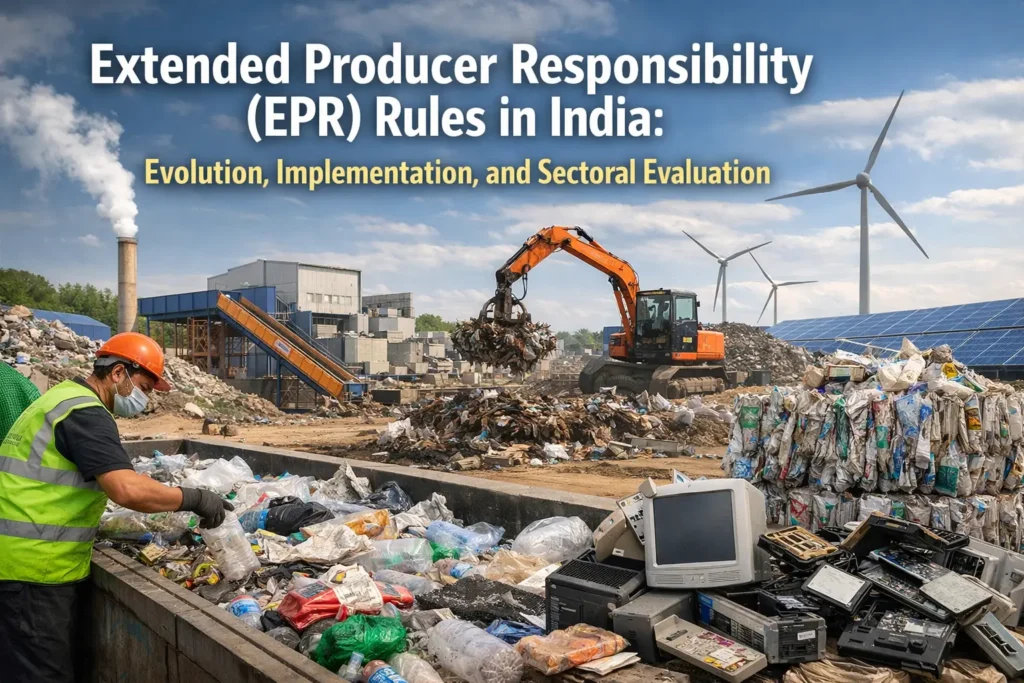
Waste generation has emerged as one of the most serious environmental challenges facing India today. Population growth, rapid urbanization, and increasing consumption patterns have… Continue reading

Environmental protection has become a global priority as industrialization and urban development continue to expand rapidly. Industries contribute significantly to economic growth… Continue reading