
HEALING BHARAT MATA: A MEDICO-LEGAL ROADMAP TOWARDS A NATIONAL RIGHT TO HEALTH AND DIGITAL HEALTH PROTECTION FRAMEWORK
- Suryabhan S. Ingle
- Priyanka S. Kulkarni
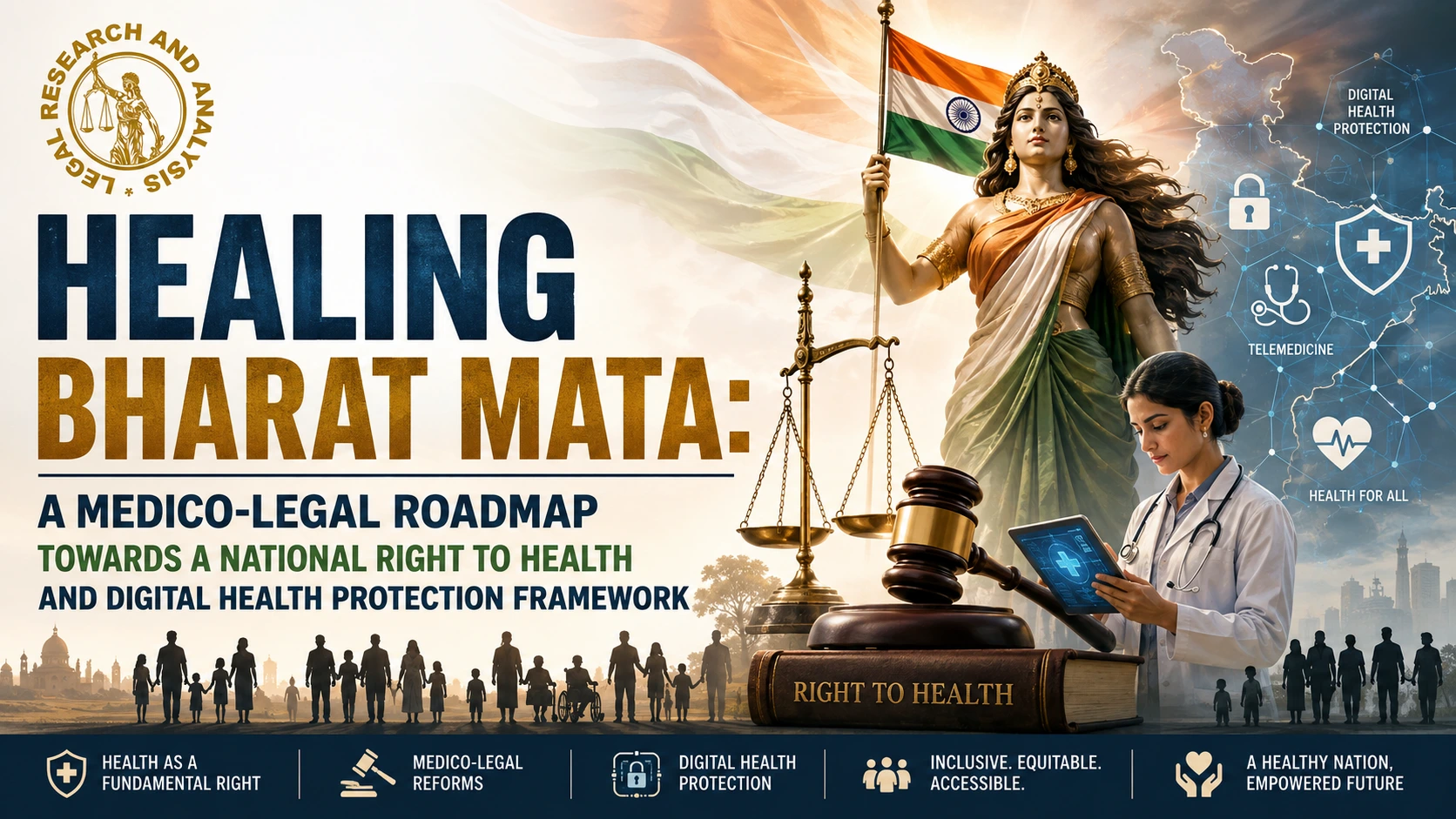
Table of Contents
ABSTRACT
Bharat Mata, the eternal mother of one hundred and forty crore children, cannot be called truly healthy while her sons and daughters in remote villages die waiting for a doctor who never arrives. This paper examines one of India’s most persistent medico-legal gaps: the absence of a codified, enforceable national Right to Health, despite judicial recognition of health as part of the right to life under Article 21 of the Constitution of India. We trace this gap through the regulation of medical practice, informed consent, negligence jurisprudence, and the emerging challenges of telemedicine and health-data protection under the Digital Personal Data Protection Act, 2023. We study Rajasthan’s pioneering Right to Health Act, 2022, and the doctor protests it provoked, to understand why good intentions without careful drafting can fail patients and practitioners alike. Drawing carefully on these lessons, we propose a ten-point model for a National Right to Health Act, supported by telemedicine-driven last-mile delivery, a doctor indemnity insurance pool, health-data safeguards, and citizen-awareness mechanisms. We argue that only such a framework can transform healthcare from a privilege of geography and income into a real, guaranteed right of every citizen of Bharat Mata, fulfilling the true spirit of patriotic, citizen-centred nation-building through law.
KEYWORDS:
Right to Health; Medical Law; Bharat Mata; Rajasthan Right to Health Act, 2022; Informed Consent; Medical Negligence; Telemedicine; Digital Personal Data Protection Act, 2023
INTRODUCTION
Bharat Mata is the mother of one hundred and forty crore children, yet she cannot be called healthy while her own sons and daughters die at her doorstep, waiting for a doctor who never comes. This is not a poetic exaggeration; it is the daily reality of millions of Indians who live in villages, hill districts, and urban slums where a hospital bed, a specialist, or even basic emergency care remains hours, sometimes days, away. This paper argues that this is not merely a public health failure; it is a constitutional and legislative gap that medical law has not yet closed. This paper examines why India still lacks a codified, enforceable national Right to Health, and why this single gap quietly explains many of the medico-legal problems this course has examined, from consent disputes and negligence litigation to the regulatory challenges surrounding telemedicine and digital health data. We then propose a detailed, workable solution: a National Right to Health and Digital Health Protection framework built for the real India, not an imported template. Healing Bharat Mata, we argue, begins with making health a guaranteed right of her citizens, not a privilege of geography or income.
RESEARCH METHODOLOGY
This paper follows a doctrinal, black-letter method of legal research. It analyses primary sources – the Constitution of India, central and State legislation, and Supreme Court jurisprudence – together with secondary academic, governmental, and journalistic material, to trace how Indian law has treated health as a right. The Rajasthan Right to Health Act, 2022 is examined as an illustrative legislative case study, used to draw drafting lessons for a national statute, and not through empirical fieldwork. No primary data was generated through surveys, interviews, or statistical sampling; every factual claim is drawn from, and cited to, published judgments, statutes, government data, and secondary sources referenced throughout. The ten-point proposal in Part VIII is accordingly a normative, policy-analytical exercise built on this doctrinal foundation, intended as a blueprint for legislative reform rather than an empirically validated model.
LITERATURE REVIEW
Existing scholarship on India’s right to health falls into two broad strands. The first, exemplified by analysis published in the CMR University Journal for Contemporary Legal Affairs, traces how Article 21 has been judicially extended to cover health, situating this development within India’s international human-rights commitments under instruments such as the Universal Declaration of Human Rights and the International Covenant on Economic, Social and Cultural Rights.1 The second strand, found in recent public-health scholarship, documents the structural gaps in service delivery – uneven doctor density, vacant specialist posts, and thin rural bed capacity – that keep the constitutional promise from becoming a lived entitlement.2 Law-review commentary on this Article 21 jurisprudence, such as that appearing in the Indian Journal of Law and Legal Research, has further mapped the case law but stops short of proposing a codified statutory framework.3 This paper draws these three strands together – constitutional doctrine, public-health data, and comparative legislative-drafting lessons from Rajasthan – into a single legislative proposal that existing scholarship has not yet offered.
THE RIGHT TO HEALTH IN INDIAN LAW: A PROMISE WITHOUT A STATUTE
The Constitution of India does not list the right to health among the Fundamental Rights in Part III. Instead, Article 47 places a duty on the State, as a Directive Principle, to raise the level of nutrition and public health.4 For decades, this meant health was treated as a goal for government policy, not as a right a citizen could enforce in court. The Supreme Court changed this gradually, reading health into the right to life under Article 21.5 In Paschim Banga Khet Mazdoor Samity v. State of West Bengal, the Court held that a government hospital’s failure to provide timely emergency treatment violated the patient’s fundamental right to life, and made the State responsible for ensuring adequate medical facilities.6 Years later, in Justice K.S. Puttaswamy v. Union of India, the Court’s expansive reading of dignity and autonomy under Article 21 strengthened the constitutional basis for treating health as inseparable from a dignified life.7 Yet judicial interpretation is not the same as codified law. A right recognised only through judgments remains inaccessible to many citizens without litigation. India therefore remains among the few large democracies without a dedicated national health rights statute, relying instead on a patchwork of regulatory laws that govern doctors and hospitals, but do not guarantee citizens access to care in the first place. India is also a signatory to the Universal Declaration of Human Rights, whose Article 25 recognises a standard of living adequate for health, including medical care, yet this international commitment has never been translated into a domestic statutory right that directly is enforceable by citizens.8
WHY THE PROBLEM PERSISTS: THE ROOT CAUSES
The first root cause is geography. India’s national doctor-population ratio has crossed the World Health Organization’s benchmark of one doctor per thousand people, but this national average conceals a deep rural-urban divide.9 Urban India has nearly four times the doctor density of rural India, and rural doctor-to-patient ratios in several states fall as low as one doctor for over eleven thousand people.10 Nearly seventy percent of specialist posts at rural Community Health Centres lie vacant,11 and rural government hospitals have barely a fifth of the bed capacity available in urban hospitals relative to population.12 The second cause is poor legislative drafting in well-intentioned reform. Rajasthan became the first Indian state to pass a Right to Health Act, in 2022, guaranteeing free emergency treatment without prepayment at every hospital, public or private.13 But the law did not clearly define what counts as a medical emergency, leaving doctors uncertain about potential liability; thousands of doctors went on strike in protest, fearing harassment through politically composed grievance committees.14 The third cause is the absence of a bridge between conduct-based laws, such as the National Medical Commission Act, 2019 and the Clinical Establishments Act, 2010, which govern how doctors and hospitals must behave, and an access-based right that tells citizens what they are entitled to receive.15 Without that bridge, even well-regulated doctors operate in a system that never guarantees the patient a doctor to begin with. A fourth, less visible cause is regulatory fragmentation: mental healthcare, disability access, and public health emergencies are each governed by separate statutes, the Mental Healthcare Act, 2017, the Rights of Persons with Disabilities Act, 2016, and the Epidemic Diseases Act, 1897, with the Disaster Management Act, 2005, so that no single law treats a citizen’s health as one connected right.16
THE PROBLEM AT GROUND LEVEL: HOW INDIAN CITIZENS EXPERIENCE IT
For a labourer’s family in a Vidarbha village, medical negligence is not an abstract legal term; it is the two-hour journey to the nearest functioning primary health centre, only to find no doctor on duty. For a pregnant woman in a hill district, it is the absence of obstetric care exactly when labour begins, since rural India holds the overwhelming majority of the population but a small fraction of the country’s hospital beds.17 Patients seeking abortion or transplant services often face long journeys to accredited centres.18 Even where India’s digital health mission has made genuine progress, with crores of citizens now holding a unique digital health identity,19 the same digitisation creates new risks: the 2022 ransomware attack on the All India Institute of Medical Sciences, New Delhi, compromised the records of an estimated forty million patients, with no compensation and no clear accountability for those affected.20 These experiences reflect a system that regulates medicine in detail while leaving access undefined.
GAPS IN THE EXISTING LEGAL FRAMEWORK
Even where Indian courts have stepped in, the resulting jurisprudence protects process more than access. In Indian Medical Association v. V.P. Shantha, the Supreme Court held that medical services rendered for a fee are a “service” under consumer protection law, giving patients a forum to claim compensation for deficient treatment.21 This remains under judicial scrutiny: in 2024, while excluding lawyers from consumer law, the Supreme Court itself observed that the V.P. Shantha precedent “deserves to be revisited” and sought its reference to a larger bench; on 7 November 2024, a three-judge bench disposed of that reference, holding it unnecessary.22 In Jacob Mathew v. State of Punjab, the Court adopted the Bolam standard, holding that criminal liability arises only where their conduct falls far below what a reasonably competent professional would do, distinguishing civil negligence from the much higher threshold required for criminal liability.23 In Samira Kohli v. Dr. Prabha Manchanda, the Court held that consent obtained for one procedure cannot justify a different, unconsented one, and preferred the doctor-centric Bolam disclosure standard over the patient-centric Canterbury standard, citing India’s “ground realities.”24 In Common Cause v. Union of India, the Court recognised passive euthanasia and living wills as part of the right to die with dignity under Article 21.25 Each judgment protects citizens who can already access healthcare. None of them guarantees that the citizen reaches the hospital at all. Meanwhile, the Digital Personal Data Protection Act, 2023, though notified, will not be fully enforceable until May 2027, leaving sensitive health data without sector-specific safeguards for years to come.26
THE SOLUTION: TOWARDS A NATIONAL RIGHT TO HEALTH AND DIGITAL HEALTH PROTECTION FRAMEWORK
We believe India needs one unifying statute, a National Right to Health Act, learning from Rajasthan’s experience. We set out our proposal in ten concrete parts.
First, the Act must statutorily define “medical emergency” with precision, separating it from urgent but non-emergency care, using an illustrative statutory schedule of qualifying conditions such as cardiac arrest, severe trauma, obstetric emergencies, and poisoning, reviewed periodically by a medical board, removing the ambiguity that triggered the Rajasthan protests.27
Second, the Act must create a pre-funded, ring-fenced State and National Health Reimbursement Corpus, financed jointly through Ayushman Bharat allocations and a small health cess,28 so that private hospitals providing free emergency care are reimbursed within a fixed, legally enforceable timeline, removing the trust deficit that fuelled the Rajasthan doctors’ protest.
Third, every registered medical practitioner attending government-mandated emergency cases should be covered by a centrally subsidised Doctor Indemnity Insurance Pool. This single step would directly address the root cause behind defensive medicine and the rising friction between doctors and consumer forums, restoring the doctor-patient trust that the Supreme Court itself prized in Samira Kohli.29
Fourth, telemedicine must be scaled as the backbone of rural delivery, not a side feature. With crores of citizens already holding a digital health account,30 the government should mandate that every Primary Health Centre be linked to a tele-consultation hub staffed with specialists, prioritising maternal care, mental health, and chronic diseases.
Fifth, healthcare must get a sector-specific data protection code under the Digital Personal Data Protection Act, comparable to dedicated health-data laws in other major economies, made mandatory before 2027 rather than after, with compulsory cyber-insurance and breach compensation for hospitals, directly answering the lessons of the AIIMS ransomware attack.31
Sixth, the Act must explicitly fold in the Mental Healthcare Act, 2017 and the Rights of Persons with Disabilities Act, 2016, so that health is never read narrowly as only physical illness; mental health and disability access must carry equal statutory weight, with mental health helplines and disability-accessible facilities made part of the same reimbursement corpus.
Seventh, India must correct doctor density through a mandatory, time-bound rural rotation for specialists trained in government colleges, paired with genuine incentives, rural service allowances, faster promotions, and guaranteed post-rural placement preference, alongside expanding AYUSH and community health officer cadres for primary-level care.
Eighth, every district must have a balanced Health Rights Authority, with equal representation of patients, doctors, and independent medical experts, not the politician-heavy committees that frightened Rajasthan’s doctors, ensuring grievance redress without enabling harassment.
Ninth, civil society has a direct role: NGOs and village health committees should run continuous legal-literacy camps teaching citizens their actual rights, including informed consent, refusal of treatment, and grievance procedures, so that citizens understand and exercise their rights, supported by a national multilingual helpline connecting every citizen to free legal aid for medico-legal grievances.
Tenth, this must operate through genuine Centre-State cooperation: health remains a State subject, so the National Right to Health Act should function as a model law adopted and adapted by States, coordinated through a permanent Health Council on the lines of the GST Council, ensuring uniform minimum guarantees with room for State-specific implementation.
Taken together, these ten measures shift the law’s centre of gravity from regulating doctors after something goes wrong to guaranteeing patients access before anything goes wrong, turning the right to health from a judicial inference into a citizen’s lived reality, and turning Bharat Mata’s healthcare map from one of privilege into one of guarantee.
CONCLUSION
Bharat Mata does not ask for charity for her children; she asks for justice. A nation that runs some of the world’s largest vaccination drives and digital identity programmes can certainly guarantee timely access to qualified medical care to every village. India’s medico-legal challenges share one root cause: the absence of a codified Right to Health. The solution we propose is not borrowed from abroad; it is built from India’s own experience. Healing Bharat Mata means making health her children’s right, not their luck.
Jai Hind! Bharat Mata Ki Jai!
REFERENCES
- Constitutional Provisions
- INDIA CONST. art. 21.
- INDIA CONST. art. 47.
- Statutes (India)
- Clinical Establishments (Registration and Regulation) Act, No. 23 of 2010.
- Digital Personal Data Protection Act, No. 22 of 2023.
- Disaster Management Act, No. 53 of 2005.
- Epidemic Diseases Act, No. 3 of 1897.
- Medical Termination of Pregnancy Act, No. 34 of 1971, as amended by the Medical Termination of Pregnancy (Amendment) Act, No. 8 of 2021.
- Mental Healthcare Act, No. 10 of 2017.
- National Medical Commission Act, No. 30 of 2019.
- Rights of Persons with Disabilities Act, No. 49 of 2016.
- Transplantation of Human Organs and Tissues Act, No. 42 of 1994.
- Cases
- Common Cause v. Union of India, (2018) 5 SCC 1.
- Indian Medical Association v. V.P. Shantha, (1995) 6 SCC 651.
- Jacob Mathew v. State of Punjab, (2005) 6 SCC 1.
- Justice K.S. Puttaswamy v. Union of India, (2017) 10 SCC 1.
- Paschim Banga Khet Mazdoor Samity v. State of West Bengal, (1996) 4 SCC 37.
- Samira Kohli v. Dr. Prabha Manchanda, (2008) 2 SCC 1.
- International Instruments
- Universal Declaration of Human Rights, G.A. Res. 217 A (III), art. 25, U.N. Doc. A/810 (Dec. 10, 1948).
- Secondary and Online Sources
- Digital Health Records in India: Privacy, Security, and the Ayushman Bharat Digital Mission, DPO INDIA (Aug. 27, 2025), https://www.dpo-india.com/Blogs/digital-health-records/ .
- Doctor-Patient Ratio in India Reach WHO Target: South India Leads, Rural Gaps Persist, EDUFEVER (July 6, 2025), https://www.edufever.com/doctor-patient-ratio-india-who-target-south-india-leads-rural-gaps/ .
- Gaurav Bharti & Anuprash Rajat, Constitutional Mechanism and Judicial Initiative for Right to Health, VI(I) Indian J.L. & Legal Rsch. 3673 (2024) https://www.iftmuniversity.ac.in/iftmuniversity/profile/download/paper/2768.pdf
- Gigimon V.S. & Merin Mathew, Role of State in Guaranteeing Right to Health Under Article 21 of the Constitution of India, 5 CMR Univ. J. Contemp. Legal Aff. 108 (2023) https://cmr.edu.in/school-of-legal-studies/journal/wp-content/uploads/2024/01/Role-of-State-in-Guaranteeing-Right-to-Health-Under-Article-21-Of-the-Constitution-of-India-Prof.Dr_.Gigimon-V.-S-Ms.Merin-Mathew.pdf
- Health Data and the DPDP Act: A Practical Guide, AMLEGALS (Nov. 20, 2025), https://amlegals.com/health-data-and-the-dpdp-act-a-practical-guide/
- Huma Ausaf & Manzoor Khan, Quality of Health Care in India: Challenges, Priorities, and the Road Ahead, 14 J. Neonatal Surgery 906 (10s) (2025) https://jneonatalsurg.com/index.php/jns/article/view/3888/3438
- India’s 1:811 Doctor-Population Ratio Explained: The Flaws in the Government’s Claim, EDUFEVER (Dec. 5, 2025), https://www.edufever.com/india-doctor-population-ratio-811-real-crisis/ .
- India’s New Data Privacy Rules Are Here: 8 Steps for Businesses as Key Compliance Deadlines Approach, FISHER PHILLIPS LLP, https://www.fisherphillips.com/en/insights/insights/indias-new-data-privacy-rules-are-here (last visited June 29, 2026).
- National Health Policy, 2017, Ministry of Health & Family Welfare, Government of India.
- Patient to Doctor Ratio: A Real Challenge in Maintaining Quality Healthcare, JMN MED. COLL. (Mar. 8, 2025), https://jmnmedicalcollege.org.in/patient-to-doctor-ratio-a-real-challenge-in-maintaining-quality-healthcare/ .
- Rajasthan Right to Health Act: The Provisions and Why Doctors Protested, BUS. STANDARD (Apr. 7, 2023), https://www.business-standard.com/india-news/rajasthan-right-to-health-bill-the-provisions-and-why-doctors-protested-123040700254_1.html .
- Rajasthan’s Right to Health Act: A Case of Using the Wrong Means to Achieve the Right Ends, OXFORD HUM. RTS. HUB BLOG, https://ohrh.law.ox.ac.uk/rajasthans-right-to-health-act-a-case-of-using-the-wrong-means-to-achieve-the-right-ends/
- Revitalising Rural Health Care Delivery: Can Rural Health Practitioners Be the Answer?, NCBI PMC, https://www.ncbi.nlm.nih.gov/pmc/articles/PMC2763651/
- Supreme Court Refuses to Reconsider Judgment Which Brought Doctors Under Consumer Protection Act, Says Reference Was Unnecessary, LIVELAW (Nov. 7, 2024), https://www.livelaw.in/top-stories/supreme-court-refuses-to-reconsider-judgment-which-brought-doctors-under-consumer-protection-act-says-reference-was-unnecessary-274529 .
FOOTNOTES
- Gigimon V.S. & Merin Mathew, Role of State in Guaranteeing Right to Health Under Article 21 of the Constitution of India, 5 CMR Univ. J. Contemp. Legal Aff. 108 (2023) ↩︎
- Huma Ausaf & Manzoor Khan, Quality of Health Care in India: Challenges, Priorities, and the Road Ahead, 14 J. Neonatal Surgery 906 (10s) (2025 ↩︎
- Gaurav Bharti & Anuprash Rajat, Constitutional Mechanism and Judicial Initiative for Right to Health, VI(I) Indian
J.L. & Legal Rsch. 3673 (2024) ↩︎ - INDIA CONST. art. 47. ↩︎
- INDIA CONST. art. 21. ↩︎
- Paschim Banga Khet Mazdoor Samity v. State of West Bengal, (1996) 4 SCC 37. ↩︎
- Justice K.S. Puttaswamy v. Union of India, (2017) 10 SCC 1. ↩︎
- Universal Declaration of Human Rights, G.A. Res. 217 A (III), art. 25, U.N. Doc. A/810 (Dec. 10, 1948). ↩︎
- Doctor-Patient Ratio in India Reaches WHO Target: South India Leads, Rural Gaps Persist, EduFever (July 6, 2025), see also India's 1:811 Doctor-Population Ratio Explained: The Flaws in the Government's Claim, EduFever (Dec. 5, 2025), ↩︎
- Patient to Doctor Ratio: A Real Challenge in Maintaining Quality Healthcare, JMN Medical College (Mar. 8, 2025), ↩︎
- Doctor-Patient Ratio in India Reaches WHO Target: South India Leads, Rural Gaps Persist, supra note 9. ↩︎
- Revitalizing Rural Health Care Delivery: Can Rural Health Practitioners Be the Answer? Nat'l Ctr. for Biotechnology Info. ↩︎
- Rajasthan Right to Health Act: The Provisions and Why Doctors Protested, Bus. Standard (Apr. 7, 2023), ↩︎
- Rajasthan's Right to Health Act: A Case of Using the Wrong Means to Achieve the Right Ends, Oxford Hum. Rts. Hub Blog ↩︎
- National Medical Commission Act, No. 30 of 2019; the Clinical Establishments (Registration and Regulation) Act,
No. 23 of 2010. ↩︎ - Mental Healthcare Act, No. 10 of 2017; Rights of Persons with Disabilities Act, No. 49 of 2016; Epidemic Diseases Act, No. 3 of 1897; Disaster Management Act, No. 53 of 2005. ↩︎
- Patient to Doctor Ratio: A Real Challenge in Maintaining Quality Healthcare, supra note 10. ↩︎
- Medical Termination of Pregnancy Act, No. 34 of 1971, as amended by the Medical Termination of Pregnancy (Amendment) Act, No. 8 of 2021; Transplantation of Human Organs and Tissues Act, No. 42 of 1994. ↩︎
- Digital Health Records in India: Privacy, Security, and the Ayushman Bharat Digital Mission, DPO India (Aug.
27, 2025), ↩︎ - Health Data and the DPDP Act: A Practical Guide, AMLegals (Nov. 20, 2025), ↩︎
- Indian Medical Association v. V.P. Shantha, (1995) 6 SCC 651. ↩︎
- Supreme Court Refuses to Reconsider Judgment Which Brought Doctors Under Consumer Protection Act, Says Reference Was Unnecessary, LiveLaw (Nov. 7, 2024). ↩︎
- Jacob Mathew v. State of Punjab, (2005) 6 SCC 1. ↩︎
- Samira Kohli v. Dr Prabha Manchanda, (2008) 2 SCC 1. ↩︎
- Common Cause v. Union of India, (2018) 5 SCC 1. ↩︎
- Digital Personal Data Protection Act, No. 22 of 2023; see also India's New Data Privacy Rules Are Here: 8 Steps for Businesses as Key Compliance Deadlines Approach, Fisher Phillips LLP ↩︎
- Rajasthan's Right to Health Act: A Case of Using the Wrong Means to Achieve the Right Ends, supra note 14. ↩︎
- Ministry of Health & Family Welfare, National Health Policy 2017 (2017) ↩︎
- Samira Kohli v. Dr. Prabha Manchanda, supra note 24. ↩︎
- Digital Health Records in India: Privacy, Security, and the Ayushman Bharat Digital Mission, supra note 19. ↩︎
- Health Data and the DPDP Act: A Practical Guide, supra note 20. ↩︎
+919458479236

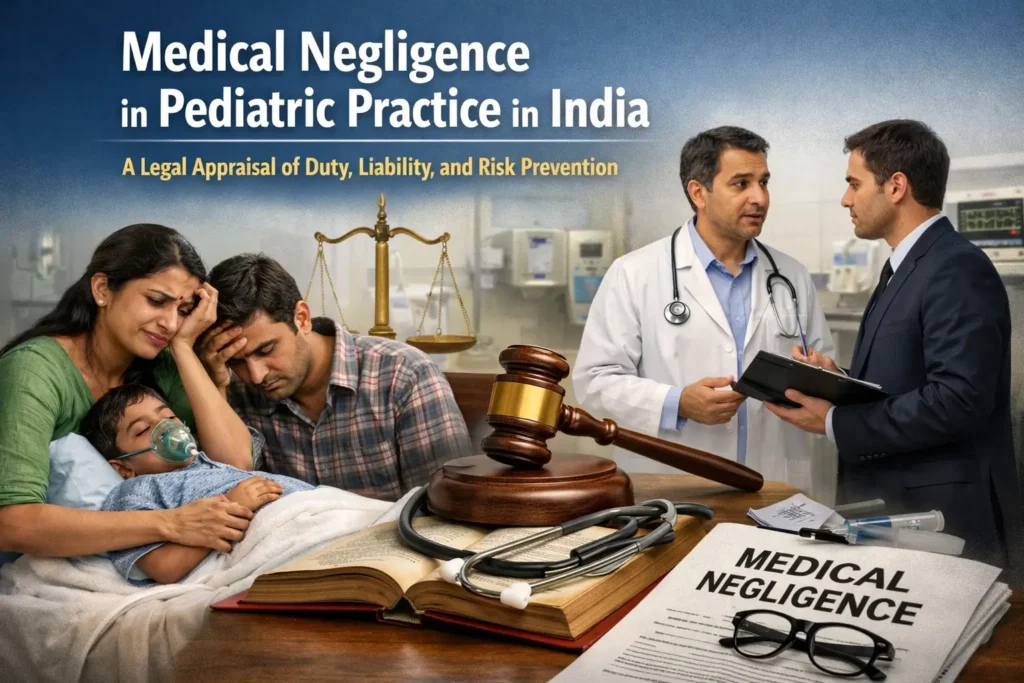

Questions of medical negligence have acquired increasing importance in India as healthcare has moved into a more rights-conscious and legally supervised environment.… Continue reading
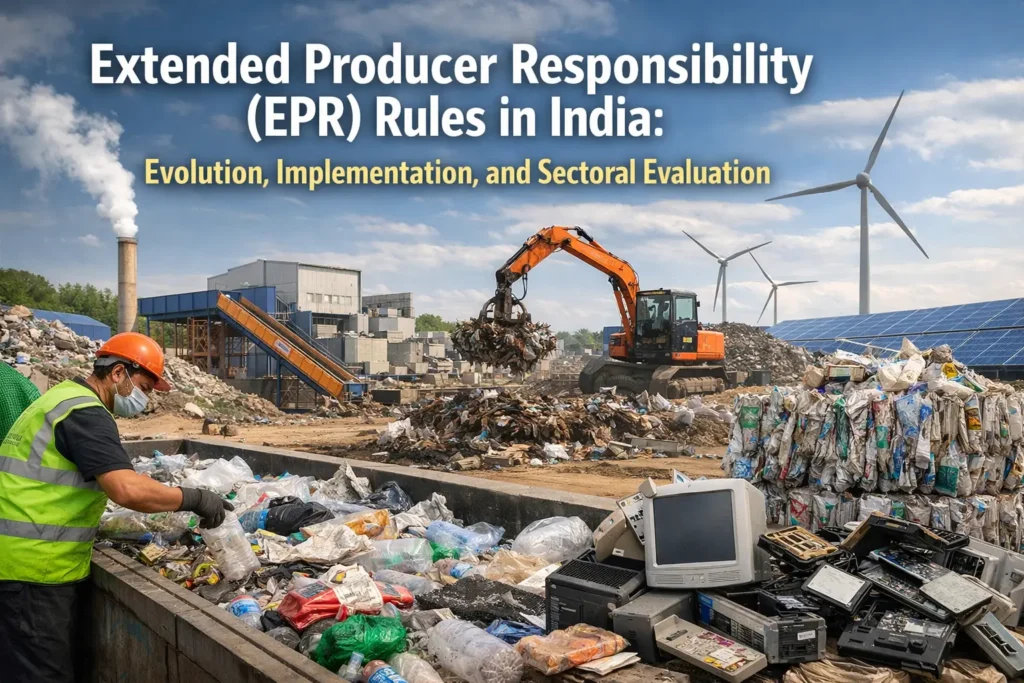
Waste generation has emerged as one of the most serious environmental challenges facing India today. Population growth, rapid urbanization, and increasing consumption patterns have… Continue reading

Environmental protection has become a global priority as industrialization and urban development continue to expand rapidly. Industries contribute significantly to economic growth… Continue reading