
HEALTHCARE ACCESSIBILITY AND EQUITY IN INDIA
- SREEVINDA CHALLAPALLI
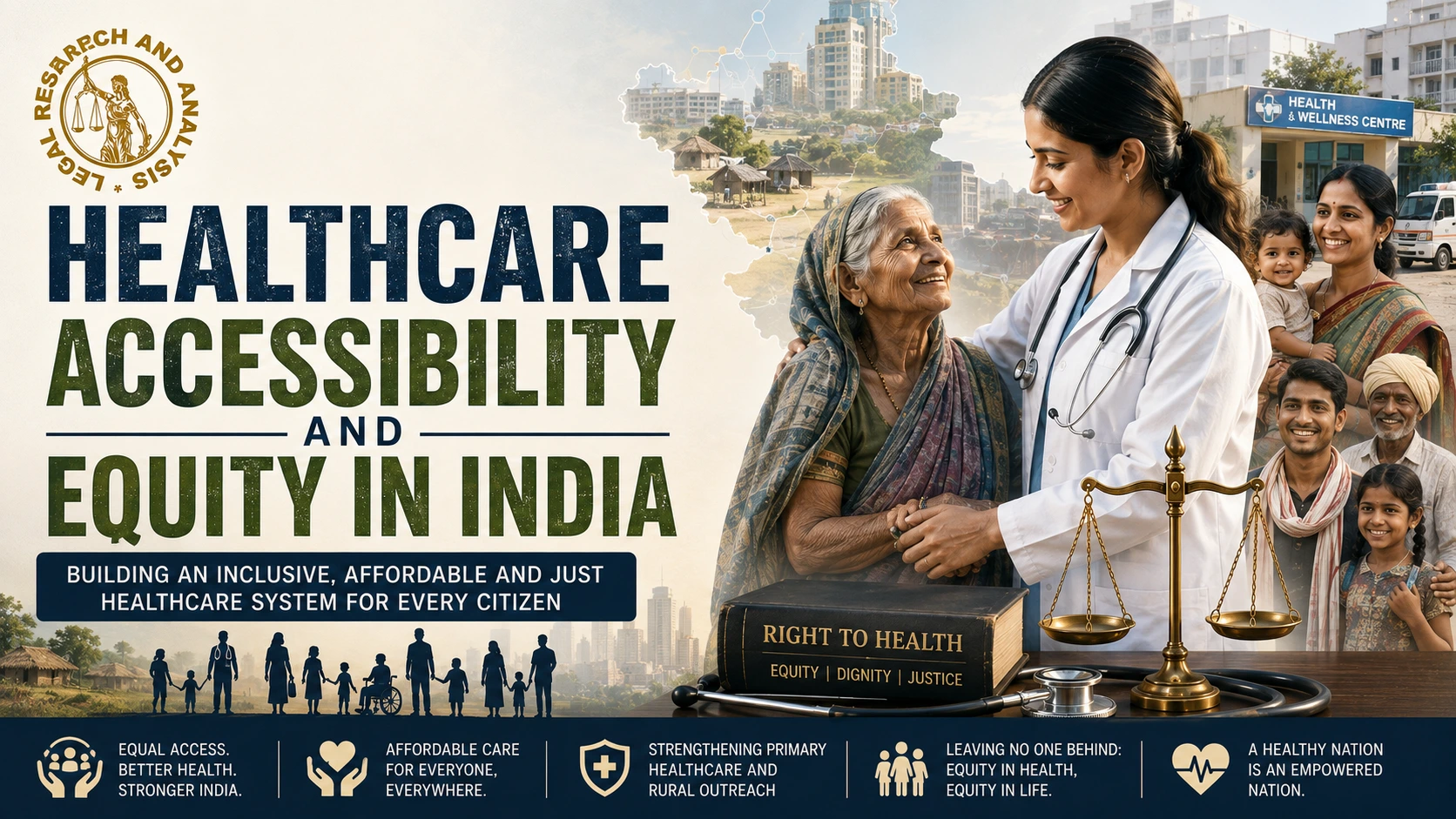
Table of Contents
ABSTRACT
Healthcare Accessibility: India is faced with an extremely complex and challenging healthcare sector, particularly concerning ensuring quality, affordable and accessible healthcare for its citizens. While the right to life is a fundamental right guaranteed by the Indian Constitution and various policy measures and welfare schemes have been enacted to improve the healthcare delivery system, there are continuing challenges with effective implementation. Infrastructure gaps, resource allocation, and administrative inefficiencies have been issues that result in unequal access to healthcare. The paper critically evaluates the variances between the public and private healthcare sectors and the extent to which the delivery of healthcare has been made equal in India. It also assesses the role of the judiciary in expanding the interpretation of the right to life under Article 21 of the Constitution to include the right to health, and the constitutional vision and duty of the state as per the Directive Principles of State Policy. The study concludes that improvement in public healthcare infrastructure and delivery, effective implementation of policy measures, and addressing structural inequalities are critical in realizing the goals of equitable and universal healthcare in India.
INTRODUCTION
India accounts for a large proportion of the global burden of disease. An estimated 20% of disability-adjusted life years (DALYs) lost and almost 18% of all deaths worldwide take place in India. A fifth of all maternal deaths and a quarter of child deaths also occur in India. The overall life expectancy at birth is only about 63 years for males and 66 years for females, owing to continued challenges in the health sector.1
While healthcare is a basic human right, the notion of universal access to healthcare remains elusive around the world. There are several determinants of health which act as barriers in accessing healthcare facilities. Some of these determinants are socio-economic status of individuals, health belief practices, culture and religion, geographical location, residence and factors linked to policies and governance. When talking about the Indian context, a lot of disparities in healthcare are linked to caste, class, gender, age and discrimination based on these parameters. Availability of health care services and their timely delivery is uneven and unequal for various sections of the society. Despite government efforts in the form of various welfare schemes and policies the Government of India has implemented with regard to healthcare for the Indian citizens, there are growing concerns related to the efficient implementation of these schemes, and if it is actually able to provide easy access to all sections of society.2
Access to healthcare is the availability of timely and appropriate health care to those who need it. It can be defined as the access of individuals to health care facilities, goods and services they need, in an affordable, acceptable and quality form. In other words, accessibility, which can be called effective accessibility if it includes the quality, availability and acceptability of services, means that people should not face geographical, financial, social, or institutional barriers and should get the right healthcare when they need it, in time.3
Equity and equality have been the principal ethos to ensure that the poor and the marginalized sections of the society are able to avail the necessary health care. The Health Survey and Development Committee Report of 1946, more popularly known as the Bhore Committee Report after its chairman Sir Joseph Bhore, set up a long-term vision for the purpose of universal coverage through government led health services for the entire population. Equity in health care is important to serve the marginalized and the underprivileged people and they have been long standing guiding principles to serve them, The Health Survey and development Committee Report of 1946, which was led by Sir Joseph Bhore, set up a detailed vision for the purposes of providing coverage to the whole population through government led health services. The Bhore Committee proposals required implementation of structural changes in the then health care system, and had they been implemented they would have radically altered health care access and health status of the Indian masses, especially the 80% population residing in rural areas. It is only an embarrassment for the Indian nation that more than half a century later there is no evidence of development of health care services to a level that the Bhore Committee regarded as a minimum decent standard. And neither has the health status of the masses altered very significantly – both in terms of the technology and means available as well as in comparison with developed countries today. The gap then and now has not changed much.4 5
In the successive five-year plans, healthcare was always looked upon as an important component of the country’s development agenda. In 2009, the Government of India had introduced a National Health Bill, which if introduced would have provided for a legal basis of the “right to health” and “right to healthcare” by underlining the social determinants of health. But even after so many policy formulations, it remains to be seen that implementation is the key area where lack of efficient implementation plagues the country even though this is not a problem confined to India only.6
In the Indian healthcare system, there is also a strong belief that, in spite of the policies and schemes which have come up over the years with an eye on strengthening the primary health care services, primary healthcare still remains to be one of the under-funded and under-equipped area in the health sector. Not only is there an extreme level of disparity between the quality and the availability of medical services in public health institutions and hospitals on the one hand, and private hospitals on the other, the fact that the healthcare system is so disjointed and partitioned also comes in the way of a good delivery of services. This is more prominent in the case of those residing in the rural and the remote areas and their access to health care facilities.7
The need of the hour is to increase the number of health centres and their facilities with more medical and equipment backup as well as increase the strength of human resources in health by training more and more physicians in the field of family medicine and primary care. This would help in the process of availing services related to a wide spectrum of illnesses and the health services available to persons of all age groups.8
The World Health Report, 2008 had reconfirmed that primary healthcare is the bedrock of a health system and the most appropriate strategy for realising UHC as well as achieving SDGs. The report put special focus on a number of reforms for strengthening primary healthcare systems. It included health equity through universal health coverage, a transformation of health systems into people-centred service delivery systems, strengthened governance through effective leadership, and community oriented public health programmes.9
The right to healthcare has been interpreted by the judiciary as a fundamental part of the right to life as guaranteed by Article 21 of the Constitution of India, and as a result every person is entitled to a basic level of healthcare. Doctors are also subject to a fiduciary duty not to abandon a patient once they have taken on the responsibility for their treatment, except after giving reasonable notice and allowing for an opportunity to the patient to find alternative treatment. Additionally, registered medical practitioners are also duty bound not to wilfully cause any act of negligence, which would result in the patient being denied of medical treatment and care.10
Against this backdrop, the present paper aims at critically analysing the lacunas and the obstacles which hinder the right to healthcare in India. It further makes a comparative study of health care facilities in the public and private sectors and analyses the extent to which the laws and policies have failed to check the trend of inequality and inequity in the sphere of primary healthcare services.
The aim of this research is to study the lacunas in the healthcare system in India and the inefficient delivery of primary healthcare even after the implementation of schemes and welfare facilities provided by the Government of India and the most important objective is the study of the increased mortality rates caused due to unequal and untimely treatment provided to certain sections of the society. The main question that arises after taking into consideration all the above aspects regarding healthcare here is “Why is there still an inefficiency in the implementation of the existing legal and policy framework system in India in ensuring accessible and equitable healthcare for all sections of society despite the constitutional promises?” This research is doctrinal, analytical and comparative and completely done with the usage of secondary sources.
EXISTING POLICY FRAMEWORKS REGARDING HEALTHCARE IN INDIA
India faces the challenge of multiple health issues, including under nutrition, poor sanitation, and a rise in the burden of infectious diseases. India’s public health concern ranges from communicable diseases like tuberculosis, malaria, dengue fever, chikungunya, respiratory infection, and water-borne diseases to non-communicable diseases, including cardiovascular disorders, diabetes, and cancer. The Central Bureau of Health Intelligence (2016) also reports on the emergence of infectious diseases, like Ebola, SARS, and H1N1 influenza. India is also dealing with the “triple burden of diseases” i.e. the unfinished agenda of communicable diseases, a rising prevalence of non-communicable diseases, and emerging infectious diseases (The Central Bureau of Health Intelligence, 2016). In 2015, acute respiratory infections were the most significant cause of morbidity (67%), followed by acute diarrhoeal diseases (23%). In terms of mortality, Influenza A H1N1 (23%) was followed by acute respiratory infections (20%), and pneumonia (18%) (The Central Bureau of Health Intelligence, 2016). Hence, the challenge that India faces is not only related to population growth and composition but also the country’s improvement in the quality of human resources through the delivery of effective health care.11
The development of the healthcare policies and plans in India can be linked to the Alma-Ata Declaration of 1978, which laid the focus on social justice and an integrated approach of primary healthcare instead of the existing selective and disease-specific programs. Later, in the Ninth Five-Year Plan (1997–2002), the Structural Adjustment Programmes (SAPs) were introduced in a time when the Indian healthcare sector was transitioning into a new phase. Although SAPs were focused on improving the welfare of the vulnerable sections of the population, the financial aid from the IMF and the World Bank resulted in a diminished role of the State, and more private participation and market-driven competition in the healthcare sector.12
Between 2005 and 2021, several significant policy measures were implemented with the overall aim of developing healthcare infrastructure and reducing the rural-urban divide.13
The Pradhan Mantri Ayushman Bharat Health Infrastructure Mission (PM-ABHIM) was launched for the Health and Wellness Centres and improving the health infrastructure and
- The National Health Policy, 1983, was based on the Primary Healthcare model to integrate healthcare services.14
- This was followed by the National Health Policy, 2002, and the launch of the National Rural Health Mission (NRHM) in 2005 to enhance the accessibility, affordability, and quality of healthcare services in the rural regions.15
- The Pradhan Mantri Swasthya Suraksha Yojana (PMSSY) was launched for the development of high-level medical infrastructure; however, its implementation has been affected by delays and other administrative issues.16
- The National Health Policy, 2017, was introduced, keeping in view the shifting dynamics of the healthcare space to bring the public health expenditure to 2.5 percent of GDP and lay focus on primary healthcare.17
- In 2018, the Pradhan Mantri Jan Arogya Yojana (PM-JAY), an insurance-based financial protection for the economically vulnerable families was launched under the Ayushman Bharat initiative.18
- The COVID-19 pandemic brought to the fore the gaps in the health infrastructure, and the government announced Emergency COVID Response Packages (ECRP) to strengthen the national and state health systems.19
- The Pradhan Mantri Ayushman Bharat Health Infrastructure Mission (PM-ABHIM) was launched for the Health and Wellness Centres and to improve the health infrastructure and preparedness. India also conducted the world’s largest vaccination drive, with over 2.2 billion doses administered.20
INEFFICIENCIES IN THE IMPLEMENTATION OF THE POLICY FRAMEWORKS
Nonetheless, it must be conceded that there are numerous lacunas in the implementation of these policies. The programmes in the health sector are often disproportionately skewed in favour of urban areas even after 20 years of healthcare reforms thus accentuating rural and urban divide and defeating the very purpose of equitable access. The healthcare system itself has not provided a clear roadmap to fulfill its goals. Successive policies have been vocal about increased public investment in health, yet government expenditure on health has remained around 1 per cent of the GDP, with Out-of-Pocket (OOP) expenditure remaining one of the highest in the world. The lack of basic infrastructure, especially in rural areas, and a critical shortage of healthcare workers have become the key stumbling blocks in the path of universal health coverage. As a result, the bulk of the population has been forced to rely on the private sector and has often ended up getting pushed into debt and poverty due to catastrophic health spending, especially in the case of the marginalised sections of the society. The healthcare system has also historically overemphasised curative services at the cost of preventive care and there has also been a lack of rural-urban parity that has affected equitable access to services. Rollout of schemes like Ayushman Bharat has itself been bogged down by severe operational inefficiencies.21
There are certain lacunas in rural and urban sectors as well, they are:22
INEFFICIENCY IN THE RURAL AREA:
Rural inhabitants have been continually deprived of healthcare services and as a result, their mortality rates have been higher than those in urban areas. There are 716 million people residing in rural India and almost 72 percent of the population living under the poverty line finds it difficult to access healthcare services. India has made tremendous progress since independence; the life expectancy of Indian citizens has increased from 33 years in 1947 to 62 years in 1998. Infant mortality has decreased from 146 in 1947 to 57 in 1997 while under-five mortality has reduced from 166 in 1947 to 74 in 1997. However, there exist significant disparities when it comes to geographical regions, socioeconomic class and even the gender divide. Although India has come a long way since Independence, several of its health indicators still compare unfavourably with several developing countries.23
The rural population is the most vulnerable to disease due to poor living conditions, unhygienic and unsanitary surroundings, unsafe childbirth practices, malnutrition, and lack of proper sanitation and most of them are employed as either agriculturists or artisans or daily wage labourers with very little to spare. Money spent on health is at times not affordable. It is for this reason that the rural populace is much more susceptible to epidemics and communicable diseases.24
INEFFICIENCY IN THE URBAN AREA:
Urban healthcare facilities are much better in comparison to rural facilities and as a result, the mortality rate is lower than in rural areas, The Krishnan Committee laid stress on the healthcare needs of urban areas and the Seventy-Fourth Constitutional Amendment Act enabled the Urban Local Bodies (ULBs) to take up water supply, sanitation, and registration of births and deaths, which strengthened the urban public health setup.25
Allocation of public expenditure in favour of the higher-level curative services which are concentrated in urban areas has remained high over the decades. According to studies conducted, the urban allopathic care services receive a much greater share of public expenditure in comparison to rural allopathic care services. However, these services have not trickled down to the urban poor. In spite of the presence of world-class hospitals and highly advanced treatment facilities, the deprived sections of the urban population are still often denied access to healthcare. Largely as a reaction to this, the National Urban Health Mission (NUHM) has been created to meet the healthcare needs of the urban poor but, Inadequate allocation and continuing shortage of healthcare staffs have stunted the primary healthcare centres.26
A COMPARISON OF PRIVATE AND PUBLIC HEALTHCARE SECTORS:
The healthcare sector is one in which there exists a clear point of demarcation between private healthcare and public healthcare. Public healthcare, as the name suggests, is meant to provide the common man with reasonably cheap medical facilities, however, there exists a significant chunk of the population that still opts to be treated in private hospitals. However, if one takes a closer look at the reasons behind it, the differentiation not only remains in terms of one being different from the other, but in which areas of public healthcare and private hospitals have been consistently outperforming each other and in which areas one of them lags behind the other. Although both of the public and private sectors face some shortcomings as discussed earlier, it still remains in the perception of people that private hospitals are more efficient with the services they provide, and offer better care for their patients as compared to the public hospitals.27
According to the socio-economic comparison between the private and the public healthcare sectors, there are certain socio-economic characteristics that create a point of differentiation between the two. For the sake of analysis, these characteristics have been segregated into three categories.28
The first category is a set of people that have been segregated according to their castes, and it showcases the people who visit the public and the private healthcare sector for OPD and IPD services. In terms of OPD services, it is found that a total of almost 54% of patients visiting a public hospital belonged to the OBC category. It was then followed by 21% of patients from the SC category, and 12% of patients from the ST category. In private hospitals, there were only 16% of SC patients and 4% of ST patients taking OPD services. If the scenario is reversed, a similar set of observations can be made in the case of IPD services as well where it was found that a total of around 45% of people who were taken in for IPD services in public hospitals, were from the OBC category and 30% were from the SC category. In private hospitals, there were only 15% of SC patients and 4% of ST patients availing IPD services.29
In the second category, the data for the middle-income states have been taken into consideration. For OPD services, it is found that in public hospitals, the major chunk of the OPD services in public hospitals were availed by people belonging to the OBC category. In the case of private hospitals, the major chunk of OPD services in private hospitals were availed by people belonging to the General category. It was then followed by almost 47% of the patients availing IPD services in private hospitals, who also belonged to the OBC category. It was further observed that 15% of the people who belonged to the lowest quintile in terms of wealth were dependent on public healthcare facilities, whereas 27% of the people who belonged to the highest wealth quintile availed public healthcare facilities for OPD services. In the case of private hospitals, only 9% of people in the lowest quintile of the wealth availed private hospitals for OPD services, whereas 31% of people in the highest quintile availed private hospitals for OPD services. These observations thus further state that even in the middle-income states, the public healthcare institutions still majorly provided healthcare services to the socially and economically backward section of the society, whereas private hospitals attracted more people from the General category and economically stronger groups.30
The last set of the category is the data that has been taken from the low-income states. For OPD services, the major chunk of OPD services that was availed in public hospitals, was by people belonging to the OBC category, followed by people belonging to the SC category, which accounted for 18% of OPD patients and 23% of IPD patients. In the case of private hospitals, there were only 14% of patients who belonged to the SC category, and a measly 2% from the ST category, where as 44% of the patients belonged to the General category.31
The data from the statistics clearly exhibit that the people who approach public healthcare institutions are majorly the economically weaker sections, socially backward people, and less educated people. As mentioned earlier, there exist a significant amount of shortcomings in the private healthcare sector as well. However, as discussed earlier, in the case of the private healthcare sector, people majorly have to provide from their own pockets, which makes it a bit more difficult for a person from the lower strata of the society to approach a private hospital as it would majorly be a heavy expense for them. In terms of the public sector, even though it is quite a bit more affordable when compared to the private sector, it still does not have the same efficiency in terms of the services they provide and the way they are provided. Although the private healthcare sector has its own set of flaws as well, people’s perceptions in terms of receiving better medical treatment and care for the patients in private hospitals when compared to public hospitals still is a common sentiment.32
In addition to that, other statistical comparisons give us a better scope in terms of the performance of the two sectors when they are comparatively looked at in different aspects. A comparison of in-hospital mortality in public and private hospitals under PM-JAY in the period between 2018 and 2019 reveals that public hospitals reported a higher in-hospital mortality than private hospitals and the mortality across various surgical specialities was notably higher in public facilities.33 When observed mortality by speciality, it can be found that there are remarkable variations between public and private hospitals in different medical specialities. A comparison in the speciality of Neurosurgery, it was observed that public hospitals recorded a mortality that was 3.6 times higher than that in private hospitals. A comparison between the same speciality in public and private hospitals, it was observed that public hospitals recorded a mortality that was almost 57% higher than the mortality in private hospitals. In the speciality of Paediatric Surgery, the mortality was 5.9 times higher in public hospitals. It was also observed that in the speciality of General Surgery, public hospitals recorded a mortality that was 2.4 times higher than in private hospitals. In the speciality of Plastic and Reconstructive Surgery, the mortality was also moderately higher in public hospitals, and the difference in Surgical Oncology was only marginal, with public hospitals reporting a slightly higher mortality than private hospitals. The private hospitals recorded higher mortality in Polytrauma than the public hospitals, although the difference is only marginal. In the speciality of Neurology, however, the mortality in public hospitals was 5.9 times higher than in private hospitals. Similarly, the mortality in the speciality of Orthopaedics was also found to be approximately 2.1 times higher in public hospitals. In the speciality of ENT procedures, the mortality was also found to be higher in public hospitals. The mortality in the speciality of Ophthalmology was also approximately 2.4 times higher in public hospitals. In the specialities of Obstetrics and Gynaecology and Oral and Maxillofacial Surgery, higher mortality was reported in private hospitals as compared to the public hospitals.34
However, a comparatively lower mortality in private hospitals cannot be regarded as an evidence that quality in private healthcare is better, because a host of other factors can also play a significant role in patient outcomes and have to be accounted for as well. A lot of these also include a delayed consent in the treatment procedure due to the lack of education or illiteracy, delay in seeking medical treatment, and the caseload of the speciality or complexity of cases in public hospitals. The public healthcare institutions also witness a greater influx of emergency or patients who are already on the verge of death and peripheral healthcare facilities may not have the required infrastructure and equipment to cater to such complex cases. Other infrastructure related issues, delayed referrals, overcrowding, and accessibility also continue to plague treatment outcomes. Therefore, before even linking the difference in mortality to the functioning of the public hospital, structural and other systemic limitations have to be taken into consideration first because of the significant role that they play in patient outcomes.35
EQUALITY AND HEALTHCARE
Equitable healthcare can only be provided to people when the healthcare infrastructure and the service distribution is fairly divided in different regions, as well as across different people. The basis of availing a healthcare service must be need-based and not upon a person’s ability to pay for it. Although it is the aim of the National Health Policy to provide the citizens of the country equitable treatment, there exists a great amount of social bias and acts of discrimination that are continuing to hinder this aim.
THE VICTIMS OF CASTE SYSTEM IN HEALTHCARE
The group that remains to be most affected is that of the Dalits who are one of the major victims of social and economic backwardness, with negligible or no land holdings and a strong deeply rooted caste-based discrimination. Other minorities, are also subject to the same kind of marginalization, humiliation and biased treatment at different times, inside and outside healthcare institutions.36 Healthcare and inequity is something that needs to be studied in order to better the disadvantages. A systematic review on articles from 1980 to 2017 using electronic databases such as PubMed, MEDLINE, Shodhganga, Google Scholar, etc., found significant disparities on health outcomes, prevalence and access to healthcare. Health equity has been placed in a prime position in the health policy of the country, since, the State as a responsibility enshrined in the Constitution, to ensure that a quality healthcare service is provided to the poor and other marginalised sections of society. Equity in health can be viewed as having health services available for all and their accessibility without discrimination on the basis of caste, class, gender or other social determinants.37
CONSTITUTIONAL PROMISES FOR EQUITY IN HEALTHCARE
The right to life, under Article 21 of the Constitution, has been given a meaning and content to include a right to health as one of the indispensable conditions of living a life of dignity with universal access to healthcare services for all individuals, to the best of its resources and capacity. This guarantee has also been furthered, with some assistance by international instruments, like the UDHR and ICESCR that also have recognized health as a fundamental human right. Articles 38, 39, 42, 43 and 47 of the Directive Principles of State Policy have also had a hand in the process of forming the health policy of the country as well as in the concomitant welfare measures to ensure and provide easily accessible, reasonably affordable, and more importantly, equitable healthcare services to the population of the country at large.38
Articles 38, 39, 42, 43 and 47 of the Constitution of India to all effects and purposes direct and guide the State to work towards the goal of improving and bettering the standard of living, the health and the strength of its people, the advancement of public health, and the provision of healthcare services, all of which have been a part of a larger social welfare objective and has had a guiding hand in enacting the necessary laws and policies to provide accessible healthcare to the people of the country. Although a part of the non-justiciable part of the Constitution, these articles guide the State, as a constitutional objective and to do their best to ensure equitable healthcare to all of the citizens and residents of the country, to better their quality of life.39
Article 21 of the Constitution of India guarantees the right to life and personal liberty, to the best of the resources and capacity, which has been enlarged on by the judicial dictums of the Supreme Court to also include a right to health, and access to adequate medical care as a necessary precondition to living a life of dignity. When it is read in harmonious construction with the Preamble as well as the Directive Principles of State Policy under Part IV, especially Articles 38, 39, 42, 43 and 47, it also imposes the concomitant constitutional obligation on the State, as a duty, to improve and better the living conditions and the standard of life of its citizens and residents.
The Supreme Court has furthered this guarantee with the help of some landmark judgements of theirs.40
- In Paschim Banga Khet Mazdoor Samity v. State of West Bengal, it was held by the Court, that the State has a primary duty to provide timely and adequate medical facilities and that a failure of a government hospital to provide immediate medical assistance, would amount to a violation of Article 21.41
- In State of Punjab v. Ram Lubhaya Bagga, it was held by the Court that the State’s policy to regulate medical reimbursement was valid, and even further reaffirmed the State’s primary responsibility of protecting public health.42
- In Parmanand Katara v. Union of India, the Court held that every doctor whether in a government or a private hospital, had an absolute professional obligation to preserve human life by providing immediate medical treatment and that no procedural formalities had the right to deter them from doing so.43
- In State of Karnataka v. Manjanna, the Court emphasised that no doctor could insist on a prior police requisition when it came to examining and providing medical assistance to a rape victim immediately, and thus would also amount to a violation of the victim’s right to life under Article 21.44
CONCLUSION
India has a fairly detailed constitutional and policy structure in place to ensure a system that is accessible and equitable in terms of healthcare to everyone. However, as has been discussed in the entirety of the study, there still exists a great amount of disparity and difference in the healthcare received by the people of this country because of lack of implementation and enactment of already existing policies, a lack of public investment and unequal socio-economic distribution of resources and facilities. The study has also shown how although private healthcare may often have a better infrastructure and in some aspects, better treatment outcomes and results, public healthcare is still sought after the most, as it is the major source of healthcare to all of the people from the economically weaker sections and other marginalised groups of the society, that come under the purview of reservation policies. The way to ensure healthcare equity is to better primary healthcare, increase public health expenditure, improve healthcare in rural areas, and ensure implementation. Only a rights-based, and an inclusive approach can ensure the concomitant constitutional promise of equitable healthcare, which is easily accessible and affordable to all of its citizens.
FOOTNOTES
- Yarlini Balarajan, S. Selvaraj & S. V. Subramanian, Health Care and Equity in India, 377, The Lancet, 1-2,(2011), https://pmc.ncbi.nlm.nih.gov/articles/PMC3093249/pdf/nihms292456.pdf ↩︎
- Kawtar Zahidi et al., Healthcare Accessibility: Metrics, Assessment, Policies, and Barriers, in Economics of Healthcare: Studies and Cases (1st ed. 2024), available at https://www.intechopen.com/chapters/1188361 ↩︎
- Ibid 2 ↩︎
- Ravi Duggal, Evolution of Health Policy in India, 2-3, (1st ed. 2001), https://www.cehat.org/uploads/files/a147.pdf ↩︎
- Yarlini Balarajan, S. Selvaraj & S. V. Subramanian, Health Care and Equity in India, 377, The Lancet, 1-2,(2011), available at https://pmc.ncbi.nlm.nih.gov/articles/PMC3093249/pdf/nihms292456.pdf ↩︎
- Ibid 5 ↩︎
- Allen Prabhaker Ugargol, Arnab Mukherji & Ritika Tiwari, In Search of a Fix to the Primary Health Care Chasm in India: Can Institutionalising a Public Health Cadre and Inducting Family Physicians Be the Answer?, 13, The Lancet Regional Health – Southeast Asia, 100197, (2023), available at https://pmc.ncbi.nlm.nih.gov/articles/PMC10305920/ ↩︎
- Ibid 7 ↩︎
- Ibid 8 ↩︎
- Pt. Parmanand Katara v. Union of India & Ors., 4 SCC (S.C. 1989), https://indiankanoon.org/doc/498126/ ↩︎
- Arvind Grover & R. B. Singh, Health Policy, Programmes and Initiatives,(1st ed.2020), https://pmc.ncbi.nlm.nih.gov/articles/PMC7122919/ ↩︎
- Vishal Chauhan, Neha Dumka, Erin Hannah, Tarannum Ahmed & Atul Kotwal, Recent Initiatives for Transforming Healthcare in India: A Political Economy of Health Framework Analysis, 2, Journal of Global Health Economics and Policy, (2022) ↩︎
- Janak Raj, Shauryavir Dalal & Aashi Gupta, Evolution of the Healthcare Policy Framework in India, CSEP Working Paper No. 78, Centre for Social and Economic Progress,(2024), https://csep.org/working-paper/evolution-of-the-healthcare-policy-framework-in-india/ ↩︎
- Ibid 13 ↩︎
- Ibid 14 ↩︎
- Ibid 15 ↩︎
- Ibid 16 ↩︎
- Ibid 17 ↩︎
- Ibid 18 ↩︎
- Ibid 19 ↩︎
- Ibid 20 ↩︎
- Ibid 21 ↩︎
- Ashok Vikhe Patil, K. V. Somasundaram & R. C. Goyal, Current Health Scenario in Rural India,10, Australian Journal of Rural Health,(2002) ↩︎
- Ibid 23 ↩︎
- Smita Shrivastava, Ashutosh Kothari & Himanshu Bhushan, Urban Health in India: From Smaller Steps to a Big Leap, 3, Journal of Global Health Economics and Policy, (2023) ↩︎
- See Urban Studies Institute, Challenges and Solutions for India's Urban Health Care System, Urban Studies Institute (last updated Jan. 12, 2026), https://urbanstudies.institute/urban-planning-development-challenges/challenges-solutions-india-urban-healthcare/, (last visited June 27, 2026). ↩︎
- Sanjay Basu, Jason Andrews, Sandeep Kishore, Rajesh Panjabi & David Stuckler, Comparative Performance of Private and Public Healthcare Systems in Low- and Middle-Income Countries: A Systematic Review, 9, PLOS Medicine, (2012),
https://journals.plos.org/plosmedicine/article/file?id=10.1371/journal.pmed.1001244&type=printable ↩︎ - Sarit Kumar Rout, Kirti Sundar Sahu & Sandeep Mahapatra, Utilization of Health Care Services in Public and Private Healthcare in India: Causes and Determinants, 14, International Journal of Healthcare Management, (2021), https://www.researchgate.net/profile/Sarit-Rout/publication/336441256_Utilization_of_health_care_services_in_public_and_private_healthcare_in_India_Cau ses_and_determinants/links/5da1e3b392851c6b4bd0e7e8/Utilization-of-health-care-services-in-public-and-private-healthcare-in-India-Causes-and-determinants.pdf ↩︎
- Ibid 28 ↩︎
- Ibid 29 ↩︎
- Ibid 30 ↩︎
- Ibid 31 ↩︎
- Siddhesh Zadey, Himanshu Iyer, Anveshi Nayan, Nikhil Agarwal, Nakul P. Raykar, Joao Ricardo Nickenig Vissoci, et al., Evaluating the Status of the Lancet Commission on Global Surgery Indicators for India, 85 (Supplement 2), Indian Journal of Surgery, 6, (2023),
https://www.researchgate.net/figure/n-hospital-mortality-rates-in-public-vs-private-hospitals-empanelled-under-Pradhan_fig4_371212507 ↩︎ - Ibid 33 ↩︎
- Ibid 34 ↩︎
- Sanghmitra S. Acharya, Health Equity in India: An Examination Through the Lens of Social Exclusion, 4, Journal of Social Inclusion Studies, 6 (2018) ↩︎
- Ibid 36 ↩︎
- Ravinder Kumar, Strict Implementation of the Right to Health as a Fundamental Right: Ensuring Universal Access and Equity in India, 93, Law and Safety, 6, (2024) ↩︎
- Ibid 38 ↩︎
- Deepu P, Right to Health as a Constitutional Mandate in India, 7, Journal on Contemporary Issues of Law (JCIL), (2021) ↩︎
- Ibid 40 ↩︎
- Ibid 41 ↩︎
- Ibid 42 ↩︎
- Ibid 43 ↩︎
+919458479236



Questions of medical negligence have acquired increasing importance in India as healthcare has moved into a more rights-conscious and legally supervised environment.… Continue reading

Waste generation has emerged as one of the most serious environmental challenges facing India today. Population growth, rapid urbanization, and increasing consumption patterns have… Continue reading

Environmental protection has become a global priority as industrialization and urban development continue to expand rapidly. Industries contribute significantly to economic growth… Continue reading