By Shreya Sahu1
Evaluating the Supreme Court’s Regulatory Framework for Artificial Intelligence in Courts for acknowledging the journey from AI Assistance to AI Governance, where law merges with technology and supports innovation while maintaining judicial independence and integrity.
ABSTRACT
For decades, courts asked a simple question: Can technology make justice faster? India’s draft regulation for the use of AI in courts answers the same. In a far more interesting manner, portraying the Supreme Court as the first AI regulator, this article traces the journey from a tentative attempt to inculcate technology with accessibility of law to regulating AI in law. It critically analyzes how the governing framework of AI in law abides constitutional supremacy by critically examining the foundational principle behind it and all, evaluating its efficiency by comparative analysis with the EU AI Act. The draft is strongly coherent with India’s ambition of AI augmentation, but has various lacunae in it, which might lead to regulatory ambiguities in all spheres that need to be resolved. This article identifies both failures and argues that fixing them is not optional but necessary if the regulation is to honor its own constitutional commitments.
KEYWORDS:
Artificial intelligence, judicial governance, Draft AI Regulations 2026, SUPACE, high-risk AI, EU AI Act, district courts, access to justice, judicial independence
STATEMENT OF PROBLEM
The Indian judiciary is no longer asking whether AI can be augmented, but how AI can be governed. The Draft Regulations for Use of Artificial Intelligence in Courts, 2026, are an important step in that direction. However, key gaps remain. The absence of a clear definition of high-risk AI, limited attention to district courts, and unclear lines of accountability raise concerns about the framework’s practical viability.
RESEARCH METHODOLOGY
This article adopts a doctrinal and comparative legal research methodology. It examines the Draft Regulations for Use of Artificial Intelligence in Courts, 2026, relevant constitutional provisions, judicial precedents, and academic literature on AI governance. A comparative analysis of the EU AI Act is undertaken to evaluate India’s regulatory approach to judicial AI. The study employs analytical legal reasoning to clarify structural gaps in the Draft Regulations and properly assess their implications for constitutional values such as fairness, accountability, transparency, and judicial independence. The research is limited to the analysis of legal texts as primary and secondary sources and does not clearly involve the collection of empirical data.
LITERATURE REVIEW
1. Taruna Solanki & Animesh Pareek, ‘AI and Technology in the Indian Judiciary: A Step Toward Enhancing Efficiency and Equity’, 45(1) Legal Reference Services Quarterly (2026)2
This article provides the foundational context for AI adoption in Indian courts, tracing the e-Courts Mission Mode Project and its role in creating the infrastructure for AI integration. Like every innovation requires a problem to exist, it helps to provide the same context here. It establishes systemic conditions, such as judicial backlog and access deficits, that made AI adoption both necessary and inevitable, forming the backdrop against which the 2026 Draft Regulations must be read.
4. Varun Mehta & Ashirbad Nayak, ‘Regulating Artificial Intelligence in Indian Judiciary: From Institutional Experimentation to a National Framework’, Live Law (June 11, 2026)3
The most directly relevant secondary source to this article. Mehta and Nayak trace the regulatory arc from SUPACE and SUVAS to the Draft Regulations, situated the 2026 framework within a broader governance discourse. It acts as the basis of the whole background about the AI journey in the Indian judiciary, from tech integration to AI governance. Their analysis of the transition from experimentation to institutionalization closely informs this article’s central argument.
3. Advaith Sri Krishna Datta Mamidanna, ‘Artificial Intelligence in the Indian Judiciary: SUPACE, SUVAS, and the Limits of Assistive Automation’, Dr Syama Prasad Mookerjee Research Foundation (February 10, 2026) 4
Offers a critical evaluation of SUPACE and SUVAS, identifying the limits of assistive automation and the risks of opacity and unverified AI outputs in judicial processes. It clearly demonstrates how the problem of black box AI is solved or addressed by draft regulations. His concerns about accountability and transparency directly support this article’s critique of the regulatory gaps under the Draft Regulations.
INTRODUCTION
Can artificial intelligence be integrated into courts without compromising judicial independence, fairness, and public trust?
“The Supreme Court’s draft regulations attempt to answer this not by restricting AI, but by governing it.” Now, the debate regarding the use of artificial intelligence in courts is no longer whether we should integrate AI into the judicial system; the answer is affirmative, without a doubt, given its acknowledged potential by the venerated Supreme Court. The question is how we can properly
govern the use of AI in the judicial system by leveraging its full potential while minimizing harm. The regulation does not support the replacement of AI but its assistance in our judicial system, where clear red lines are drawn and guidelines established to ensure proper integration of technology and law while maintaining judicial independence
The supreme court engagement evolved with AI from experimentation to its governance, which began with SUPACE (Supreme Court Portal for Assistance in Court’s Efficiency) as an assistance tool and has now culminated in a draft regulation that not merely utilizes but also regulates its presence in the judicial system. It might be the best example where the judiciary seeks a balance between innovation, accountability, and transparency.
Now we can say that “the judiciary is not merely a consumer of technology but an architect of its governance.”
INDIA JUDICIARY’S AI JOURNEY
TECHNOLOGICAL ADVANCEMENT – AI INTEGRATION – AI GOVERNANCE.
India’s judicial encounter with artificial intelligence did not begin with regulation; it began with a quest for AI integration aimed at increasing efficiency and accessibility.
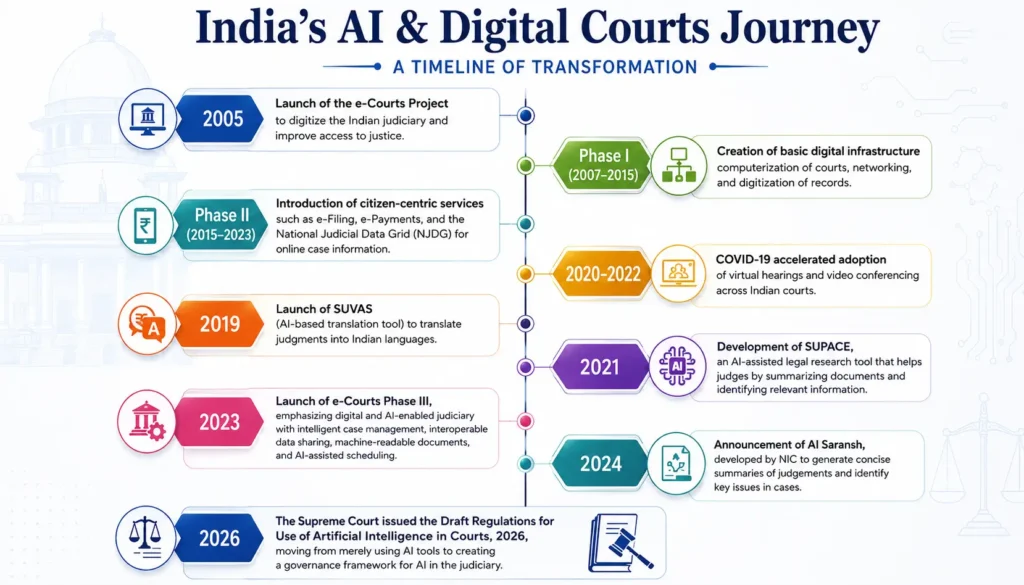
The Supreme Court’s Draft Regulations for Use of Artificial Intelligence in Courts, 2026, did not emerge in isolation; it reflects the major shift from technological adoption to institutional governance of AI. The journey started with the e-courts project in 2005 with the primary goal of improving judicial efficiency. It focused on making the system more affordable, transparent, cost-effective, and accessible, thereby initiating the process of digitized judicial administration.5
Phase I (2007-2015)6 of the project started with the objective of creating the basic digital infrastructure and limited online services on the court premises.
Phase II (2015-2023) focuses on a “litigant-centric monolithic system” by establishing a linkage between the judiciary and other institutions for interoperability. The case information system, National Judicial Data Grid (hereinafter NJDG)7 . It is a service portal that emerged from Phase II and offered a single window for access from the lowest court in the hierarchy to the Supreme Court. However, many limitations were identified during implementation, such as the need to revise systems to accommodate evolving user needs and to scale to enable data sharing across courts and institutions within the justice delivery system.8
In 2020-2022, due to COVID-19, the integration of technology into the judiciary also accelerated, starting from the adoption of virtual hearings and video conferencing across Indian courts. .In 2019, SUVAS9 (Supreme Court Vidhik Anuvaad Software) was introduced — a machine-assisted translation tool trained using Artificial Intelligence10. In 2021, SUPACE11 (Supreme Court Portal for Assistance in Court’s Efficiency) was developed to automate administrative and data-processing aspects of judicial research without intruding into legal reasoning or decision-making12. that finally acts as a stepping stone where technology specifically talks about AI integration into the judicial system.
Phase III envisions a digitalized, tech-driven, and AI-empowered justice system. It aims to shift from monolithic systems to modular microservices architecture. Given the challenges and its significance, the E-Committee of the Supreme Court has been empowered to oversee the execution of the Courts project, as set out in the “National Policy and Action Plan for Implementation of Information and Communication Technology in the Indian Judiciary—200513
The Honorable Chief Justice of Delhi High Court, during the IBA International Conference in Mexico City, 2024, announced that the Supreme Court of India was going to introduce an AI tool known as AI Saransh. It was developed by the National Informatics Centre (NIC) to generate concise summaries of pleadings and to simplify the identification of a case’s contentious issues.14
The journey finally ended with the draft AI regulation of 2026 till now, with upcoming innovation in the pipeline. By critically analyzing the journey, it can be broken down into three phases with their own objective that are
- Digitization
- AI assistance and augmentation
- AI governance
The journey, whose major objective is to inculcate technology with judicial reasoning, will deal with the problem of judicial efficiency and access to justice, which is now moving towards not just AI assistance but creating an environment where AI can work with judicial integrity.
GENERAL PRINCIPLE
Sanjeev K Kapoor, Senior Partner at Khaitan & Co, said: “The concern is not with AI per se, but with its indiscriminate and unverified use of AI.”15
The Supreme Court of India flagged serious concerns about the increasing misuse of Artificial Intelligence (AI) tools in court-related work, especially the tendency to cite judgments that do not exist, often referred to as “hallucinated” decisions.16
This might be making things crystal clear that the problem is not with AI but the way we use it. These principles tend not to ignore the problems created by AI by trying to reduce them by sketching clear lines for its proper operability.
· SAFEGUARDING HUMAN CONTROL AND ACCOUNTABILITY
Human control (regulation 4), continuous oversight (regulation 9), and accountability (regulation 8)17
It is the backbone of the whole AI regulation, where it clearly depicts the idea that AI will always act in an assistive, augmentative capacity, subservient to human judgment, and not in replacement or supplantation, where the final authority to determine is judicial authority, and every AI system in use is subjected to continuous monitoring and periodic technical, legal, and ethical audit to prevent malfunctioning. Proper accountability is put over the officer using AI and cannot avoid its responsibility for any harm caused. International scholarship cautions that such oversight must be substantive rather than ceremonial, particularly where AI systems affect vulnerable populations.18
· ENSURING FAIR AND CONSTITUTIONAL AI
Rule of Law (Reg. 5), Fairness and Non-Discrimination (Reg. 6), Proportionality (Reg. 12), and accessibility (Reg. 13)
It has been clearly laid down that the supremacy of constitutional principle also governs the use of AI in law, such as due process of law, and the right to a fair trial, embodied in Article 2119 It ensures equality before the law and equal access to the law in Article 1420 which tries to decrease the digital divide of the country and extends fairly to all stakeholders, from rural to its diverse communities, and promotes inclusive growth as an idea. The system must promote fairness and not discriminate among individuals because of any bias, provide special protection to vulnerable groups, and reconcile with the Constitution’s commitment to substantive equality under Articles 1521 and 16.22 Proportionality tends to resonate with all other principles, but establishing humans in the loop of the system is a higher risk to personal liberty and judicial integrity.
· PROTECTING JUDICIAL DATA
Transparency (Reg. 7), data privacy (Reg. 10), purpose limitation (Reg. 11), data integrity (Reg. 14), and cybersecurity (Reg. 15).
The problem of black box AI23 is clearly addressed by the Supreme Court by setting a high standard of transparency and explainability of AI systems going to be used in the judicial process. The right to privacy under Article 21,24 Privacy and protection of personal data, are also addressed here through the principle of purpose limitation and data minimization. Also, to address the issue where ai often governed by data that is not verified and lawfully taken, to reduce such issues of copyright infringement, AI hallucination, and AI bias, the Supreme Court came up with prior data verification, which needs to be accurate, lawfully taken, and free from any bias, with proper security measures to protect the sensitivity of data.
· INNOVATION-ORIENTED AI
Presumption in favor of responsible use of AI (Reg. 16) and innovation over restraint (Reg. 17). The regulation tries to expand the use of AI in improving access to justice, reducing delays, or enhancing administrative efficiency, but not just blank adoption but responsible adoption, which clearly demarcates how technology is slowly inculcating in law without compromising constitutional values, independence of the judiciary, and its integrity, to augment, not supplant, human judges, supporting easy access to justice.
THE BOUNDARIES OF JUDICIAL AI
The draft regulation by the Supreme Court clearly demarcated the boundaries for permitted and prohibited use of AI in law for balancing two acts that are proper utilization of its potential and improving court efficiency, and to decrease the damage that may be caused by an AI system.
Under Regulation 19, the permitted use of AI is clearly demarcated in a broad range of judicial and administrative functions, which include:
- case management, cause list preparation, hearing scheduling, and docket prioritization.
- Transcription of court proceedings, translation of judgment, translation for people with disabilities.
- Legal research and conversational AI assistance chatbot.
- Auto-generation of the prescribed format for notices, anonymization of judgment, and for verifying the authenticity of judgment25.
Under Regulation 20, the framework draws firm red lines around certain uses of AI in which the use of AI is strictly prohibited to protect the integrity of the judicial system, which includes:
- No personal data of any individual has been used for training the AI system
- No judicial outcome can be reached solely based on algorithmic decision making, and there is a requirement of a human in the loop when the function includes adjudication and final authority is human.
- No AI system can be used for predicting the future behaviors of an individual, for continuous surveillance, which undermines the confidentiality and independence of the judiciary26.
- If there is any violation of the provision regarding the use of AI, it must be carefully dealt with by the AI committee, and then a remedy will be issued.
INSTITUTIONAL FRAMEWORK
The Regulations create a multi-layered governance structure starting with an apex body in the Supreme Court, which acts like the Supreme Court’s AI regulator and policymaker, whose main task is to create a national AI policy, set standards, and coordinate with various HC. Then there are various specialized bodies working under the apex body, such as the Judicial Committee, Technical Committee, Committee on Infrastructure and Finance, Case and Data Management Committee, and Cyber Security Committee.
They collectively provide expertise in various fields for proper analysis of the AI system through various angles.
Their CoRe-AI( Centre of Research and Excellence on Artificial Intelligence which is like the knowledge generator, helps in research and legal compliance to the apex body.AT every HC and in the Supreme Court, there e will be an AI committee to oversee, regulate, and facilitate the responsible, and every AI committee supported by the AI Secretariat that implements decisions.
COMPARATIVE STUDY WITH EU AI ACT
India’s framework most closely resonates with the EU AI framework, where India’s current framework is specifically for the judicial system, but the EU AI Act is for every sphere in which special AI use in law is categorized in a high-risk category. In the high-risk category, it also asks for:
- “An assessment of the risks that the AI system could pose to the health, safety, or fundamental rights of the people concerned;
- The maintenance of very extensive technical documentation and a quality management system;
- Governance of the data used event logging, mandatory human oversight, accuracy, and data security;
- Transparency toward users and/or the persons concerned”27;
All these are the feature which we can Cleary observes in the Supreme Court draft regulation, and even I found India regulation to be more precise by constructing a definite framework which work on their expertise to better deployment of ai.
The EU asks, “How can AI be regulated before deployment?” whereas India asks, “How can AI be governed within judicial institutions?”
While the EU focuses primarily on the regulation of AI systems in all sectors, India goes forward because it allows a Dedicated Institutional Framework, Stronger Judicial Ownership, Explicit Ban on Predictive Justice, Balance Between Innovation and regulation, and Continuous Learning Mechanism.
This aligns with Hildebrandt’s argument that legal systems deploying algorithmic tools must embed transparency as a structural requirement, not merely a procedural one.28
OVERSIGHT, AUDITS, ACCOUNTABILITY
There is a mandatory requirement of a comprehensive technical and ethical impact assessment by the appropriate authority before approving an AI system, and controlled environment testing under the supervision of the AI Secretariat.
For record-keeping purposes, maintain a proper AI register and undergo periodic technical, legal, and ethical audits at intervals not exceeding one year.
AI Secretariat will also maintain an AI incident database for systematic recording of each incident, its cause, location, and consequences, and maintain emergency and fallback protocols which can be followed in the event of when ai system malfunction and its unavailability.
WHAT DRAFT DOESN’T SAY
The Definition Deficit — “High-Risk” Without a Taxonomy
The draft rapidly relies on the term “high-risk” but never defines what constitutes a high-risk system. The term appears in regulation 7(3) that deals with heightened scrutiny, regulation 12(2), which deals with enhanced safeguards, and regulation 46(4)(h), which deals with mandatory explainability documentation, yet chapter I, which contains all the definitions, has no such reference or specific definition of “high-risk” system.
The problem is not merely semantic, but it clearly showcases the regulatory gap that might be faced because of this ambiguity, where Regulation 18 authorizes the “APPROPRIATE AUTHORITY” to determine where AI can be used.
This creates a regulatory vacuum where different high courts might have different definitions according to their understanding, in which, for example, a docket-prioritization system affecting liberty interests may be treated as high-risk in one jurisdiction, but ordinary administrative software in another, and Litigants have no objective benchmark against which to challenge a classification decision.
This opacity in classification mirrors what Pasquale identifies as the core danger of ungoverned algorithmic systems: the absence of defined criteria renders meaningful challenge impossible.29
Unlike the EU AI Act, which clearly demarcates AI into 4 categories that are unacceptable, high, limited, and minimal risk AI with predefined criteria and a prior list of items.
This might raise constitutional concerns about affecting personal liberty, and there is no clear definition that could affect the heart and soul of Article 21. A person cannot meaningfully challenge the deployment of a system when the regulatory framework provides no criteria for determining its risk status.
District Courts Are the Primary Users but Have No Voice
The district court will be bound by the regulations because they fall within the high court jurisdiction, and they are going to be the largest consumer of the AI administration system, using tools such as case management, scheduling, transcription, and filing assistance, and many more.
The governance architecture contains Supreme Court judges, High Court judges, technical experts, Academics, Government representatives, and Advocates. But no mandatory representation from:
- District Judges
- Judicial Magistrates
- Civil Judges
- Court Registry staff at the district level
Despite these actors being the judiciary’s primary frontline users.
The success or failure of AI deployment into the judiciary largely depends on the district level where most litigation occurs, pending cases exist, and the primary source where litigants interact with the justice system.
Yet the draft adopts a largely top-down governance structure in which policy is designed at the Supreme Court and High Court levels and then implemented downward. Which must be replaced with bottom-up governance, like in the case of the planning commission, replaced with Niti Aayog in 2015 because of inefficiencies due to its top-down approach. The district, as the major stakeholder, must also be added to the AI governance framework decision-making in various committees.
A framework committed to inclusivity and access to justice; the absence of formal district-court representation is striking; the judiciary’s frontline users are expected to implement AI governance without participating in its design
CONCLUSION
The current Draft AI Regulation represents the most significant attempt yet to transform the Indian judicial system, with the Supreme Court positioning itself as the first regulator of AI in India and advancing India’s integration of AI through sound governance. It clearly demarcates the boundaries within which technology and AI may operate, with human oversight preserved and human judgment maintained as final. It is a clear example of India seeking to integrate AI across various domains — not with the intention of replacing human labor or reasoning, but with the aim of augmenting the process.
Ultimately, the draft succeeds in recognizing the risks of AI in judicial processes, but its effectiveness will depend on addressing the gaps between principle and implementation.
RECOMMENDATIONS
The requirement is not to completely dismantle the regulation, but to make amendments to it to enhance its regulatory scope and efficiency. The two advise which need to be addressed to improve its future implementation are that the definition of high-risk AI needs to be given and must include the district court in decision-making because they are the major stakeholders in it.
REFERENCES
A. PRIMARY SOURCES
I. Constitution
- INDIA CONST. art. 14.
- INDIA CONST. art. 15.
- INDIA CONST. art. 16.
- INDIA CONST. art. 21.
II. Cases
- Justice K.S. Puttaswamy (Retd.) v. Union of India, (2017) 10 SCC 1.
III. Regulations and Official Documents
- Supreme Court of India, Draft Regulations for Use of Artificial Intelligence (AI) in Courts, 2026 (June 3, 2026), https://cdnbbsr.s3waas.gov.in/s3ec0490f1f4972d133619a60c30f3559e/uploads/2026/06/2 026060342.pdf (last visited June 12, 2026). Ministry of Law and Justice, Government of India, National Policy and Action Plan for Implementation of Information and Communication Technology in the Indian Judiciary (2005).
- Ministry of Law and Justice, Government of India, e-Court Mission Mode Project, Press Information Bureau (Aug. 5, 2022), https://www.pib.gov.in/PressReleasePage.aspx?PRID=1848737 (last visited June 12, 2026).
- Government of India, Press Information Bureau, Press Release on SUVAS (2023), https://www.pib.gov.in/PressReleasePage.aspx?PRID=1947490 (last visited June 12, 2026).
B. SECONDARY SOURCES
I. Journal Articles
- Taruna Solanki & Animesh Pareek, AI and Technology in the Indian Judiciary: A Step Toward Enhancing Efficiency and Equity, 45(1) Legal Reference Services Quarterly (2026), https://doi.org/10.1080/0270319X.2026.2617784 (last visited June 5, 2026).
II. Online Articles and News
- Advaith Sri Krishna Datta Mamidanna, Artificial Intelligence in the Indian Judiciary: SUPACE, SUVAS, and the Limits of Assistive Automation, Dr. Syama Prasad Mookerjee Research Foundation (Feb. 10, 2026), https://spmrf.org/artificial-intelligence-in-the-indian-judiciary-supace-suvas-and-the-limits-of-assistive-automation/ (last visited June 12, 2026).
- Varun Mehta & Ashirbad Nayak, Regulating Artificial Intelligence in Indian Judiciary: From Institutional Experimentation to a National Framework, Live Law (June 11, 2026), https://www.livelaw.in/articles/regulating-artificial-intelligence-indian-judiciary-537485 (last visited June 12, 2026).
- ANI, Courts Flag AI Misuse in Legal Work, Experts Call for Accountability, Verification, The Tribune (Apr. 15, 2026), https://www.tribuneindia.com/news/business/courts-flag-ai-misuse-in-legal-work-experts-call-for-accountability-verification/ (last visited June 12, 2026).
- Satyajeet Barik, AI Misuse in Courts? Supreme Court Slams Use of Fake Judgments, Urges Bar Council of India to Act, LawChakra (May 6, 2026), https://lawchakra.in/supreme-court/ai-misuse-in-courts-bci-to-act/ (last visited June 12, 2026).
- Thomas Vini Pires, AI Act: Scope, Key Provisions and Compliance Obligations, EQS Group (Feb. 26, 2026), https://www.eqs.com/compliance-blog/ai-act-regulation-overview/
(last visited June 12, 2026).
III. Official Portals and Databases
- National Judicial Data Grid, NJDG Portal, https://njdg.ecourts.gov.in/ (last visited June 12, 2026).
- National Informatics Centre, Ministry of Electronics and Information Technology, Government of India, AI Saransh, https://cloud.gov.in/user/services_ai_saransh.php (last visited June 12, 2026).
- Frank Pasquale, The Black Box Society: The Secret Algorithms That Control Money and Information (Harvard University Press, 2015).
- Mireille Hildebrandt, Law for Computer Scientists and Other Folk (Oxford University Press, 2020).
- Supreme Court of India, SUPACE Portal, available at https://supace.sci.gov.in (last visited June 12, 2026)
- Government of India, Transformation of Planning Commission into NITI Aayog, Cabinet Resolution (Jan. 1, 2015), Press Information Bureau.
FOOTNOTES
- Shreya Sahu,2nd year BA LLB student at NLIU, Bhopal. ↩︎
- Taruna Solanki & Animesh Pareek, ‘AI and Technology in the Indian Judiciary: A Step Toward Enhancing Efficiency and Equity’ 45(1) Legal Reference Services Quarterly (2026), available at <https://doi.org/10.1080/0270319X.2026.2617784> (last visited June 5, 2026). ↩︎
- Varun Mehta & Ashirbad Nayak, ‘Regulating Artificial Intelligence in Indian Judiciary: From Institutional Experimentation to a National Framework’, Live Law (June 11, 2026), available at <https://www.livelaw.in/articles/regulating-artificial-intelligence-indian-judiciary-537485> (last visited June 12, 2026). ↩︎
- Advaith Sri Krishna Datta Mamidanna, ‘Artificial Intelligence in the Indian Judiciary: SUPACE, SUVAS, and the Limits of Assistive Automation’, Dr Syama Prasad Mookerjee Research Foundation (February 10, 2026), available at <https://spmrf.org/artificial-intelligence-in-the-indian-judiciary-supace-suvas-and-the-limits-of-assistive-automation/> (last visited June 7, 2026). ↩︎
- Taruna Solanki & Animesh Pareek, ‘AI and Technology in the Indian Judiciary: A Step Toward Enhancing Efficiency and Equity’ 45(1) Legal Reference Services Quarterly (2026), available at
<https://doi.org/10.1080/0270319X.2026.2617784> (last visited June 5, 2026). ↩︎ - Varun Mehta & Ashirbad Nayak, ‘Regulating Artificial Intelligence in Indian Judiciary: From Institutional Experimentation to a National Framework’, Live Law (June 11, 2026), available
<https://www.livelaw.in/articles/regulating-artificial-intelligence-indian-judiciary-537485> (last visited June 12, 2026). ↩︎ - National Judicial Data Grid, NJDG Portal, available at <https://njdg.ecourts.gov.in/> (last visited June 7, 2026). ↩︎
- Ministry of Law and Justice, Government of India, e-Court Mission Mode Project (Press Information Bureau, August 5, 2022), available at <https://www.pib.gov.in/PressReleasePage.aspx?PRID=1848737> (last visited June 7, 2026). ↩︎
- SUVAS (Supreme Court Vidhik Anuvaad Software) is an AI-trained machine-assisted translation tool designed to translate judicial documents from English into various vernacular languages used in India. ↩︎
- Government of India, Press Information Bureau, Press Release on SUVAS (2023), available at
<https://www.pib.gov.in/PressReleasePage.aspx?PRID=1947490> (last visited June 7, 2026). ↩︎ - SUPACE (Supreme Court Portal for Assistance in Court's Efficiency) is a tool designed to help judges retrieve essential case information quickly by summarizing bulky documents. ↩︎
- Advaith Sri Krishna Datta Mamidanna, ‘Artificial Intelligence in the Indian Judiciary: SUPACE, SUVAS, and the Limits of Assistive Automation’, Dr Syama Prasad Mookerjee Research Foundation (February 10, 2026), available at <https://spmrf.org/artificial-intelligence-in-the-indian-judiciary-supace-suvas-and-the-limits-of-assistive-automation/> (last visited June 7, 2026). ↩︎
- Ministry of Law and Justice, Government of India, e-Court Mission Mode Project, supra note 8. ↩︎
- National Informatics Centre, Ministry of Electronics and Information Technology, Government of India, AI Saransh, available at <https://cloud.gov.in/user/services_ai_saransh.php> (last visited June 7, 2026). ↩︎
- ANI, ‘Courts Flag AI Misuse in Legal Work, Experts Call for Accountability, Verification’, The Tribune (April 15, 2026), available at <https://www.tribuneindia.com/news/business/courts-flag-ai-misuse-in-legal-work-experts-
call-for-accountability-verification/> (last visited June 12, 2026). ↩︎ - Satyajeet Barik, ‘AI Misuse in Courts? Supreme Court Slams Use of Fake Judgments, Urges Bar Council of India to Act’, LawChakra (May 6, 2026), available at <https://lawchakra.in/supreme-court/ai-misuse-in-courts-bci-to-act/> (last visited June 7, 2026). ↩︎
- Supreme Court of India, Draft Regulations for Use of Artificial Intelligence (AI) in Courts, 2026, regs. 4, 8 & 9 (June 3, 2026), available at
<https://cdnbbsr.s3waas.gov.in/s3ec0490f1f4972d133619a60c30f3559e/uploads/2026/06/2026060342.pdf> (last visited June 7, 2026). ↩︎ - Virginia Eubanks, Automating Inequality: How High-Tech Tools Profile, Police, and Punish the Poor (St. Martin's Press 2018) 12. ↩︎
- INDIA CONST. art. 21. ↩︎
- INDIA CONST. art. 14. ↩︎
- INDIA CONST. art. 15. ↩︎
- INDIA CONST. art. 16. ↩︎
- "Black Box AI" refers to an artificial intelligence system that produces outcomes without providing a clear or understandable explanation of how those outcomes were generated. ↩︎
- Justice K.S. Puttaswamy (Retd.) v. Union of India, (2017) 10 SCC 1. ↩︎
- Supreme Court of India, Draft Regulations for Use of Artificial Intelligence (AI) in Courts, 2026, reg. 19 (June 3, 2026), available at
<https://cdnbbsr.s3waas.gov.in/s3ec0490f1f4972d133619a60c30f3559e/uploads/2026/06/2026060342.pdf> (last visited June 12, 2026). ↩︎ - Supreme Court of India, Draft Regulations for Use of Artificial Intelligence (AI) in Courts, 2026, reg. 20 (June 3, 2026), available at
<https://cdnbbsr.s3waas.gov.in/s3ec0490f1f4972d133619a60c30f3559e/uploads/2026/06/2026060342.pdf> (last visited June 12, 2026) ↩︎ - Thomas Vini Pires, ‘AI Act: Scope, Key Provisions and Compliance Obligations’, EQS Group (February 26, 2026), available at <https://www.eqs.com/compliance-blog/ai-act-regulation-overview/> (last visited June 7, 2026). ↩︎
- Mireille Hildebrandt, Law for Computer Scientists and Other Folk (Oxford University Press 2020) 45. ↩︎
- Frank Pasquale, The Black Box Society: The Secret Algorithms That Control Money and Information (Harvard University Press 2015) 8. ↩︎