
Certificate Course on
International Law
Online
International Law Certification India
Build a structured understanding of the nature, sources and subjects of International Law, State responsibility, treaties, the United Nations, use of force, International Humanitarian Law, human rights, and international criminal justice through 8 live case-centric classes plus orientation and concluding sessions. Designed for law students, legal professionals, researchers, and International Relations learners. 4 weeks, 10 sessions — just ₹1,000.
What Is International Law?
International Law sits at the intersection of treaties, custom, and institutional practice — the Vienna Convention on the Law of Treaties 1969, the UN Charter, the ICJ Statute, the Geneva Conventions, and the Rome Statute of the ICC. It decides how States interact, when force may be used, how disputes are resolved, and how individuals are protected under international human rights and humanitarian law.
Nature & Scope
Public and Private International Law, and the relationship between International and Municipal Law under Monism and Dualism.
Sources & Subjects
Treaties, custom, general principles, jus cogens, and the role of States, international organizations, and individuals as subjects.
Statehood & State Responsibility
Recognition, territorial sovereignty, State succession, and legal consequences of internationally wrongful acts.
United Nations & Institutions
The UN Charter, General Assembly, Security Council, and the role of international organizations in maintaining global order.
Humanitarian & Human Rights Law
Geneva Conventions, IHL, IHRL, and the protections owed to civilians, POWs, and individuals in conflict and peace.
Dispute Settlement
Negotiation, mediation, arbitration, and adjudication before the ICJ and other international tribunals.
Why International Law Matters Today
From trade disputes to armed conflict to climate governance, a dense web of treaties and institutions shapes how States and individuals act globally. Anyone working across borders — as a lawyer, diplomat, researcher, or policy professional — needs fluency in the following, which is exactly what this course is structured around.
UN Charter
Foundational instrument governing peace, security and collective action.
Vienna Convention, 1969
Governs formation, interpretation and termination of treaties.
ICJ Statute
Defines the sources of International Law and settlement of State disputes.
Geneva Conventions & IHL
Protect civilians and combatants during armed conflict.
Rome Statute & ICC
Establishes individual criminal liability for the gravest international crimes.
UDHR, ICCPR & ICESCR
Core instruments underpinning International Human Rights Law.
Law of the Sea
Governs maritime zones, navigation rights and ocean resource disputes.
Emerging Frameworks
Cyber warfare, AI, climate governance, and Space Law reshape the field.
Who Should Enroll In This Course
A Case-Centric Certificate Course, Not Just Theory
This Certificate Course on International Law is a four-week intensive programme featuring eight live, interactive classes that combine conceptual lectures with case-based analysis. It integrates foundational principles of International Law with contemporary global developments, ensuring both theoretical understanding and applied relevance. Each session draws upon landmark international judgments, treaties, and institutional practices to illustrate how legal norms function in real-world contexts — delivered by experienced legal researchers and practitioners associated with Legal Research & Analysis, examining the intersections between law, diplomacy, technology, and governance.
What Makes This Course Different
Structured Academic Design
A four-week intensive programme featuring eight live, interactive classes combining lectures with case analysis.
Doctrinal Depth & Practical Insight
Integrates foundational principles with contemporary global developments for applied relevance.
Case-Centric Pedagogy
Each session draws on landmark international judgments, treaties, and institutional practices.
Expert-Led Instruction
Delivered by experienced legal researchers and practitioners ensuring scholarly rigor and professional orientation.
Global & Interdisciplinary Perspective
Examines intersections between law, diplomacy, technology, and governance.
Career & Academic Advancement
Ideal for students, professionals, and scholars strengthening expertise in international legal systems.
Live + Recorded Classes
Attend live on Google Meet or catch up anytime with session recordings.
Assignment-Based Certification
A structured assignment ensures practical application before the e-certificate is issued.
Internship & LOR Pathway
Full attendance and timely submission open the door to an internship and recommendation letter.
Foundations, Sources & Subjects
Understand the foundations, sources and subjects of International Law.
Statehood & Responsibility
Understand Statehood, sovereignty, State responsibility and diplomatic law.
UN & the ICJ
Examine the role of the United Nations and the International Court of Justice.
Dispute Settlement
Evaluate mechanisms of international dispute settlement, including ICJ and arbitration.
Treaties & Instruments
Analyse treaties, conventions and other primary international legal instruments.
Career Readiness
Build a credential that supports roles in international legal practice, research and diplomacy.
4 Weeks · 8 Classes + 2 (Orientation & Concluding)
Exact curriculum as designed by LRA faculty — every session pairs doctrine with case-based discussion.
WEEK 1Foundations, Sources & Subjects of International Law
Orientation Session
- Welcome and Course Overview
- Introduction to International Law and its Relevance
- Course Structure, Learning Outcomes & Assessment
- Introduction to Faculty and Participants
Foundations of International Law
- Meaning, nature, scope, and historical development of International Law
- Public and Private International Law; relationship between International and Municipal Law (Monism & Dualism)
- Sovereignty within the international legal order and the application of International Law in India
Sources & Subjects of International Law
- Article 38 of the ICJ Statute; treaties, custom, and general principles; opinio juris and State practice; jus cogens
- States, international organizations, and individuals as subjects of rights and duties
- Role of non-State entities and multinational corporations in the international legal order
WEEK 2Treaties, Diplomacy & Global Governance
States, Territory & State Responsibility
- Statehood and recognition; territorial sovereignty and State succession
- Legal consequences and mechanisms for reparation under international law
- Nationality and diplomatic protection; attribution and internationally wrongful acts; circumstances precluding wrongfulness
International Treaties & Diplomatic Law
- Reservations, invalidity, termination, and the doctrine of pacta sunt servanda under the Vienna Convention on the Law of Treaties, 1969
- Legal framework and privileges governing diplomatic and consular functions
- Diplomatic immunity and State immunity
WEEK 3Global Institutions, Armed Conflict & International Crimes
United Nations & International Organizations
- UN Charter and organizational structure; General Assembly, Security Council, International Court of Justice, and Secretariat
- Chapter VI and Chapter VII; peacekeeping, sanctions, and collective security mechanisms
- Role, influence, and constraints of international organizations in maintaining international order
Use of Force, Armed Conflict & IHL
- Prohibition on the use of force; Article 2(4) and Article 51 of the UN Charter; self-defence and collective self-defence
- Humanitarian intervention and Responsibility to Protect (R2P); international and non-international armed conflicts
- Geneva Conventions, protection of civilians and prisoners of war (POWs), and accountability for war crimes
WEEK 4Human Rights, Criminal Justice & Emerging Horizons
International Human Rights & International Criminal Law
- UDHR, ICCPR, ICESCR; UN human-rights mechanisms and State obligations
- Genocide, crimes against humanity, war crimes, and the crime of aggression under international law
- International Criminal Court and Rome Statute; relationship between IHL, IHRL, and ICL
Dispute Settlement & Emerging Issues
- Negotiation, mediation, conciliation, ICJ jurisdiction and advisory opinions, international arbitration, and investor–State dispute settlement (ISDS)
- Law of the Sea and maritime disputes; evolving challenges in cyber warfare, Artificial Intelligence, and autonomous weapons
- Climate change governance, Space Law, and the trajectory of international legal development
Concluding Session
- Recap of all modules and open Q&A with faculty
- Career guidance and next steps in International Law
- E-Certificate, recommendation letter and internship process explained
Key Instruments & Documents You'll Study
This course is built around real treaty text, landmark judgments and institutional practice — not just definitions. You will engage with the following instruments across the 4 weeks:
Sources & Subjects of International Law
Every lawyer, diplomat, and researcher working across borders needs to be fluent in identifying where a rule of International Law comes from and who it binds. This course covers:
Treaties
Binding agreements between States, governed by the Vienna Convention, 1969.
Custom
Consistent State practice combined with opinio juris — a sense of legal obligation.
General Principles
Principles common to major legal systems, applied where treaty and custom are silent.
Judicial Decisions & Writings
Subsidiary means for determining rules of law under Article 38(1)(d) of the ICJ Statute.
Jus Cogens
Peremptory norms of International Law from which no derogation is permitted.
Subjects of International Law
States, international organizations, and increasingly individuals as bearers of rights and duties.
How International Disputes Are Resolved
International Law offers a spectrum of peaceful mechanisms for resolving disputes between States, individuals, and organizations. Here is how the process typically unfolds, from informal talks to binding adjudication:
Negotiation
Parties attempt direct bilateral talks to resolve the dispute before escalating it further.
Mediation & Conciliation
A neutral third party facilitates dialogue or proposes non-binding terms of settlement.
International Arbitration
Parties agree to submit the dispute to arbitrators whose award is binding under treaty or contract.
ICJ Contentious Jurisdiction
States consenting to ICJ jurisdiction litigate the dispute for a binding judgment.
ICJ Advisory Opinion
UN organs may request a non-binding legal opinion from the ICJ on a question of International Law.
Investor–State Dispute Settlement (ISDS)
Investors bring claims against host States under investment treaties before arbitral tribunals.
Enforcement & Compliance
Judgments and awards are enforced through diplomatic, institutional, or Security Council mechanisms.
| Aspect | International Court of Justice (ICJ) | International Criminal Court (ICC) |
|---|---|---|
| Jurisdiction over | Disputes between States | Individuals accused of international crimes |
| Governing instrument | UN Charter & ICJ Statute | Rome Statute, 1998 |
| Nature of proceedings | Civil, State-to-State | Criminal, individual liability |
International Law — Key Comparisons
| Aspect | Treaty | Customary International Law |
|---|---|---|
| Formation | Written agreement, negotiated and ratified | Consistent State practice plus opinio juris |
| Applicability | Binds only consenting parties | Can bind States generally, absent persistent objection |
| Governing framework | Vienna Convention on the Law of Treaties, 1969 | Article 38(1)(b), ICJ Statute |
| Aspect | IHL | IHRL |
|---|---|---|
| Applies during | Armed conflict only | Peacetime and, to an extent, armed conflict |
| Core instruments | Geneva Conventions and Additional Protocols | UDHR, ICCPR, ICESCR |
| Protects | Combatants, civilians, POWs during conflict | All individuals against State violations |
| Aspect | Monism | Dualism |
|---|---|---|
| Relationship of laws | International and domestic law form a single system | International and domestic law are separate systems |
| Domestic effect | Treaties apply automatically once ratified | Treaties require domestic legislation to take effect |
| Aspect | Contentious Jurisdiction | Advisory Opinion |
|---|---|---|
| Who may approach | States that are parties to a dispute | UN organs and specialised agencies |
| Binding effect | Binding on the parties to the case | Generally non-binding, though persuasive |
| Aspect | International Arbitration | ICJ Litigation |
|---|---|---|
| Forum | Party-appointed arbitral tribunal | Permanent bench of ICJ judges |
| Flexibility | Procedure and seat chosen by the parties | Fixed procedure under the ICJ Statute and Rules |
| Common use | Investment and commercial disputes (e.g. ISDS) | Inter-State sovereignty, boundary, treaty disputes |
Human Rights & International Criminal Justice
UDHR, ICCPR & ICESCR
Foundational instruments establishing civil, political, economic, social and cultural rights.
Genocide & Crimes Against Humanity
Elements of the gravest international crimes and the threshold for individual liability.
ICC & the Rome Statute
Jurisdiction, complementarity, and the process of prosecuting international crimes.
IHL, IHRL & ICL Interplay
How the three bodies of law overlap and reinforce protection for individuals.
War Crimes & POWs
Protection of prisoners of war and accountability mechanisms under the Geneva Conventions.
R2P & Humanitarian Intervention
The Responsibility to Protect doctrine and its limits under the UN Charter.
Emerging Trends In International Law
International Law is evolving fast — these are the topics shaping the next decade of practice, and future career relevance.
Cyber Warfare
Applying existing legal frameworks to State-sponsored cyber operations.
AI & Autonomous Weapons
Regulating artificial intelligence and lethal autonomous weapons systems.
Climate Change Governance
Emerging international frameworks addressing State obligations on climate.
Space Law
Regulating the use and exploration of outer space by States and private actors.
Investor–State Dispute Settlement
Ongoing reform debates around ISDS and investment treaty arbitration.
Law of the Sea Disputes
Maritime boundary and resource disputes under UNCLOS.
Digital Diplomacy
Technology's growing role in treaty-making, negotiation, and governance.
Global Institutional Reform
Debates on reforming the UN Security Council and multilateral institutions.
Career Opportunities After This Course
International Law Associate
₹6-18 LPAHandling cross-border legal matters, treaty analysis, and international transactions at a law firm.
Legal Researcher
₹4-12 LPAConducting research on treaties, case law, and international legal developments for think tanks and firms.
Diplomatic Services Aspirant
₹8-25 LPABuilding the legal foundation required for foreign service and diplomatic career tracks.
Policy & Governance Professional
₹6-16 LPAAdvising on international policy, treaty compliance, and multilateral engagement.
Dispute Resolution Practitioner
₹6-20 LPAWorking in international arbitration and investor-State dispute settlement practice.
International Organisation Staff
₹8-22 LPALegal and policy roles within UN bodies, WTO, and other international institutions.
Human Rights Officer
₹5-14 LPAMonitoring, documenting, and advocating on human-rights compliance for NGOs and agencies.
Academic & Lecturer
₹5-15 LPATeaching and researching International Law at universities and law schools.
Trade & WTO Law Consultant
₹7-20 LPAAdvising on international trade law, tariffs, and WTO dispute settlement.
NGO Legal Advisor
₹4-12 LPAGuiding humanitarian and human-rights organisations on international legal compliance.
Independent Legal Consultant
Fee-basedFreelance advisory on cross-border legal and compliance matters.
Freelance International Law Researcher
Fee-basedRemote research and publication support for law firms and academic institutions.
Who Hires International Law Professionals
At A Glance
| Provider | Legal Research & Analysis |
| Duration | 4 Weeks |
| Classes | 8 Classes + 2 (Orientation & Concluding) |
| Days | Saturday & Sunday |
| Time | 7:00 PM – 8:00 PM |
| Mode | Online — Google Meet |
| Course Fee | ₹1,000 |
| Course Starts | 17 October 2026 |
| Course Ends | 17 November 2026 |
| Last Date to Apply | 16 October 2026 |
Course Benefits
E-Certificate
Internship Opportunity
Letter of Recommendation
Recorded Sessions
Notes & Study Material
Case-Based Learning
Assignment-Based Assessment
Expert Mentorship
Your Faculty For This Course
Meet the expert mentors who bring extensive knowledge and real-world experience in International Law to guide your learning journey.

Adv. Anuveeta Dutta Chowdhury

Adv. Jha Pranav Kumar
Sample Certificate
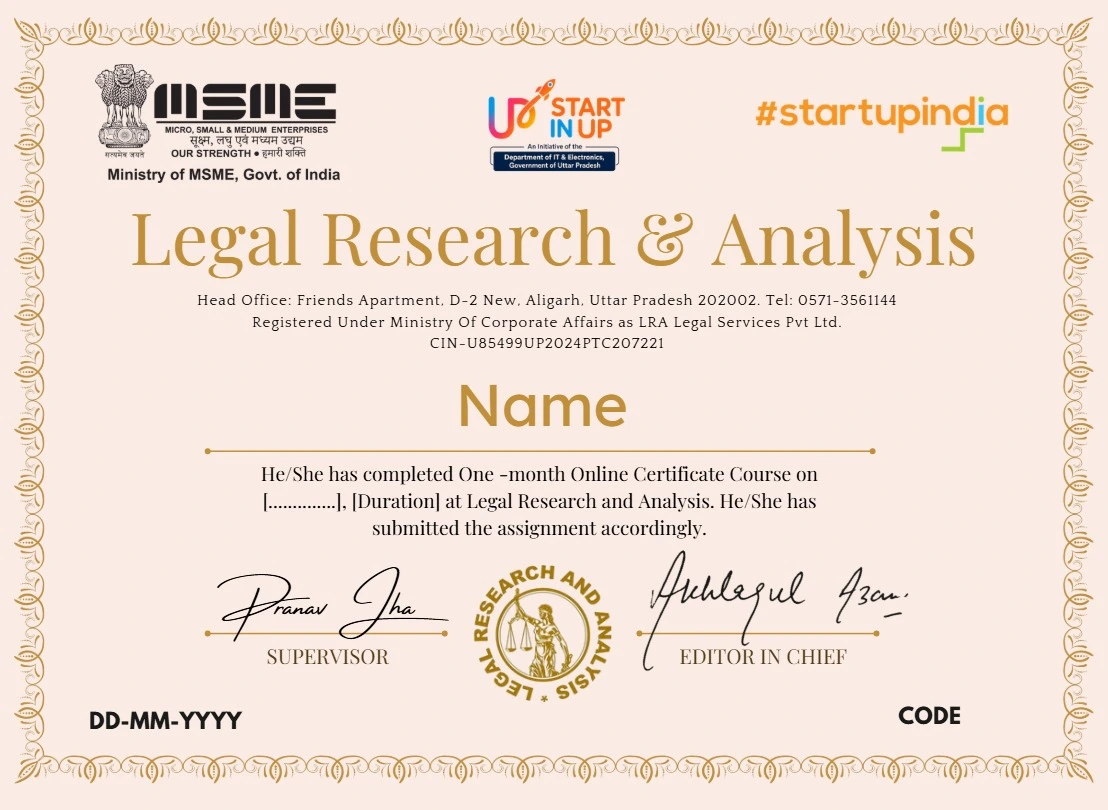
Issued On Completion
Your e-certificate is issued once all sessions and the assignment are completed.
Independently Verifiable
Each certificate carries a unique code that employers and institutions can verify.
Resume Enhancement
A recognised credential in International Law strengthens your resume.
LinkedIn Profile Value
Add a specialised, in-demand certification to your LinkedIn credentials section.
Internship Applications
Use this certificate to support internship and job applications in international law.
Why Choose Legal Research & Analysis
Expert Faculty
Learn from practising advocates with real corporate and litigation experience.
Live Classes
Interactive live sessions on Google Meet, not pre-recorded video dumps.
Case-Centric Learning
Hands-on case analysis, not just theory-heavy lectures.
Internship Support
Internship opportunity and recommendation letter for eligible participants.
Updated Curriculum
Reflects current global developments and recent international case law.
Global Case Studies
Learn through landmark ICJ, ICC and UN institutional practice.
Industry-Ready Training
Built to make you ready for international legal and policy roles.
Career Guidance
Ongoing support and community for career direction after the course.
Related Certificate Courses
If International Law interests you, you may also want to strengthen your dispute-resolution skills with our Alternative Dispute Resolution course, or build a broader commercial law foundation with our Corporate Law course. Researchers often pair this with our Research Writing course and our Data Protection Law course for a well-rounded global-compliance skill set. Policy-focused learners may also explore our Environmental Law course and Cyber Law course.
Your Questions, Answered
International Law is the body of rules and principles governing relations between States, international organizations, and increasingly individuals — covering treaties, custom, general principles of law, State responsibility, the UN system, armed conflict, human rights, and dispute settlement.
Under Article 38 of the ICJ Statute, the primary sources are international treaties, custom evidenced by State practice and opinio juris, and general principles of law, with judicial decisions and juristic writings as subsidiary means.
Law students, law graduates, legal professionals, academicians, researchers, exam aspirants, and learners from International Relations, Political Science, diplomacy, and governance backgrounds.
Yes. The course welcomes learners from International Relations, Political Science, diplomacy, and governance backgrounds, with concepts explained in a structured, accessible manner.
Yes. The course examines the UN Charter, the General Assembly, Security Council, Secretariat, Chapter VI and VII mechanisms, and the role of the ICJ in contentious cases and advisory opinions.
Foundations and sources of International Law, Statehood and State responsibility, treaties and diplomatic law, the United Nations, use of force and IHL, IHRL and ICL, and dispute settlement including the ICJ and arbitration.
4 weeks, from 17 October to 17 November 2026, with 8 live classes plus an orientation and a concluding session, every Saturday and Sunday, 7 PM to 8 PM, on Google Meet.
Rs.1,000 only — covering all live sessions, study material, e-certificate, internship opportunity, and letter of recommendation for eligible participants.
Yes. Participants who attend all sessions and submit the assignment on time are eligible for an internship opportunity, with a Letter of Recommendation on successful completion.
Yes, every participant who attends the sessions and submits the assignment receives a verifiable e-Certificate of Completion in International Law.
It builds case-centric knowledge for careers in international legal practice, research, diplomacy, global governance, human rights, international organizations, arbitration, and academia.
Yes, covering the prohibition on use of force, self-defence, humanitarian intervention, R2P, the Geneva Conventions, and accountability for war crimes.
Yes, covering the UDHR, ICCPR, ICESCR, UN human-rights mechanisms, and International Criminal Law under the Rome Statute of the ICC.
Yes, the concluding module examines cyber warfare, artificial intelligence and autonomous weapons, climate change governance, Space Law, and the Law of the Sea.
You can enroll by paying the registration fee of Rs.1,000 through the official Razorpay link on this page before the last date to apply, 16 October 2026.
Enroll in the Certificate Course on International Law — Starting 17 October 2026
Join 20,000+ professionals trained by Legal Research and Analysis. Master the foundations of International Law, the United Nations, treaties and diplomatic law, International Humanitarian Law, human rights, international criminal justice, and dispute settlement — at just ₹1,000. Limited seats.
⚡ Last date to apply: 16 October 2026 · Saturday & Sunday · 7:00–8:00 PM · Google Meet