Top 10 Best Certificate Courses for Law Students in India (2026)
The Definitive Career-Oriented Guide to Legal Upskilling, Specialisation & High-Paying Roles
- Author (s) Legal Research & Analysis
Table of Contents
Written by:- Legal Research and Analysis (LRA)
Reviewed by practising advocates and legal education specialists
Sources: IT Act 2000, DPDP Act 2023, Mental Healthcare Act 2017, POSH Act 2013, Indian Labour Codes, NHRC Reports, Ministry of Law, NITI Aayog
Why Law Students Cannot Afford to Ignore Certificate Courses in 2026
“A certificate course will not replace your law degree. But it will be the difference between your CV being shortlisted and being skipped.” — Legal Hiring Partner, Top-100 Indian Law Firm
Why Should Law Students Take Certificate Courses?
Which Legal Skills Are Most In-Demand in India in 2026?
Quick Comparison: Top 10 Certificate Courses for Law Students in India 2026
Use this reference table to quickly identify which course aligns with your career goals, skill level, and available time:
| # | Course Name | Duration | Level | Best For | Career Scope | Demand 2026 |
|---|---|---|---|---|---|---|
| 1 | Cyber Law | 6 Weeks | Beginner | CS/LLB Students | Cybercrime Lawyer, IT Counsel | ⭐⭐⭐⭐⭐ |
| 2 | Legal Drafting | 4 Weeks | Beginner–Mid | All Law Students | All Practice Areas | ⭐⭐⭐⭐⭐ |
| 3 | HR Management | 4 Weeks | Beginner | HR Aspirants, LLB | Compliance, HR Advisor | ⭐⭐⭐⭐ |
| 4 | Labour Law | 4 Weeks | Beginner–Mid | Corporate, LLB | Labour Consultant | ⭐⭐⭐⭐⭐ |
| 5 | Medical Law | 4 Weeks | Intermediate | Medical & Law | Healthcare Lawyer | ⭐⭐⭐⭐ |
| 6 | AI & Law | 4 Weeks | Intermediate | Tech-Savvy Students | LegalTech, IP Lawyer | ⭐⭐⭐⭐⭐ |
| 7 | POSH Law | 4 Weeks | Beginner | HR, Corporate Law | POSH Trainer, ICC Member | ⭐⭐⭐⭐ |
| 8 | Data Protection Law | 4 Weeks | Intermediate | Tech-Law Students | Data Privacy Counsel, DPO | ⭐⭐⭐⭐⭐ |
| 9 | Mental Health Law | 4 Weeks | Beginner–Mid | Policy, LLB | Mental Health Advocate | ⭐⭐⭐⭐ |
| 10 | Human Rights Law | 4 Weeks | Beginner | Judiciary Aspirants | NGO, Rights Lawyer, IAS | ⭐⭐⭐⭐⭐ |
📌 Pro Tip: Do not limit yourself to one course. Many top law students stack 2–3 complementary certifications (e.g., Cyber Law + Data Protection Law, or Labour Law + HR Management) to build a more marketable profile.
Top 10 Certificate Courses — Detailed Reviews
Course 1: Certificate Course in Cyber Law
⏱ Duration: 6 Weeks | 👥 Best For: BA LLB, LLB, CS Students
India is one of the world’s fastest-growing digital economies — and one of its highest-risk cybercrime environments. With over 1.5 million cybercrime cases recorded in 2023 alone (NCRB), the demand for legally trained cybercrime specialists has never been more urgent. The IT Act, 2000 (amended 2008), alongside emerging social media regulations, e-commerce frameworks, and digital evidence procedures, has created a permanently high-demand niche that very few law graduates are equipped to fill.
A Cyber Law certificate positions you in one of the most future-proof legal specialisations available — one that combines legal expertise with digital fluency, and one where qualified professionals remain in short supply across government, corporates, and private practice.
What You Will Learn:
- Fundamentals of the IT Act, 2000 and its 2008 amendments — jurisdiction, offences, penalties
- Cybercrime investigation procedures, digital evidence collection, and chain of custody in law
- Online privacy rights, data breach response frameworks, and consumer protection online
- Intellectual property in the digital space — domain disputes, software copyright, digital plagiarism
- E-commerce regulations, fintech legal frameworks, and UPI/payment system liability
- Jurisdiction challenges in cross-border cyber offences and international cooperation frameworks
- Emerging issues: social media liability, AI-generated content, and cybersecurity due diligence
Career Opportunities After Cyber Law Certification:
- Cybercrime lawyer or specialist public prosecutor
- Legal consultant for IT companies, SaaS startups, and e-commerce platforms
- In-house counsel for fintech, banking, and digital payments companies
- Advisor to government cybersecurity agencies and CERT-In
- Legal content specialist and researcher for technology law publications
- Forensic legal analyst for law enforcement digital investigation units
💼 Who Should Join: BA LLB and LLB students with a technology interest, computer science graduates who have pursued law, professionals in IT or fintech seeking legal upskilling, and anyone targeting corporate tech sector legal roles.
💰 Salary Scope: INR 6–20 LPA. IT company in-house roles and government cybercrime prosecution units pay the highest packages. Senior consultants with proven case experience earn INR 20+ LPA.
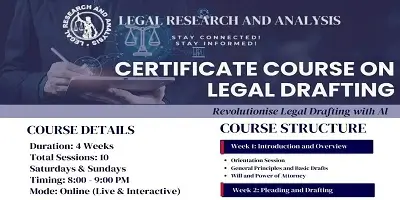
Course 2: Certificate Course in Legal Drafting
⏱ Duration: 4 Weeks | 👥 Best For: All Law Students — Universally Recommended
If there is one skill every single lawyer needs — regardless of their specialisation, city, or practice area — it is legal drafting. Every contract, petition, MoU, legal notice, affidavit, and regulatory submission requires language that is simultaneously precise, legally enforceable, and unambiguous. A single poorly drafted clause can cost a client millions and a lawyer their reputation.
This is the most universally applicable of all certificate courses — valued equally in litigation, corporate law, real estate, intellectual property, arbitration, and policy work. It is also directly tested in most state and central judicial service examinations.
What You Will Learn:
- Drafting contracts, agreements, MoUs, and letters of intent from scratch
- Legal notice drafting, reply strategies, and demand letter formulation
- Plaints, written statements, affidavits, and appeals for civil and criminal courts
- Corporate documentation: NDAs, employment agreements, shareholder agreements, and term sheets
- Legislative and policy drafting: how government orders, regulations, and rules are structured
- Editing and reviewing existing legal documents for ambiguity, errors, and enforceability gaps
- Standard clauses, limitation of liability, indemnity, and jurisdiction provisions
Career Opportunities After Legal Drafting Certification:
- Contract drafter for law firms, corporate legal departments, and government bodies
- Paralegal or legal associate in litigation and transactional firms
- Freelance legal drafter — one of the highest-demand remote work roles for law graduates
- In-house legal associate at any industry sector — IT, manufacturing, pharma, FMCG
- Judiciary exam candidate — drafting proficiency tested in all judicial service exams
💼 Who Should Join: Every single law student — first year to final year. This is a non-negotiable foundation skill. Also essential for practising lawyers seeking to sharpen their documentation capabilities.
💰 Salary Scope: INR 4–18 LPA. Freelance drafters with a strong portfolio and client base can earn significantly more.
Course 3: Certificate Course in HR Management for Law Students
⏱ Duration: 4 Weeks | 👥 Best For: Corporate-Track LLB Students, HR Professionals
The intersection of law and human resources is one of the most consistently in-demand career spaces in India’s corporate sector. Workplace law, employment contracts, statutory compliance, disciplinary proceedings, and retrenchment procedures all sit firmly at the boundary of legal and HR practice.
Law students who understand HR frameworks become extraordinarily effective compliance officers, employment lawyers, and legal advisors to HR departments in MNCs, Indian corporates, and startups. This course bridges the knowledge gap that law school typically leaves in practical corporate operations.
What You Will Learn:
- Core HR functions: recruitment frameworks, onboarding procedures, performance management systems
- Employment law compliance integrated into HR processes — offer letters, probation, termination
- Statutory requirements: Shops and Establishments Act, Factories Act, EPF, ESIC, and Gratuity Act
- Drafting HR policies, employee handbooks, and workplace conduct guidelines
- Legal handling of disciplinary proceedings, domestic enquiries, and termination disputes
- Payroll compliance, bonus regulations, and social security obligations under Indian law
- Contract labour management and vendor compliance under the Contract Labour Act
Career Opportunities:
- HR Legal Advisor or Employment Law Specialist in corporate legal teams
- Compliance Officer in MNCs, conglomerates, and large Indian corporates
- Legal consultant for HR technology platforms managing payroll and compliance
- Independent HR legal consultant for SMEs and family businesses
💼 Who Should Join: Law students targeting corporate careers, HR professionals seeking legal upskilling, and anyone aiming for compliance officer or employment lawyer roles in India’s growing corporate sector.
💰 Salary Scope: INR 5–15 LPA. HR Legal Advisors and Compliance Officers in MNCs earn at the higher end of the range.
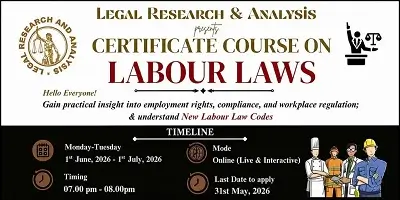
Course 4: Certificate Course in Labour Law
⏱ Duration: 4 Weeks | 👥 Best For: Corporate, LLB, Industrial Law Students
India has one of the world’s most complex labour law frameworks — over 40 central statutes and 100+ state-level laws governing employment, industrial relations, and worker welfare. The consolidation of these into four Labour Codes (on Wages, Industrial Relations, Social Security, and Occupational Safety) represents the most significant reform of Indian employment law in decades.
This makes Labour Law one of the highest-demand certificate specialisations in 2026. Companies of every scale — from funded startups to listed multinationals — need professionals who can navigate this evolving landscape with confidence and precision.
What You Will Learn:
- Industrial Disputes Act, Factories Act, ESIC, EPF, and social security frameworks
- India’s four Labour Codes — consolidation, transition implications, and practical compliance
- Trade union law, collective bargaining procedures, and unfair labour practice
- Worker rights: wages, working conditions, leave entitlements, and termination rules
- Contract labour, migrant worker regulations, and inter-state worker protections
- Labour dispute resolution: conciliation, arbitration, and labour court proceedings
- Startup and gig economy compliance — platform workers and emerging employment models
Career Opportunities:
- Labour Law Consultant for industry associations and trade bodies
- In-house labour counsel at manufacturing units, IT companies, and logistics firms
- Compliance Officer for industrial units navigating the new Labour Codes
- Labour court practitioner and dispute resolution specialist
- Policy researcher for government ministries and economic think tanks
💼 Who Should Join: Law students interested in both litigation and corporate practice, students targeting industrial disputes courts, and those aiming for union advisory or government regulatory roles.
💰 Salary Scope: INR 5–20 LPA. Senior Labour Law consultants with established industry clients earn significantly more.
Course 5: Certificate Course in Medical Law
⏱ Duration: 4 Weeks | 👥 Best For: Medical Background, Tort/Constitutional Law Students
India’s healthcare sector is undergoing its most significant expansion in history — driven by medical tourism (projected at USD 13 billion by 2026), telemedicine normalisation, private hospital network growth, and pharmaceutical sector globalisation. With this expansion comes an exponentially growing volume of legal work: negligence litigation, consent disputes, pharmaceutical compliance, bioethics reviews, and clinical establishment regulations.
Medical Law is one of the most underserved specialisations in Indian legal practice, which makes it an exceptional career opportunity for law students willing to invest in this knowledge domain.
What You Will Learn:
- Medical negligence: principles under Indian tort law, criminal law, and the Consumer Protection Act, 2019
- Patient rights, informed consent frameworks, and medical records law
- Clinical establishment regulations and accreditation legal requirements
- Drug and pharmaceutical law under the Drugs and Cosmetics Act and its amendments
- Bioethics: organ transplant law, end-of-life care, and the Transplantation of Human Organs Act
- Telemedicine legal framework and digital healthcare regulatory compliance
- Medical insurance disputes and third-party administrator (TPA) liability
Career Opportunities:
- Medical negligence litigator in consumer forums and civil courts
- Healthcare compliance officer for hospitals, diagnostic chains, and clinics
- Legal counsel to pharmaceutical companies, CROs, and clinical trial sponsors
- Policy consultant for Ministry of Health, NITI Aayog health policy teams
- Legal researcher for medical ethics committees and academic journals
💼 Who Should Join: Law students with a science background, LLB students interested in tort and constitutional law, and those targeting healthcare organisations, hospitals, or pharmaceutical companies.
💰 Salary Scope: INR 6–18 LPA. Healthcare lawyers in multinational pharmaceutical companies and medical devices firms earn at the top of this range.
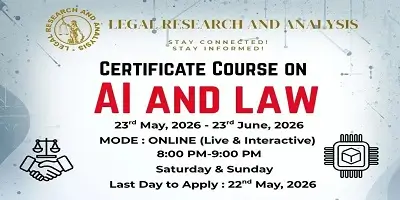
Course 6: Certificate Course in AI and Law
⏱ Duration: 4 Weeks | 👥 Best For: Tech-Savvy Law Students, CS Graduates in Law
Artificial Intelligence is no longer a horizon-level concept — it is actively reshaping legal research workflows, contract review processes, courtroom procedures, and regulatory decision-making right now. Indian law firms, global legal departments, and technology companies are all grappling with unprecedented questions: Who is liable when AI causes harm? Who owns AI-generated intellectual property? How do we regulate algorithmic decision-making that affects fundamental rights?
There are virtually no law graduates in India who are comprehensively trained in AI’s legal dimensions. Those who are will have a decisive competitive advantage for the next fifteen years.
What You Will Learn:
- How AI is transforming legal research, contract review, due diligence, and dispute resolution
- Intellectual property challenges: copyright in AI-generated content, patent eligibility of AI inventions
- Liability frameworks: who bears responsibility when autonomous systems cause harm or loss
- India’s AI governance approach: regulatory proposals, MEITY frameworks, and global comparisons
- Algorithmic bias, non-discrimination law, and constitutional implications of automated decisions
- AI in criminal justice: predictive policing, facial recognition, and risk assessment systems
- Data protection implications of machine learning — DPDP Act intersection with AI systems
Career Opportunities:
- Legal Technology Consultant for law firms modernising their AI infrastructure
- AI Policy Advisor for government ministries, TRAI, MEITY, and regulatory bodies
- In-house counsel for AI companies, LegalTech startups, and technology conglomerates
- IP lawyer specialising in AI-generated inventions and software patents
- LegalTech founder, product counsel, or investor-facing legal advisor
💼 Who Should Join: Tech-savvy law students, computer science graduates who have transitioned to law, professionals in the AI sector seeking legal clarity, and anyone planning to work with technology companies or regulatory bodies.
💰 Salary Scope: INR 8–30 LPA. AI law specialists are among the highest-paid emerging legal professionals globally. Demand far outstrips supply in 2026.
Course 7: Certificate Course in POSH Law
⏱ Duration: 4 Weeks | 👥 Best For: Law Students, HR Professionals, Corporate Compliance Teams
The Sexual Harassment of Women at Workplace (Prevention, Prohibition and Redressal) Act, 2013 — universally known as POSH — mandates that every Indian workplace with 10 or more employees must have a functional Internal Complaints Committee (ICC) and a formally documented anti-harassment policy. Non-compliance attracts financial penalties and, critically, licence cancellation risks.
What makes POSH Law exceptional among all certificate options is this: it is one of the only legal qualifications that can generate direct income almost immediately after completion. POSH trainers and ICC external members are compensated per session and per investigation — creating a flexible, recurring income stream that many students begin while still enrolled in law school.
What You Will Learn:
- Full interpretation and implementation of the POSH Act, 2013 — statutory requirements
- Employer obligations: ICC constitution, appointment procedures, and governance requirements
- End-to-end complaint handling: receipt, inquiry, proceedings, recommendations, and reporting
- Drafting POSH policies, ICC charters, and compliance documentation for organisations
- Training delivery: how to conduct effective corporate POSH awareness workshops
- Confidentiality obligations, natural justice principles, and false complaint handling
- Practical case studies: common scenarios, judgment analysis, and inquiry best practices
Career Opportunities:
- POSH Trainer and ICC External Member — immediate, flexible income stream
- HR and Compliance Advisor for corporates, MNCs, and educational institutions
- Legal Consultant to NGOs handling workplace harassment and gender rights cases
- Employment lawyer with POSH specialisation for dispute resolution and ICC advisory
💼 Who Should Join: Law students who want to begin earning while studying, HR professionals seeking legal credentials, and anyone interested in building a flexible consulting practice in workplace compliance.
💰 Income Scope: POSH trainers charge INR 5,000–25,000 per corporate session. ICC external members earn INR 3,000–10,000 per investigation. Annual income ranges from INR 5–15 LPA.
Course 8: Certificate Course in Data Protection Law
⏱ Duration: 4 Weeks | 👥 Best For: Tech-Law Students, Compliance Professionals, MNC Aspirants
India’s Digital Personal Data Protection Act, 2023 (DPDP Act) fundamentally restructured the country’s data compliance landscape. Every organisation that collects, processes, stores, or shares personal data of Indian citizens must now operate within this framework — from tech startups and e-commerce giants to hospitals, banks, and educational institutions.
There is a severe and acknowledged shortage of legal professionals who genuinely understand this law in its operational detail. Global companies operating in India are competing for qualified data privacy counsel and Data Protection Officers (DPOs). This is not a passing trend — it is a structural shift that will drive demand for the next decade.
What You Will Learn:
- Key provisions of India’s DPDP Act, 2023: definitions, obligations, rights, and enforcement
- GDPR and global data protection frameworks — comparative analysis for cross-border practice
- Consent mechanisms, data fiduciary obligations, and data principal rights in practice
- Data breach notification procedures: timelines, regulatory reporting, and remediation steps
- Privacy by design, data minimisation, purpose limitation, and data impact assessments
- Cross-border data transfer regulations and adequacy mechanisms
- Data Protection Board proceedings — complaint handling and regulatory enforcement
Career Opportunities:
- Data Privacy Counsel for technology companies, MNCs, and financial institutions
- Data Protection Officer (DPO) — a mandatory or strongly recommended role in most global privacy frameworks
- Compliance Consultant for startups and SMEs navigating DPDP Act requirements
- Legal researcher for digital rights and civil society organisations
💼 Who Should Join: Students interested in technology law, corporate compliance, and regulatory practice. Those targeting MNCs, global law firms, and data-intensive industries.
💰 Salary Scope: INR 8–25 LPA. DPO roles at large enterprises can exceed INR 30 LPA. Demand currently exceeds supply by a significant margin.
Course 9: Certificate Programme in Mental Health Law
⏱ Duration: 4 Weeks | 👥 Best For: Human Rights, Constitutional Law, Policy Students
Mental Health Law occupies one of the most neglected yet profoundly important corners of legal practice in India. The Mental Healthcare Act, 2017 marked a historic shift — recognising the right to mental healthcare as a fundamental right under Article 21 of the Constitution of India, and transforming how persons with mental illness are treated by the legal system.
From judicial proceedings involving persons with mental illness, to mental health compliance in workplaces and correctional facilities, to the rights of involuntarily admitted patients — this field demands lawyers with deep human sensitivity and specialist legal knowledge. As India’s mental health awareness grows rapidly, so does the need for qualified legal voices in this space.
What You Will Learn:
- Key provisions of the Mental Healthcare Act, 2017 — rights, procedures, and institutions
- Constitutional protections for persons with mental illness under Articles 14, 19, and 21
- Mental health in criminal law: fitness to stand trial, diminished responsibility, and Section 84 IPC
- Guardianship, supported decision-making, and property rights of persons with psychosocial disabilities
- Employer obligations for mental health under workplace safety and anti-discrimination law
- Rights of persons in psychiatric institutions — admission, treatment, and discharge procedures
- International frameworks: UN CRPD, WHO Mental Health Action Plan, and India’s obligations
Career Opportunities:
- Public interest litigator advocating for mental health rights and systemic reform
- Legal advisor to psychiatric hospitals, rehabilitation centres, and mental health NGOs
- Policy researcher for the National Mental Health Programme and government health bodies
- Lawyer practising before the National Human Rights Commission and State HRCs
- Consultant for disability rights organisations and UN-affiliated agencies in India
💼 Who Should Join: Students passionate about human rights, constitutional law, and social justice. Those working with or interested in NGOs, government health bodies, and public interest litigation.
💰 Salary Scope: INR 4–12 LPA in NGO and government roles. Independent litigation and consulting practice can earn significantly more as the sector matures.
Course 10: Certificate Course in Human Rights Law
⏱ Duration: 4 Weeks | 👥 Best For: Judiciary Aspirants, Social Justice Advocates, UPSC/IAS Students
Human Rights Law is simultaneously one of the oldest and most urgently contemporary areas of legal practice. From custodial deaths and encounter killings to refugee rights, gender justice, caste discrimination, and child protection — human rights lawyers are at the frontlines of India’s most consequential legal battles. These cases define constitutional history.
Beyond practice, this course holds exceptional strategic value for students preparing for UPSC, IAS, State PCS, and Judicial Service examinations — human rights concepts, constitutional rights, and PIL strategy are tested across all of them.
What You Will Learn:
- International human rights frameworks: UDHR, ICCPR, ICESCR, CEDAW, CRC, and UN Convention mechanisms
- Indian constitutional rights — Articles 12–35 in depth, DPSP, and fundamental duties in context
- National Human Rights Commission (NHRC) and State Human Rights Commissions — procedures and jurisdiction
- Human rights in armed conflict and international humanitarian law — Geneva Conventions
- Rights of marginalised communities: women, children, Dalits, LGBTQ+ persons, refugees, and minorities
- Public Interest Litigation: strategy, standing, writ petition drafting, and landmark case analysis
- Refugee law, statelessness, and India’s obligations under international law
Career Opportunities:
- Human rights lawyer or advocate before constitutional courts and human rights commissions
- Legal researcher for UN agencies, UNHCR, and international human rights bodies
- Policy advisor for government ministries on social justice and constitutional compliance
- Legal Officer at Amnesty India, Human Rights Watch India, and similar organisations
- UPSC, IAS, PCS, and Judicial Service aspirant — direct exam syllabus overlap
💼 Who Should Join: Students passionate about constitutional law and social justice. Judiciary and UPSC aspirants. Those targeting international organisations, NGOs, and human rights advocacy roles.
💰 Salary Scope: INR 4–10 LPA in NGO and government roles. UN agency and international NGO roles in India range from INR 20–40 LPA.
How to Choose the Right Legal Certificate Course for You
With ten high-quality options in front of you, choosing can feel overwhelming. Use this structured decision framework:
Step 1 — Identify Your Interest Domain: Technology and digital → Cyber Law or AI & Law. Corporate and compliance → Labour Law or Legal Drafting. Social justice and public service → Human Rights or Mental Health Law. Healthcare → Medical Law. Workplace and gender → POSH Law. Privacy and data → Data Protection Law.
Step 2 — Map Your Career Destination: Law firms → Legal Drafting, Cyber Law, Data Protection. Corporates → Labour Law, HR Management, POSH. NGOs and government → Human Rights, Mental Health. Judiciary → Human Rights, Labour Law, Legal Drafting. LegalTech → AI & Law, Data Protection.
Step 3 — Consider Your Timeline: Need income now? POSH (2–4 weeks). Building long-term expertise? Medical Law, Human Rights, or AI & Law (6–8 weeks). Balancing studies? Any 4–6 week course from LRA fits around a regular academic schedule.
Step 4 — Check 2026 Market Demand: Cyber Law, Data Protection Law, and AI & Law are the three fastest-growing and highest-paying areas. If in doubt, start here for maximum career ROI.
Step 5 — Stack Strategically: There is no rule limiting you to one course. Successful law students stack 2–3 complementary certificates: Cyber Law + Data Protection Law, or Labour Law + HR Management, or Human Rights + Mental Health Law.
Online vs Offline Legal Certificate Courses: What Works Better in 2026?
A frequently asked question deserves an honest, data-driven answer. Here is a direct comparison:
| Factor | Online Certificate Courses | Offline/Classroom Courses |
|---|---|---|
| Flexibility | ✅ Learn at your own pace | ❌ Fixed schedule |
| Cost | ✅ Highly affordable | ⚠️ Higher fees + travel |
| Faculty Access | ✅ National-level experts | ✅ Local faculty |
| Networking | ⚠️ Online communities | ✅ In-person bonding |
| Employer Recognition | ✅ Equally recognised | ✅ Well recognised |
| Certificate Validity | ✅ LinkedIn & CV ready | ✅ LinkedIn & CV ready |
| 2026 Verdict | ✅ Best for most students | Ideal for specific needs |
✅ 2026 Verdict: Online legal certificate courses — especially from credible, practitioner-led providers like LRA — offer equal or greater value for most Indian law students. The combination of flexibility, national-level faculty access, cost efficiency, and equal employer recognition makes online the smarter default choice in 2026.
How to Add Legal Certifications to Your CV and LinkedIn Profile
A certificate from a credible legal institution does more than add a credential — it signals your identity as a professional and your commitment to continuous learning. Use these strategies to maximise its visibility and impact:
LinkedIn Certifications Section: Go to your LinkedIn profile → ‘Add profile section’ → ‘Licences & Certifications’. Fill in the course name, issuing institution (Legal Research and Analysis), issue date, and credential ID. This makes your certification searchable and visible to recruiters.
LinkedIn Post: Write a short, authentic post announcing your certification. Share what you learned and why it matters to your career. Recruiters actively search LinkedIn for posts about legal specialisations. This is free personal branding with significant reach.
CV Placement: Add a dedicated ‘Certifications & Additional Qualifications’ section immediately after your law degree. List the certification name, issuing institution, and year. Do not bury it in the middle of unrelated content.
Cover Letters: Reference your certification in the opening paragraph when applying to firms or companies in that domain: ‘I recently completed a Data Protection Law certificate and am particularly interested in your compliance team…’ This instantly differentiates your application.
Interview Strategy: Use your certification as a conversation bridge: ‘I noticed your firm handles cyber cases — I completed a Cyber Law certificate and spent significant time on digital evidence frameworks, which I found fascinating…’ This demonstrates initiative and signals genuine interest.
Portfolio Building: For Drafting and Research certificates, compile work samples — even practice documents or research notes from the course. A portfolio of drafting samples is more compelling than a certificate alone.
What Skills Do Employers Actually Want from Law Graduates in 2026?
Based on input from legal recruiters, hiring partners at law firms, and in-house legal heads at Indian corporates, here are the skills most consistently cited as decision-making factors when evaluating fresh law graduates in 2026:
- Practical Drafting and Documentation: Consistently the most frequently mentioned requirement. Employers need graduates who can draft immediately usable documents — not just those who understand theoretical contract law.
- Domain Specialisation: Employers are moving away from hiring general law graduates and increasingly prefer those with demonstrated depth in at least one area — compliance, technology law, labour law, or similar.
- Digital and Technology Fluency: Understanding of digital legal frameworks (DPDP Act, IT Act, AI regulation), as well as comfort with legal research databases and document management systems.
- Research Precision: The ability to find, cite, and apply legal precedents quickly and accurately — both in traditional case law and in emerging regulatory frameworks.
- Written Communication: Professional legal correspondence, client memos, and regulatory submissions that are clear, precise, and persuasive. This goes beyond academic essay writing.
- Compliance and Regulatory Awareness: Understanding of how businesses interact with regulatory bodies, and the ability to identify and manage compliance risk.
- Problem-Solving Orientation: Employers explicitly want graduates who approach legal questions as business problems requiring practical solutions — not just academic exercises.
📌 Every skill listed above is directly addressed by one or more of the ten certificate courses in this guide. This is precisely why targeted certifications bridge the gap between legal education and professional readiness in 2026.
Best Legal Career Paths After Completing Certificate Courses
Completing one or more of these certificate courses opens doors across a wide spectrum of career trajectories:
- Law Firm Associate: Small and mid-sized Indian law firms actively hire certified specialists for niche practice areas. A Cyber Law or Data Protection certificate makes you immediately valuable in tech-focused practices.
- In-House Legal Counsel: IT, pharma, manufacturing, BFSI, and FMCG sector companies all need legal professionals with specialist compliance knowledge. In-house roles offer structured career growth and corporate benefits.
- Independent Legal Consultant: With POSH, Data Protection, or Labour Law certifications, you can begin offering consulting services from Day 1. Startups and SMEs actively seek affordable specialist counsel.
- Government and Regulatory Bodies: NHRC, CCI, SEBI, IRDAI, Ministry of Labour, and Ministry of Electronics and IT — all actively recruit legal specialists. Certifications complement your academic profile in these processes.
- NGO Sector: Human rights, mental health, gender justice, labour rights, and environmental law NGOs consistently need qualified legal professionals who combine specialist knowledge with mission alignment.
- LegalTech Startups: India’s LegalTech ecosystem is growing rapidly, with companies working on contract intelligence, legal research automation, compliance monitoring, and court document management. These companies want law graduates who understand both law and technology.
- Academia and Legal Research: Certifications complement postgraduate degrees for students pursuing LLM, PhD, or academic legal careers. They also strengthen fellowship and scholarship applications.
Best Certificate Course Combinations for Your Career Goals
Strategic course stacking amplifies your career positioning. Here are the most powerful combinations based on career destination:
- Technology Law Career: Cyber Law + Data Protection Law + AI & Law — creates one of the most sought-after profiles in 2026 Indian legal market.
- Corporate Compliance Career: Labour Law + HR Management + POSH Law — a complete corporate compliance toolkit for any industry sector.
- Judiciary and Government Services: Human Rights Law + Legal Drafting + Labour Law — directly reinforces judicial service exam preparation with practical depth.
- Healthcare and Pharma Legal: Medical Law + Data Protection Law — covers both patient rights litigation and the data compliance obligations of digital health platforms.
- Independent Practice / Freelance: POSH Law + Labour Law — begin earning as a POSH trainer and labour consultant while building towards a full practice.
- International and NGO Career: Human Rights Law + Mental Health Law — positions you for UN agencies, international NGOs, and constitutional public interest litigation.
Free vs Paid Legal Certificate Courses: What Should You Choose?
The internet is full of free legal content — YouTube lectures, Coursera audits, and open access readings. Here is an honest assessment of free versus paid certificate courses:
Free Resources — What They Offer: Good for introductory exploration, individual concept learning, and exam preparation supplements. Platforms like SWAYAM, NPTEL, and Coursera (audit mode) provide free content from reputable institutions.
Free Resources — What They Lack: No structured assessment, no recognised certificate, no practitioner-led practical training, no dedicated faculty support, and no credential you can legitimately add to your LinkedIn or CV.
Paid Certificate Courses — What They Offer: Structured curriculum, practitioner instruction, assessed learning, a formally recognised and shareable certificate, faculty interaction, and career guidance. These are the credentials that actually move hiring decisions.
The Practical Recommendation: Use free resources to explore and decide which areas interest you most. Then invest in a paid certificate from a credible provider like LRA to build a recognised, employer-valued credential in your chosen specialisation.
💡 Cost Perspective: LRA certificate courses are priced to be affordable for Indian law students, while delivering practitioner-level content and a formally recognised credential. The ROI — in terms of salary differential and career acceleration — typically exceeds the course cost within the first month of employment.
Career Roadmap After Legal Certificate Courses
Here is a practical roadmap to guide your journey from student to certified specialist to established legal professional:
Phase 1 — Foundation (Year 1–2 of LLB): Complete 1–2 beginner certificate courses (Legal Drafting, POSH Law, or Human Rights Law). Build your initial LinkedIn presence. Apply for internships emphasising your certified specialisation.
Phase 2 — Specialisation (Year 2–3 of LLB): Complete a more advanced certificate in your chosen domain (Cyber Law, Data Protection, AI & Law, or Labour Law). Begin freelance consulting or part-time ICC/POSH training if applicable. Build a portfolio of work samples.
Phase 3 — Professional Launch (Final Year and Post-Graduation): Stack a complementary certificate to create a combined specialisation profile. Target specific employers with a tailored CV that leads with your certifications and practical experience. Leverage LRA’s network for connections.
Phase 4 — Established Practice (1–3 Years Post-Graduation): Position yourself as a recognisable specialist in your domain. Build client base or advance to senior associate / compliance head / policy advisor roles. Consider LLM specialisation if targeting academia or international organisations.
FAQ'S
A: The best certificate course depends on your specific career goals. For technology and corporate careers, Cyber Law, Data Protection Law, or AI & Law offer the highest salary potential and fastest-growing demand. For litigation and social justice roles, Human Rights or Mental Health Law are most impactful. For immediate income generation, POSH Law is uniquely monetisable. Legal Drafting is universally recommended as the essential foundation skill for every law student regardless of specialisation.
A: Yes. Online legal certificate courses from accredited and credible institutions like Legal Research and Analysis (LRA) are fully valid and increasingly preferred by employers, law firms, and corporate legal teams. Employers evaluate the credibility of the institution and the practical quality of the curriculum — not the delivery format. Online certificates are equally shareable on LinkedIn and carry the same professional weight.
A: Absolutely — and the earlier you start, the greater your advantage. Many LRA certificate courses are specifically designed for students with no prior legal work experience. Legal Drafting, POSH Law, Human Rights Law, and Cyber Law are all ideal for first-year students. Starting in Year 1 gives you multiple certifications before your first internship application.
A: Most legal certificate courses offered by LRA range from 2 to 8 weeks, designed specifically to fit around a student’s regular academic schedule. POSH Law can be completed in 2–4 weeks. Cyber Law, Labour Law, and Data Protection Law are typically 4–6 weeks. Medical Law and Human Rights Law involve more depth and run 6–8 weeks.
A: Yes, significantly and directly. Human Rights Law strengthens constitutional understanding tested in all judicial service exams. Labour Law covers one of the most heavily examined statutory subjects. Legal Drafting directly improves answer writing, judgment analysis, and document preparation. Students who complete these courses consistently report stronger subject clarity in their exam preparation.
A: Cyber law specialists in India earn between INR 6 LPA and INR 20 LPA depending on employer, city, and experience. In-house roles at major IT companies, e-commerce platforms, and fintech firms pay the highest packages. Professionals with both a Cyber Law certificate and internship or case experience command significant salary premiums. Senior cybercrime prosecutors and corporate counsel with 5+ years experience can earn INR 25+ LPA.
A: Yes — POSH is one of the most immediately monetisable legal qualifications available. POSH-certified professionals can begin earning as ICC External Members (INR 3,000–10,000 per investigation) and corporate trainers (INR 5,000–25,000 per session) while still enrolled in law school. Many LRA students report generating a sustainable monthly income within weeks of completing the POSH certificate.
A: Data Protection Law and AI & Law offer the highest salary potential in 2026, with roles ranging from INR 8 LPA to INR 30+ LPA. The combination of deep legal expertise with technology knowledge remains exceptionally rare in India, and the demand from MNCs, global law firms, and technology companies significantly exceeds current supply of qualified candidates.
A: Yes. Most LRA certificate courses are open to non-law professionals. HR professionals, corporate executives, company secretaries, business graduates, and anyone who needs legal knowledge relevant to their field regularly complete these courses. POSH Law, HR Management, and Data Protection Law are particularly popular among non-law professionals seeking compliance expertise.
A: After completing your course and receiving your certificate: navigate to your LinkedIn profile, click ‘Add profile section’, select ‘Licences & Certifications’, and enter the course name, issuing institution (Legal Research and Analysis), issue date, and credential ID if provided. Publishing a post about your certification simultaneously significantly increases visibility with recruiters.
A: Yes, with a practical caveat: choose courses with complementary schedules and ensure you can give each adequate attention. The most effective combinations are Cyber Law + Data Protection Law (technology law focus), Labour Law + HR Management (corporate compliance focus), and Human Rights Law + Mental Health Law (public interest focus). Rushing two courses without engagement reduces the practical learning value.
A: For judicial service examination preparation, the three most valuable certificate courses are: Human Rights Law (deepens constitutional rights understanding), Labour Law (covers a heavily tested statutory subject), and Legal Drafting (directly improves answer writing, drafting questions, and document preparation skills tested in most state and central judicial service exams).
A: India’s Digital Personal Data Protection Act, 2023 (DPDP Act) is the country’s first comprehensive data privacy law. It mandates how organisations must collect, process, and store personal data of Indian citizens, with significant penalties for non-compliance. For law students, it represents a major career opportunity — there is a severe shortage of legal professionals who understand this law, and global companies operating in India are actively hiring Data Privacy Counsel and Data Protection Officers (DPOs).
A: An AI and Law certificate positions you at the intersection of two rapidly evolving fields — legal practice and artificial intelligence. It prepares you to advise on AI liability, IP in AI-generated content, algorithmic bias, regulatory compliance, and LegalTech adoption. This makes you highly relevant to technology companies, LegalTech startups, regulatory bodies, and any law firm integrating AI into its practice — a group that encompasses virtually the entire legal industry in 2026.
Final Thoughts: Your Legal Career Starts with the Right Skills
“The best investment you can make right now is in specific, credible legal knowledge that employers are actively seeking. A certificate is not just a credential — it is a signal to the market about who you are becoming.” — Legal Research and Analysis