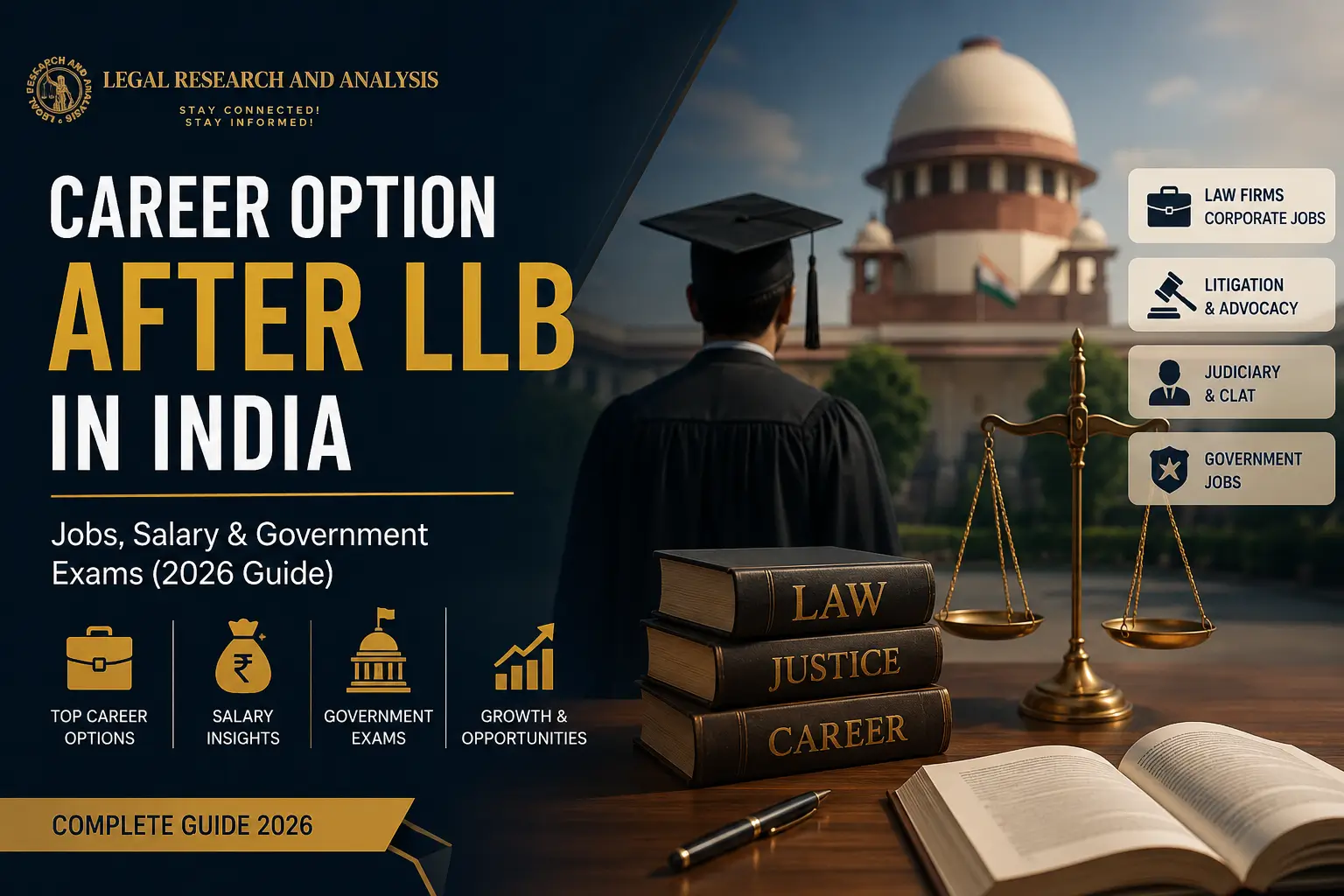
Career Option After LLB in India: Jobs, Salary & Government Exams (2026 Guide)
Author (s) Adv. Jha Pranav Kumar
Table of Contents
If you’ve just finished your LLB or you’re a few months away from it, you’ve probably already heard a dozen different opinions. Someone says litigation is the only “real” law career. Someone else swears by corporate law. Your senior who cracked the judiciary exam thinks everyone should be preparing for PCS-J. And your cousin doing an MBA insists you should pivot out of law entirely.
Here’s the honest truth: there is no single correct answer, because law is one of the few degrees that genuinely opens into a dozen different directions — litigation, corporate firms, government service, judiciary, research, and now, entirely new fields like cyber law and AI-driven legal tech that didn’t exist when your professors were studying.
This guide walks through every realistic career option after LLB available in India in 2026 — what the work actually looks like day to day, what it pays at each stage, and which specific skill or certificate course can get you there faster. No fluff, no “the sky’s the limit” talk — just what you need to make an informed decision.
Not Sure Where to Start? Build a Skill First.
Most law graduates waste their first year figuring out direction by trial and error. A focused certificate course can shortcut that. Browse all of LRA’s advocate-led courses below.
Short answer: yes, but it’s not the automatic ticket to a good job it once was. The legal industry in India is genuinely growing — corporate litigation volumes are rising, the Digital Personal Data Protection Act, 2023 has created an entirely new compliance requirement for thousands of companies, and India’s startup boom keeps generating contract and IP work. There are more jobs in law today than there were five years ago.
The catch is that there are also far more law graduates competing for those jobs. A decade ago, a plain LLB with decent grades was often enough to get a foothold in litigation or land a junior associate role. That’s no longer true, especially for corporate and law-firm roles, where recruiters now expect candidates to show up with at least one practical, demonstrable skill — not just a transcript.
Why a Plain LLB Degree Isn't Enough Anymore
More law colleges open every year, which means more graduates chasing the same entry-level litigation, corporate, and government openings.
AI tools now handle a lot of what used to be junior-associate work — first-pass legal research, document review, even first drafts of routine contracts. Firms expect you to know how to work with these tools, not be replaced by ignoring them.
Clients and corporates don’t want a generalist anymore. Telling an interviewer “I’ve done a certificate course in contract drafting” or “I understand DPDP Act compliance” puts you ahead of ten other candidates with the same degree and no specific skill.
Interviews increasingly test practical drafting and research ability, not just moot court trophies or marks. A small portfolio of real drafting work often counts for more than a polished CV.
A certificate course signals to a recruiter that you went out of your way to build one specific skill — which, in a flooded job market, is exactly the kind of signal that gets you shortlisted.
Want a Skill That Actually Shows Up on Day One?
Legal drafting is the single most universally useful skill for any legal career — litigation, corporate, or government. LRA’s certificate course is built by practising Supreme Court and High Court advocates around real drafting work, not just theory.
Skills Every Law Graduate Should Build, Whatever Path You Choose
Legal Drafting — drafting notices, agreements, pleadings, and applications correctly is what separates a job-ready graduate from a theoretical one.
Legal Research — knowing how to quickly find relevant case law and statutes using both traditional databases (SCC Online, Manupatra) and AI-assisted research tools.
Contract Review — spotting risk, ambiguity, and missing clauses, a daily task in corporate, compliance, and even litigation support work.
Comfort with AI tools — using them for first-draft research and document summarisation is increasingly expected, not optional, in 2026.
Negotiation — whether it’s a settlement discussion or a contract term, the ability to negotiate calmly and persuasively compounds over a career.
Client Communication — explaining complex legal concepts in plain language directly affects client retention and referrals.
Compliance Knowledge — understanding frameworks like the DPDP Act, Companies Act, SEBI regulations, and the new labour codes.
Legal Technology — basic familiarity with case management software, e-filing systems, and the legal tech platforms now used across courts and firms.
1. Litigation and Court Practice
This is the path most people picture when they think “lawyer” — arguing in court, drafting pleadings, building a practice one client at a time.
What the work actually looks like
Drafting pleadings and applications, attending hearings, doing legal research for ongoing matters, meeting clients, and — especially in the early years — a lot of time spent learning under a senior advocate before you’re ready to handle matters independently.
Salary
₹3–6 LPA to start (often less in the first year or two under a senior); ₹8–15 LPA by years 5–8; ₹20L+ once you’ve built a name and a client base. Income here is genuinely uneven — it depends far more on reputation and years in than on the degree itself.
✔ PROS
Independence — you build your own practice on your own terms
No real ceiling for top performers
Courtroom experience and intellectual challenge from day one
✘ CONS
Low, irregular income in the first 2–3 years
Requires real patience — reputation takes time to build
Physically demanding: long hours, travel, waiting around courts
A senior advocate will tell you the same thing on day one: your career stands or falls on how well you draft. The Certificate Course on Legal Drafting is built around exactly that — pleadings, notices, applications, the actual documents you’ll be producing under a senior within weeks of joining.
2. Corporate Law
If courtrooms don’t excite you but contracts, deals, and companies do, corporate law is where the fastest-growing demand currently sits.
What the work actually looks like
Drafting and reviewing contracts — NDAs, vendor agreements, service contracts — due diligence for M&A deals, advising on regulatory compliance, and working closely with business teams who don’t speak “legal” and need things explained plainly.
Salary
₹6–12 LPA to start at a decent firm or company; ₹15–30 LPA by years 4–7; ₹40L+ for senior counsel or partners at top firms. Progression here is far more structured and predictable than litigation.
✔ PROS
Highest-demand, fastest-growing legal segment in 2026
Clear, structured career ladder with predictable salary growth
Generally better early-career work-life balance than litigation
✘ CONS
High-pressure deadlines during live deals
Long hours at top-tier firms during deal closings
Entry is competitive — top firms lean heavily on NLU recruitment
The single biggest gap between a fresh graduate and a hireable corporate associate is contract fluency. LRA’s Certificate Course on Corporate Law is built to close exactly that gap before you walk into your first interview.
3. Labour Law and HR Compliance
Less talked about, but consistently in demand — every company with employees eventually needs someone who understands labour law.
What the work actually looks like
Drafting employment contracts and HR policies, advising on the new Labour Codes as companies transition to them, handling grievances and disciplinary matters, and occasionally representing companies before Labour Courts.
Salary
₹4–8 LPA to start; ₹10–18 LPA mid-level; ₹30L+ for senior compliance heads at large companies.
✔ PROS
Steady, recession-resistant demand
Growing fast as the new Labour Codes roll out
Mix of advisory work and limited litigation — good variety
✘ CONS
Less glamorous than corporate or litigation in most people’s eyes
Can involve genuinely difficult HR disputes
Requires constant updates as the law keeps shifting
With the new Labour Codes replacing decades-old legislation, companies are actively hiring people who actually understand the transition. The Certificate Course on Labour Laws covers exactly that shift.
4. Intellectual Property Rights (IPR)
A smaller, more specialised field — but one with real depth, especially if you have any background in science or engineering alongside your law degree.
What the work actually looks like
Filing trademark and patent applications, conducting IP due diligence, drafting licensing agreements, and representing clients in infringement disputes before courts and the IP Appellate authorities.
Salary
₹5–10 LPA to start; ₹12–22 LPA mid-level; ₹35L+ for senior IP attorneys, particularly those who can read a patent’s technical claims as easily as its legal ones.
✔ PROS
Niche specialisation with less competition than corporate law
Strong value placed on technical + legal combination
International work opportunities through patent filings and licensing
✘ CONS
Patent work specifically favours a science/engineering background
Smaller overall job market than corporate or litigation
Patent prosecution timelines are long — tests patience
India’s startup and pharma sectors are filing more IP than ever, and most companies still struggle to find lawyers who genuinely understand patents. The Certificate Course on Intellectual Property Rights is a fast way to build that depth.
5. Cyber Law
Cybercrime cases and digital fraud have risen sharply in India year after year, and most companies and law enforcement teams still don’t have enough lawyers who actually understand the IT Act and digital evidence.
What the work actually looks like
Advising on cybercrime complaints and investigations, drafting IT Act compliance policies, supporting digital evidence collection for litigation, and helping companies build incident response plans.
Salary
₹6–14 LPA to start; ₹18L+ mid-level; ₹40L+ for senior cyber law experts, particularly those advising fintech and e-commerce companies.
✔ PROS
One of the fastest-growing legal niches in India right now
Constantly evolving — genuinely interesting work
Strong overlap with the booming fintech and e-commerce sectors
✘ CONS
Needs continuous learning to keep pace with new threats and technology
Few experienced mentors in this niche in India currently
Some technical concepts take time to get comfortable with
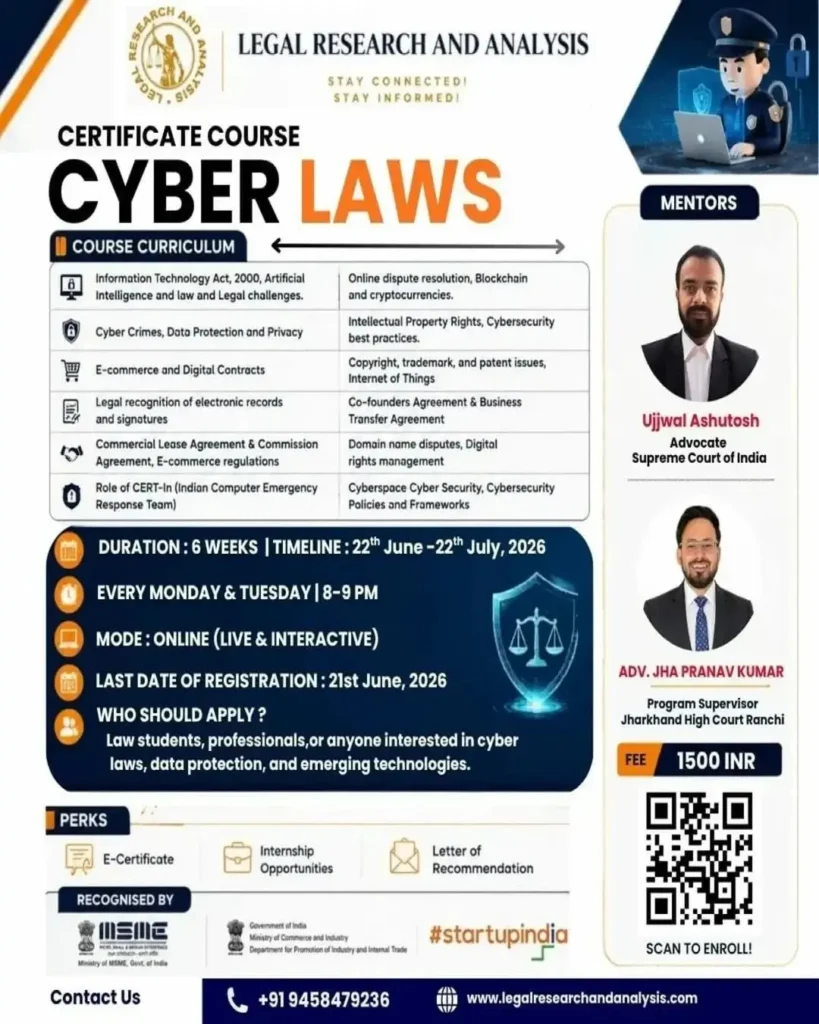
If you want in early on one of the fastest-growing niches in Indian law, the Certificate Course on Cyber Law covers the IT Act, cybercrime procedure, and digital evidence in real depth.
6. Data Protection Law
This is a genuinely new category — the Digital Personal Data Protection Act, 2023 created a legal compliance requirement that didn’t exist a few years ago, and thousands of Indian companies now need someone who actually understands it.
What the work actually looks like
Conducting data protection impact assessments, drafting privacy policies and consent frameworks, advising on cross-border data transfer rules, and handling breach notifications when something goes wrong.
Salary
₹6–15 LPA to start for dedicated privacy roles; ₹18–28 LPA mid-level DPO positions; ₹40L+ for senior privacy counsel at large companies, especially MNCs with EU exposure.
✔ PROS
Brand-new, high-demand specialisation with limited existing expertise in the market
Mandatory compliance requirement means guaranteed ongoing demand
Good international transferability — overlaps heavily with GDPR knowledge
✘ CONS
Still a maturing field in India with fewer established career ladders
Requires comfort with both legal and technical/IT concepts
Regulatory guidance under the DPDP Rules is still evolving
Very few graduates currently have real, demonstrable DPDP Act knowledge — which is exactly why this is one of the highest-leverage skills you can build right now. The Certificate Course on Cyber Law covers data protection alongside the broader cyber law framework.
7. Legal Research and Academia
For graduates who’d rather go deep into a problem than argue it out loud — research, academia, and judicial clerkships reward analytical thinking over courtroom presence.
What the work actually looks like
In-depth research on case law and legislation, writing legal opinions and memos, working as a Law Clerk to a judge, publishing academic papers, or teaching law students if you go the academic route.
Salary
₹4–9 LPA to start as a research associate or law clerk; ₹12–20 LPA mid-level (senior researcher, assistant professor with NET/PhD); ₹30L+ for senior academics and think-tank heads.
✔ PROS
Intellectually rewarding for analytically-minded graduates
Judicial clerkships offer unmatched exposure to courtroom strategy
Strong pathway into academia, think tanks, and policy work
✘ CONS
Lower starting salaries compared to corporate law
Academic roles often require further qualifications (NET, PhD)
Limited high-paying positions until you’re senior
A judicial clerkship or a strong research role almost always starts with one thing — knowing how to actually find and use precedent fast. The Certificate Course on Legal Research builds exactly that.
8. ADR, Arbitration, and Mediation
Indian courts are overloaded, and clients — especially commercial ones — increasingly prefer faster, less adversarial dispute resolution. That shift has made ADR one of the more interesting growth areas in law.
What the work actually looks like
Drafting arbitration agreements and pleadings, representing clients before arbitral tribunals, conducting or assisting mediation sessions, and advising on dispute resolution clauses while contracts are still being negotiated.
Salary
₹5–10 LPA to start; ₹14–25 LPA mid-level for experienced arbitration counsel; ₹40L+ for senior arbitrators and panel members at major institutions.
✔ PROS
Faster, less adversarial career path than litigation
Strong international exposure through cross-border arbitration
Growing institutional support — India is actively pushing to become an arbitration hub
✘ CONS
Requires real credibility and a strong professional network to build a practice
Mediation as a sole career is still developing in India
Quality arbitration work is concentrated in metro cities
This is the newest category on this list, and arguably the one with the biggest first-mover advantage right now — there simply aren’t many lawyers yet who are genuinely fluent in both law and AI tools.
AI Lawyer — using AI tools to assist research, drafting, and case strategy while staying professionally and ethically responsible for the final output.
Legal Tech — working with contract lifecycle management tools, e-discovery software, and case management systems, either as a user, consultant, or product advisor.
Prompt Engineering for Legal Work — crafting precise prompts to get reliable, accurate output from AI legal research and drafting tools.
AI Compliance — advising companies on responsible, compliant use of AI systems as governance regulation starts to take shape.
Contract Automation — reviewing and validating AI-generated contracts and clauses for accuracy, bridging the gap between automation and legally sound output.
Salary
₹8–18 LPA to start — noticeably above most traditional entry-level legal roles; ₹20L+ mid-level; ₹50L+ for senior legal AI and legal tech leadership roles.
✔ PROS
Highest starting salaries among all the paths in this guide
Very few graduates currently have this combined skill set — genuine first-mover advantage
Future-proof direction as AI adoption accelerates across the legal industry
✘ CONS
Still new — career ladders aren’t as clearly defined yet
Requires comfort learning new platforms continuously
Risk of leaning on AI without strong underlying legal fundamentals
This is the one area where being early genuinely matters. The Certificate Course on AI and Law is built to get you fluent in exactly the tools and frameworks employers are starting to ask for.
10. Government Jobs After LLB
If stability, structured pay scales, and long-term security matter more to you than the variable income of litigation or the deal-driven pace of corporate law, government legal jobs are worth taking seriously. There are far more options here than most guides mention — judiciary is only one of several paths.
UPSC Indian Legal Service (ILS)
ILS officers serve as legal advisers and law officers to ministries, departments, and statutory bodies under the Ministry of Law and Justice. The most senior ILS post — Law Secretary of India — is the highest-ranking legal officer in the Government of India.
Entry: Through UPSC’s recruitment process for legal officer posts. Salary: ₹56,100/month basic (Pay Level 10), with in-hand pay around ₹80,000–90,000/month once DA and HRA are added.
Indian Corporate Law Service (ICLS)
ICLS is a Group A central service under the Ministry of Corporate Affairs, recruited through the UPSC Civil Services Examination. ICLS officers administer the Companies Act and the LLP Act, register companies, investigate corporate fraud, and act as Registrars of Companies and Official Liquidators. A law degree isn’t mandatory for ICLS, but it’s a strong advantage given the subject matter.
Eligibility: Any bachelor’s degree, age 21–32 (with standard reserved-category relaxations); cleared through UPSC CSE. Salary: Starts around ₹56,100/month (Level 10), rising above ₹2,00,000/month at the senior-most Apex Scale.
SEBI Grade A Legal Officer
The Securities and Exchange Board of India recruits legal officers to handle enforcement actions, market manipulation cases, insider trading investigations, and securities law drafting. This is widely considered the most financially rewarding government exam open specifically to law graduates.
Eligibility: LLB mandatory, age limit typically 30 (general category, with relaxations for OBC/SC/ST). Notification usually released October–November each year. Selection: Phase I (screening), Phase II (law paper), Interview.
RBI Grade B Legal Officer
The Reserve Bank of India recruits Legal Officers (Grade B) through a two-phase process — a written exam followed by an interview. Unlike the general RBI Grade B exam, the Legal Officer selection is a dedicated track.
Eligibility: LLB from a Bar Council-recognised university, minimum 50% aggregate marks (45% for SC/ST/PwBD), at least 2 years of post-enrollment experience as an advocate, law officer, or full-time law teacher, age 21–32 with relaxations.
IBPS SO — Law Officer
The Institute of Banking Personnel Selection recruits Law Officers (Scale I) for participating public sector banks through its Specialist Officer (SO) exam — a three-stage process: Preliminary, Mains (Professional Knowledge of Law), and Interview.
Eligibility: LLB degree from a BCI-recognised university, minimum 50% aggregate, ideally 2 years of experience as an advocate or law officer, age 20–30 with relaxations.
Assistant Public Prosecutor (APO / APP)
Recruited by state Public Service Commissions to prosecute criminal cases on behalf of the state government in subordinate courts. Some states (like Delhi) require 3 years of Bar practice; others allow fresh graduates to apply directly.
2026 snapshot: UP APO — Pay Matrix Level 8, ₹47,600 to ₹1,51,100 per month. Rajasthan APO — Pay Matrix Level 11, roughly ₹91,000–97,000/month in-hand at entry. Delhi Assistant Public Prosecutor — Group A Gazetted, Pay Level 10, ₹56,100–₹1,77,500/month (requires 3 years of Bar practice).
Judge Advocate General (JAG) Entry — Indian Army
The Indian Army’s JAG branch recruits law graduates as Short Service Commission officers to advise on military law, handle court martial proceedings, and represent the Army in tribunals. Selection runs through the SSB (Service Selection Board) process.
Eligibility: LLB (3-year or 5-year) from a BCI-recognised college, minimum 55% aggregate, age 21–27, unmarried at the time of joining, eligible for Bar Council registration.
PSU Legal Officer Roles
Public Sector Undertakings — ONGC, IOCL, BHEL, NTPC, GAIL, Power Grid, Coal India, and others — regularly recruit law graduates for roles like Trainee Legal Advisor, Legal Executive, and Assistant Legal Advisor, often using CLAT PG scores or dedicated recruitment notifications.
Eligibility: LLB from a BCI-recognised university, minimum 55–60% aggregate (varies by PSU), age generally 26–28 for entry-level posts.
WHY GOVERNMENT LEGAL JOBS ARE WORTH CONSIDERING
Stable, predictable income with defined pay scales under the 7th Pay Commission
Strong job security and pension/retirement benefits
Structured promotion paths across almost every one of these services
Genuine variety — from courtroom prosecution to corporate regulation to military law
Vacancy numbers and eligibility change yearly, so always check the latest official notification before planning around a specific exam
11. Judiciary — Becoming a Civil Judge
For many law graduates, becoming a judge is the single most prestigious destination after LLB. The Judicial Services Examination — commonly called PCS-J — is conducted annually by each state’s High Court or Public Service Commission to recruit Civil Judges (Junior Division) and Judicial Magistrates First Class.
Eligibility
An LLB degree from a university recognised by the Bar Council of India, along with enrollment as an advocate.
Several states (Maharashtra, Kerala, and a growing number of others) now require a minimum of 3 years of active Bar practice before you can even apply; other states still allow fresh graduates to apply directly.
Age limit generally falls between 21 and 35 years, with relaxations of 3–5 years for reserved categories depending on the state.
Exam pattern
Three stages: Preliminary Examination (objective, usually qualifying only), Main Examination (descriptive papers on Civil Law, Criminal Law, Language, and General Knowledge), and Viva-Voce (Interview).
Salary
Entry-level Civil Judge pay typically ranges from around ₹56,100 to ₹1,77,500 per month depending on the state’s 7th Pay Commission matrix (Delhi sits at the higher end; many other states follow a ₹27,700–₹44,770 basic scale plus allowances). In-hand pay after deductions usually works out to ₹75,000–₹1,30,000/month for a newly appointed judge. Progression runs from Civil Judge (Junior Division) → Senior Civil Judge → District Judge → High Court Judge.
IMPORTANT
Judiciary exam eligibility — especially the 3-year Bar practice requirement — and exam dates vary significantly by state and change frequently. Always verify current details on the official High Court website or your State Public Service Commission’s notification before planning your preparation around it.
Higher Studies After LLB: LLM, MBA, CS, PhD, and Foreign LLM
Not everyone wants to start working right away, and that’s a completely reasonable call. Here’s what most graduates consider:
LLM (Master of Laws) — lets you specialise deeply in one area: Corporate Law, IPR, Criminal Law, Constitutional Law, International Law, or Cyber Law. Many academic and senior roles either prefer or require it.
MBA — increasingly chosen by graduates aiming for corporate strategy, business development, or general counsel roles where business acumen complements legal training.
CS (Company Secretary) — combined with an LLB, this creates a strong profile for corporate governance and compliance roles, particularly valued by listed companies.
PhD in Law — for those drawn to academia and research, opening pathways to professorships, judicial academies, and senior policy research roles.
Foreign LLM — significantly enhances opportunities at international firms and in cross-border legal practice. Common routes include the LSAT, direct university admissions, and scholarships like Chevening or Commonwealth.
Career After LLB: Salary Comparison Table (2026)
Here’s how the major career paths stack up, along with a rough 2026 demand outlook (rated on hiring trends and growth trajectory).
Career Path
Starting Salary
Mid-Level (5–7 Yrs)
Senior Level
Demand 2026
Litigation
₹3–6 LPA
₹8–15 LPA
₹20L+
★★★★☆
Corporate Law
₹6–12 LPA
₹15–30 LPA
₹40L+
★★★★★
Cyber Law
₹6–14 LPA
₹18L+
₹40L+
★★★★★
Labour Law
₹4–8 LPA
₹10–18 LPA
₹30L+
★★★★☆
Legal Research
₹4–9 LPA
₹12–20 LPA
₹30L+
★★★★☆
AI & Legal Tech
₹8–18 LPA
₹20L+
₹50L+
★★★★★
IPR
₹5–10 LPA
₹12–22 LPA
₹35L+
★★★★☆
ADR / Arbitration
₹5–10 LPA
₹14–25 LPA
₹40L+
★★★★☆
Data Protection Law
₹6–15 LPA
₹18–28 LPA
₹40L+
★★★★★
Judiciary (Civil Judge)
₹56,100–1,77,500/month
Senior Civil Judge
District Judge+
★★★★☆
SEBI / RBI Legal Officer
₹56,100+/month (Level 10)
Senior Officer
Department Head
★★★★☆
Which Career After LLB Is Right for You?
Salary numbers only tell half the story. Use this as a quick gut-check based on what you actually enjoy:
If You Like…
Best-Fit Career
Courtroom advocacy and public speaking
Litigation
Working with companies and business deals
Corporate Law
Technology and digital systems
Cyber Law / AI & Legal Tech
Deep analysis and academic writing
Legal Research & Academia
HR, workplace policy, and people management
Labour Law
Building and using cutting-edge tools
AI & Legal Technology
Creativity, brands, and innovation
Intellectual Property (IPR)
Calm, structured dispute resolution over courtroom conflict
ADR, Arbitration & Mediation
Stability, structured growth, and public service
Government Jobs / Judiciary
Data privacy and regulatory frameworks
Data Protection Law
LRA Certificate Courses to Build These Skills Faster
Whichever direction you pick, a focused certificate course compresses months of trial-and-error into a few weeks of structured, advocate-led learning. Here’s the full lineup, mapped to the careers above:
The single most universally useful skill for any legal career — litigation, corporate, or government. Learn to draft notices, agreements, pleadings, and applications the way practising advocates actually do.
A plain LLB degree alone is no longer enough to guarantee a strong start, given how competitive the market has become. But an LLB combined with one focused practical skill — through internships, moot courts, or a certificate course in something like legal drafting or corporate law — meaningfully improves your chances and starting pay.
There’s no single “best” option — it depends on what you actually enjoy doing every day. Corporate Law, Cyber Law, Data Protection Law, and AI & Legal Technology currently show the strongest demand and salary growth in 2026. Litigation and Judiciary remain prestigious, stable long-term paths for people drawn to courtroom work and public service.
AI & Legal Technology and Data Protection Law currently offer the highest starting salaries (₹8–18 LPA), simply because there aren’t enough qualified people yet relative to demand. Corporate Law and Cyber Law follow closely, with senior-level pay in both often crossing ₹40 LPA.
Yes. Plenty of companies hire fresh graduates as Legal Associates, Compliance Executives, or Junior Counsel — especially in corporate law, labour law compliance, and data protection roles. A certificate course or solid internship experience noticeably improves your odds of a direct offer.
Depends on the direction you’re heading. Legal Drafting is the most universally useful regardless of specialisation. For corporate-focused careers, the Corporate Law course makes sense; for the fastest-growing niches right now, Cyber Law, Data Protection, or AI and Law are strong choices.
Neither is objectively better — they suit different people. Corporate law usually means faster, more predictable income growth and better early-career balance. Litigation means independence, no real income ceiling for top performers, and direct courtroom experience, but typically a slower, less predictable start.
Yes, though it usually needs an additional qualification. Common routes: a foreign LLM (UK, USA, Singapore, Australia), the SQE for England and Wales, or the New York Bar Exam for the US. International arbitration and IP law also offer strong cross-border opportunities directly from an Indian LLB with the right experience.
Not replacing — but genuinely changing how junior-level legal work gets done, particularly first-pass research, document review, and contract drafting. Lawyers who learn to use AI tools as a productivity multiplier rather than ignoring them are the ones benefiting most from this shift.
Based on current hiring trends — Corporate Law, Cyber Law, Data Protection Law, and AI & Legal Technology, driven by the DPDP Act compliance wave, rising cybercrime cases, and fast AI adoption across the legal industry.
Yes, particularly if you enjoy deep, detailed work more than client-facing or courtroom roles. It’s an excellent stepping stone into judicial clerkships, academia, think tanks, and policy work — though starting salaries are typically lower than corporate law.
Quite a few: UPSC Indian Legal Service (ILS), Indian Corporate Law Service (ICLS), SEBI Grade A Legal Officer, RBI Grade B Legal Officer, IBPS SO Law Officer for nationalised banks, Assistant Public Prosecutor (state-level), JAG entry into the Indian Army, and various PSU Legal Officer roles. Judiciary is the most well-known, but far from the only option.
An LLB from a recognised university plus enrollment as an advocate. Several states (Maharashtra, Kerala, and others) now require a minimum of 3 years of active Bar practice before applying, while other states permit fresh graduates to apply directly. Age limits are generally 21–35 years with category-based relaxations — always check the specific state’s official notification, since requirements vary.
It varies by state but follows the 7th Pay Commission matrix. For example, UP APO carries a pay scale of ₹47,600–₹1,51,100/month (Level 8), while Delhi’s Assistant Public Prosecutor — a Group A Gazetted post requiring 3 years of Bar practice — sits at ₹56,100–₹1,77,500/month (Level 10).
Both work. An immediate LLM makes sense if you already know your specialisation and want to strengthen your academic profile early — especially for academia. Gaining 1–2 years of work experience first often helps you choose a more informed specialisation and makes your LLM application stronger for top universities.
Legal Research & Academia and Labour Law/Compliance roles generally offer better predictability than deal-driven corporate firm roles or unpredictable litigation court schedules. Government legal jobs and Judiciary also offer structured hours, though with their own demanding preparation and responsibility requirements.
Conclusion
There’s no single “right” career after LLB — only the right one for you. Litigation gives you independence and unmatched courtroom experience. Corporate law and cyber law offer fast-growing demand and strong early income. Government roles — from ICLS to SEBI to the judiciary itself — offer stability most private-sector paths can’t match. And AI & Legal Technology offers a genuine first-mover advantage in a field still being defined.
The one factor that consistently determines how quickly any of these pays off is the same: a practical, demonstrable skill built through focused training, not just a degree on paper. Pick a direction that genuinely interests you, then go build the specific skill that direction actually demands.
Sources and Further Reading
Bar Council of India — barcouncilofindia.org UPSC — Civil Services Examination notifications — upsc.gov.in Reserve Bank of India — recruitment notifications — rbi.org.in Securities and Exchange Board of India — careers — sebi.gov.in Ministry of Corporate Affairs — barcouncilofindia.org Indian Institute of Corporate Affairs (ICLS training) — iica.nic.in Department of Justice, Government of India — Judicial Services — doj.gov.in