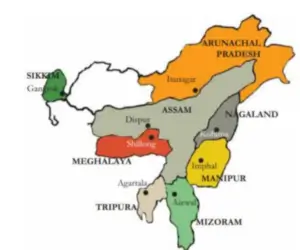
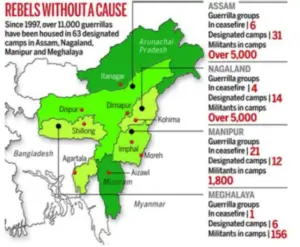
North-East India is the home of seven sisters which is closely intertwined with insurgencies. This region is not new in the news, the northeastern region has been going through turmoil since Independence.
Brief History of the North-East :
Indian northeast Indian states share a border with Bangladesh, Myanmar, China, Bhutan, and Nepal making it the “Gateway of the South East Asia”. These states share 99.9% of their border with The other states and only 1.1% of their border with India.
The region is connected to mainland India via Siliguri Corridor. Its sensitive location makes it important for India. The 7 sisters consist of various diverse tribal groups that have different historical backgrounds and they have been keeping different perspectives on their political future. But the sad truth is that the region remains in conflict for a long.
Genesis of Insurgencies In North East India :
Before independence, Britain adopted Non-Interference Policy in the northeastern states. British see the region as an exporter of raw materials and continued to exploit the region. After India’s independence in 1947, it was hence important to add these princely states but when this point was raised a lot of tribal communities opposed the decision.
This led to the first outrage of insurgencies by the Naga National Council (NNC) in the mid-1950s. Nagas launched the armed rebels after India rejected the demand for “Independent Nagaland”. As per Article 1 of the Indian Constitution, “India, that is Bharat, shall be a Union of States”, which abolish the idea of separatists for a separate independent state.
This also applies to the matter of Kashmir. In 1956, the Indian army launched a counter-insurgency operation claiming the region as “disturbed”. Inspired by Naga Insurgent Group NNC other tribes launched their insurgent groups for their independence, and Naga Insurgency is hence known as “the mother of all Insurgencies”.
In 1966, the People of Mizoram’s Lushai Hills District rose in revolt against the Assam Administration complaining that the government neglected their concerns and demands completely. Manipur Meitei Community in Imphal Valley claimed that their state was merged with India by deception.
Tripura on the other hand joined India peacefully but later saw a demographic shift, with 40% prosperous and educated Bengali getting more preference in Jobs making the 60% percent indigenous group feel unsure about their future. In the 1980s, the Tripura National Volunteer group revolted against this discrimination.
What’s so common in these cases?? :
There is a common thread that ties all these incidents together. Some of the reasons are listed below;
- Ethnic Diversity – According to the Anthropological Survey of India, 40 million people of 213 tribal groups out of 635 listed live in this region. They belong of mongoloid origin and consider themselves very different from
the Aryan and Dravidian race of mainland India. This created a fear of losing their own identities.
- Political and Governance Issues – According to reports there is a nexus between politicians and insurgent groups causing high corruption. The lower representation of northeast people both in bureaucracy and central administration and the ineffectiveness of local bodies have more problems. As the decision is taken in Delhi which is far from the east and there is low representation, people are unable to make their voice heard at the central level.
- Centralised Planning – The government-led centralised planning often leads to the restriction of the Indigenous population of the northeast regions leading to scars or no development for their well-being at all.
- Failure of policies – As the ground reality is far more than what the mainland people assume the policies made often fail. It is important to underline that all the requirements of every region are different depending on factors like geography, political demands, economic status, population, diversity in culture and customs, and other specific aspects associated with a particular region. It becomes important for policymakers to understand these factors and find solutions according to the problems faced by people. Insurgents believe that the government’s, “so-called progressive policies that stick to the demands of the mainstream India” are the reason behind the backwardness of the region.
- Conflict pushing to military level – Experts believe that acts like Armed Force Special Power Act (AFSPA) push the conflict to the military level. AFSPA was launched in 1958, an act of the Parliament of India that grants special powers to the Indian Armed Forces to maintain public order in “disturbed areas”.
This also opens the gate for military exploitation of the commons. Such acts are in the direction of “National Security” but at the same time, it is causing more agitation among the people who are demanding the protection of their rights. This also led to the alienation of the people.
- Natural Problems – These regions not only contains narrow valleys and dense forest but also face floods, landslides, land loss, and eventually infrastructure loss. Central government not taking any relief action on such matters bring distrust among the people.
- Illegal Immigrants – Illegal immigrants from Bangladesh are staying in northeastern regions and using the scarce resources of the already residing people, this is also a reason behind the growing agitation. Example – In 1979 around 45,000 illegal immigrants registered in the electoral rolls which lead to insurgencies by the United National Liberation Front (Assam).
- Underdevelopment due to Geographical Challenges – The hilly regions are a major cause that transport lines are not able to develop. The poor
development widens the void between the Government and the People of the North Eastern region.
- Borders – The 4500-kilometre-long international border is porous that give the insurgents a chance to cross borders and move to Bhutan, Myanmar, and Bangladesh. This porous border also supports the transport of arms, drugs, and illegal immigrants. The youth hence get affected easily by the insurgent groups.
- Sense of Isolation, Deprivation, and Exploitation – Political instability and economic development in a few areas also affect the development of the people. Leading to people being unaware, illiterate, and poverty struck. The scarcity of resources also leads to people being dependent on Government funds. The geography of the region and the climate do not support much agriculture or industry, and the service sector has a very low representation of the indigenous population leading to unemployment and poverty.
Hence, the youth get diverted to extremist activities to earn money. There is also a clash between traditional social structure and modernization effects. The 96% part of the region is under a sensitive border zone, which leads to less security and so the companies and private sector do not want to take the risk of investment in the region.
- External Support – Insurgent movements get support, arms, funding, and haven from countries like Pakistan and China. China even considers Arunachal Pradesh as its part, while India always denied these claims. On the other hand, Indo-Pak relations are always a hot topic because of Kashmir matters. This makes China a very clever party that uses insurgents as its ‘trojan virus’ to capture the land of India.
Conclusion:
From all the points above we can easily draw that there are problems within our structure and we can not neglect the fault of our system. To solve the matter, it hence becomes important for the policymakers to sit back and think over the matter.
Try to look forward to a long-lasting workable peace agreement between the government and the people. This can only be done if the government can win the trust of the people and work for their betterment. Not just this, but also recognize their demands and address their problems as soon as possible keeping in my the diversity.
Moreover, its also important for Indian Government to strengthen its intelligence network to tackle ongoing violence in the northeast. At the end of the day, Government is responsible and accountable for the protection of the rights of the people. It’s the responsibility of the government to look after its citizens.
References:
- http://naganationalcouncil.org/ -Naga National Council
- https://www.mha.gov.in/sites/default/files/armed_forces_special_powers _act1958.pdf – Ministry of Home Affairs.
- https://www.mea.gov.in/Images/pdf1/Part1.pdf – Ministry of External Affairs.
- https://www.tandfonline.com/doi/full/10.1080/09592318.2023.2174762 – Tylor and Francis
- https://www.satp.org/terrorist-profile/india-insurgencynortheast-assam /united-liberation-front-of-asom-ulfa – South Asian Terrorism Portal
- https://ansi.gov.in/people-of-india/ – Anthropological Survey of India
Image Source:
- https://www.google.com/url?sa=i&url=https%3A%2F%2Fthehillstimes.i n%2Ffeatured%2Finsurgency-leads-underdevelopment-in-northeast&p sig=AOvVaw3rkMcnBNwiPHuhH-wyoXje&ust=1684700166904000&sour ce=images&cd=vfe&ved=0CBMQjhxqFwoTCKDDparbhP8CFQAAAAAdA AAAABAN
- https://www.google.com/url?sa=i&url=https%3A%2F%2Fglasnostnludel hi.wordpress.com%2F2015%2F09%2F09%2Finsurgency-in-the-north-eas t-a-beginners-guide%2F&psig=AOvVaw3rkMcnBNwiPHuhH-wyoXje&us t=1684700166904000&source=images&cd=vfe&ved=0CBMQjhxqFwoTC KDDparbhP8CFQAAAAAdAAAAABAS
- https://www.google.com/imgres?imgurl=https%3A%2F%2Fwww.deccanherald.com% 2Fsites%2Fdh%2Ffiles%2Farticleimages%2F2022%2F05%2F05%2Fmilitants-afp-11 06743-1651756581.png&tbnid=r-shKjB_NDeLiM&vet=12ahUKEwiX8KOp24T_AhUh
- ktgFHT2xCOMQMyhJegQIARB6..i&imgrefurl=https%3A%2F%2Fwww.deccanherald. com%2Fnational%2Feast-and-northeast%2Flowest-insurgency-incidents-in-northeas t-in-two-decades-mha-report-1106743.html&docid=4YGYBbKH_CM2IM&w=700&h=3 94&q=insurgencies%20in%20east&ved=2ahUKEwiX8KOp24T_AhUhktgFHT2xCOM QMyhJegQIARB6
- https://www.google.com/url?sa=i&url=https%3A%2F%2Fwww.insightsonindia.com%2 F2022%2F08%2F16%2Feditorial-analysis-the-fragility-of-the-northeasts-integration% 2F&psig=AOvVaw2nRBLaOauUmGiXVv0zWS01&ust=1684700505301000&source=i mages&cd=vfe&ved=0CBMQjhxqFwoTCMCazsvchP8CFQAAAAAdAAAAABAE